- The paper presents a quantitative model linking tight knotted flux tube configurations with the QCD glueball spectrum.
- It extends the concept of Gaussian linking to higher order linking, capturing quantum interference effects in Aharonov-Bohm and Josephson setups.
- It reveals a universal topological framework applicable to plasma physics, biosystems, and nonabelian gauge theories through numerical and theoretical analysis.
Knotting and Higher Order Linking in Physical Systems
Overview
The paper "Knotting and higher order linking in physical systems" (1010.5832) presents a comprehensive analysis of linked and knotted topologies as they arise in diverse physical contexts, with an emphasis on quantum mechanical and quantum field theoretical systems. It systematically extends the foundational concept of Gaussian linking to encompass higher order linking and knotting phenomena, elucidates their concrete implications, and provides a quantitative model connecting knotted flux tube configurations in quantum chromodynamics (QCD) with the glueball spectrum. The results highlight tight knot structures as a unifying theme across plasma physics, biological, and quantum systems, while offering new perspectives on spectral universality in quantized flux-bearing media.
Knots and Links in Classical and Biological Systems
The prevalence of knots and links is first discussed in the context of classical plasma physics, where magnetic flux tubes support nontrivial topologies due to non-vanishing helicity. In ideal plasmas, magnetic helicity is gauge-invariant and conserved, with minimal energy configurations fixed by topological constraints (Taylor states). However, in these classical systems, flux tubes can have arbitrary radii as the magnetic flux is not quantized, so the connection with spectral quantization is absent.
Biosystems such as DNA and proteins are also noted to exhibit topological entanglement. DNA molecules can realize a range of knot types, albeit not tight knots, due to their finite persistence lengths. Similarly, knotted proteins display complex foldings without constituting tight knots.
Quantum Mechanical Manifestations
A central focus of the paper is the manner in which quantum mechanical systems exhibit sensitivity to topological structures beyond Gaussian linking. The canonical example is the Aharonov-Bohm (AB) effect, wherein the electron's wavefunction accumulates a phase dependent on the magnetic flux through the enclosed region, even though the electron moves through a field-free region. Here, the topology is encoded in the Hopf link configuration, with nontrivial first homotopy group π1(S3−S1)=Z.
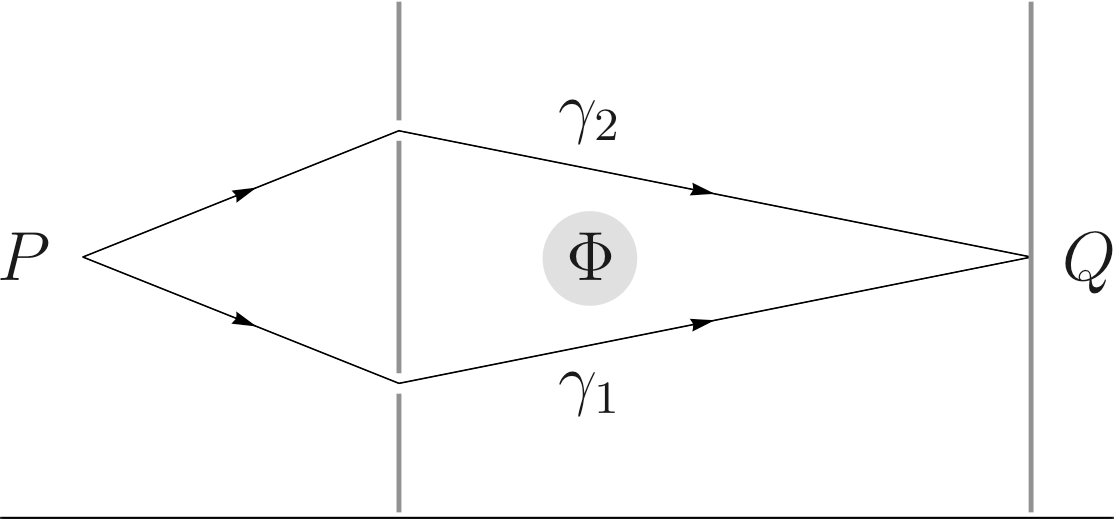
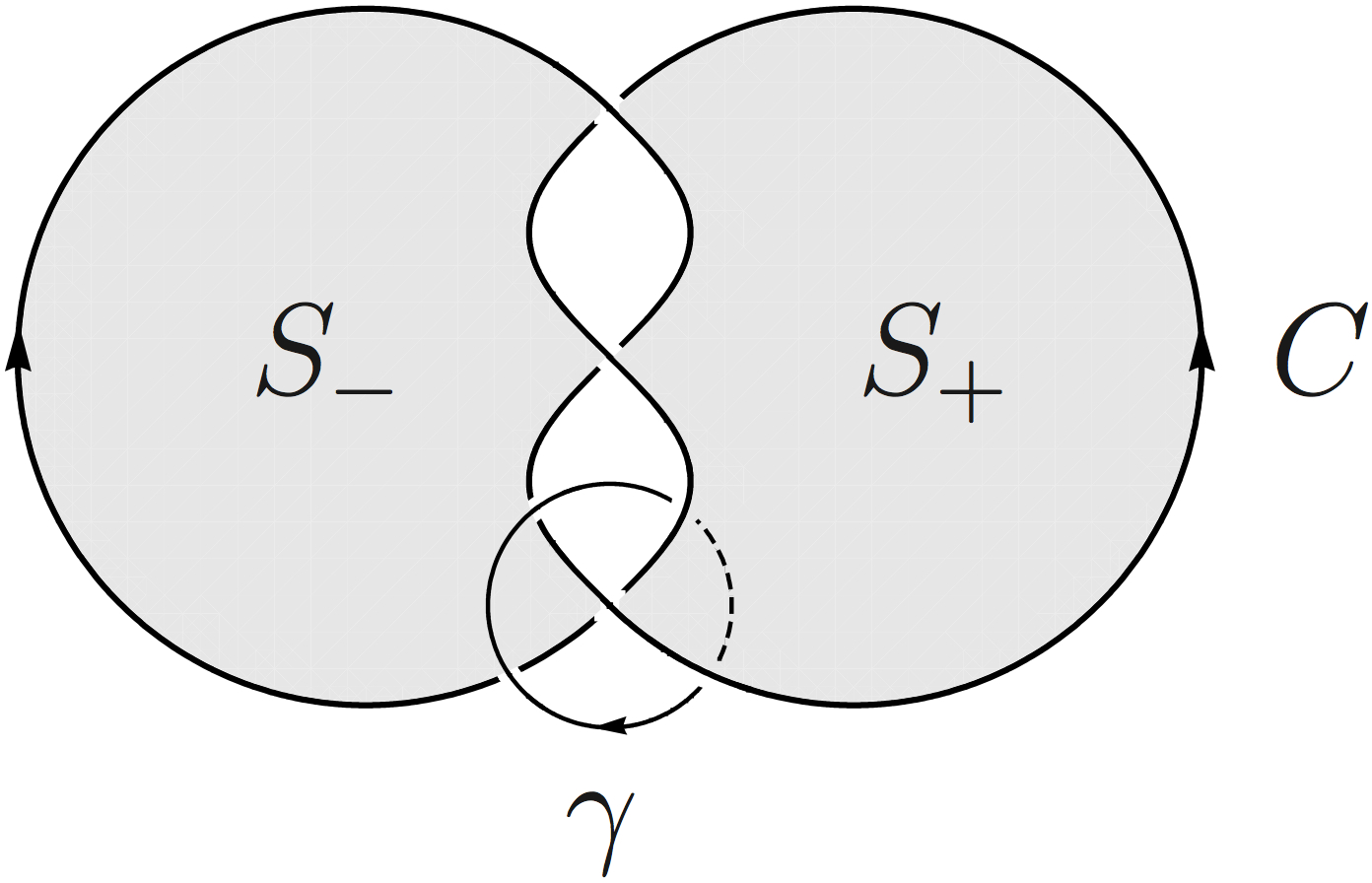
Figure 1: A plane projection of the standard magnetic Aharonov-Bohm effect apparatus.
The paper extends this framework to the case of knotted (nontrivial) solenoids, such as the trefoil knot, where the fundamental group becomes nonabelian and more complex relations govern the linking.
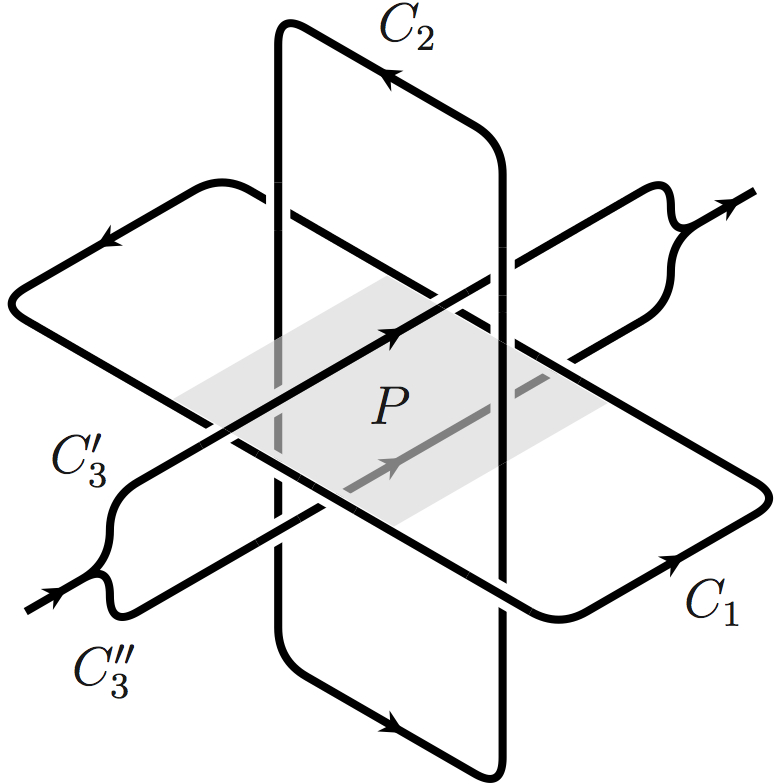
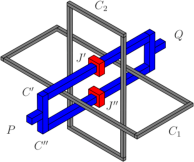
Figure 2: Schematic of a Borromean ring arrangement to detect the second order phase.
Higher order linking, as exemplified by configurations such as the Borromean rings, leads to quantum mechanical interference effects that are not captured by the Gaussian linking number. The resulting quantum phase is shown to be proportional to the product of the magnetic fluxes associated with independent solenoids. In a generalized Josephson junction setup, higher order phases induce a critical current component depending on such product fluxes, generalizing the standard Josephson effect.
Knots and Links in Quantum Field Theories
The study systematically progresses from abelian examples to nonabelian gauge theories. In QCD and related theories supporting flux tubes, the prospect emerges for physically realized, tightly knotted and/or linked field configurations. This is revisited in the historical context of Kelvin's model of atoms as knotted vortices, and transcended via explicit quantum field models.
Tight Knots and the Glueball Spectrum in QCD
A significant contribution of the paper is the proposal and quantitative modeling of the glueball spectrum in QCD as a manifestation of tightly knotted and linked chromo-electric flux tubes. The guiding principle is that in quantum systems, flux quantization forces the radii of such tubes to be fixed, resulting in discrete energy/mass levels.
The mapping identifies each presumed glueball state (fJ) with a distinct topological configuration (e.g., the Hopf link, the trefoil, etc.), with energy proportional to the knot or link length. The parameterization is reduced to a single overall scale factor for the system. The authors present a linear fit of the experimentally inferred glueball masses against the calculated tight knot lengths, displaying strong numerical agreement.
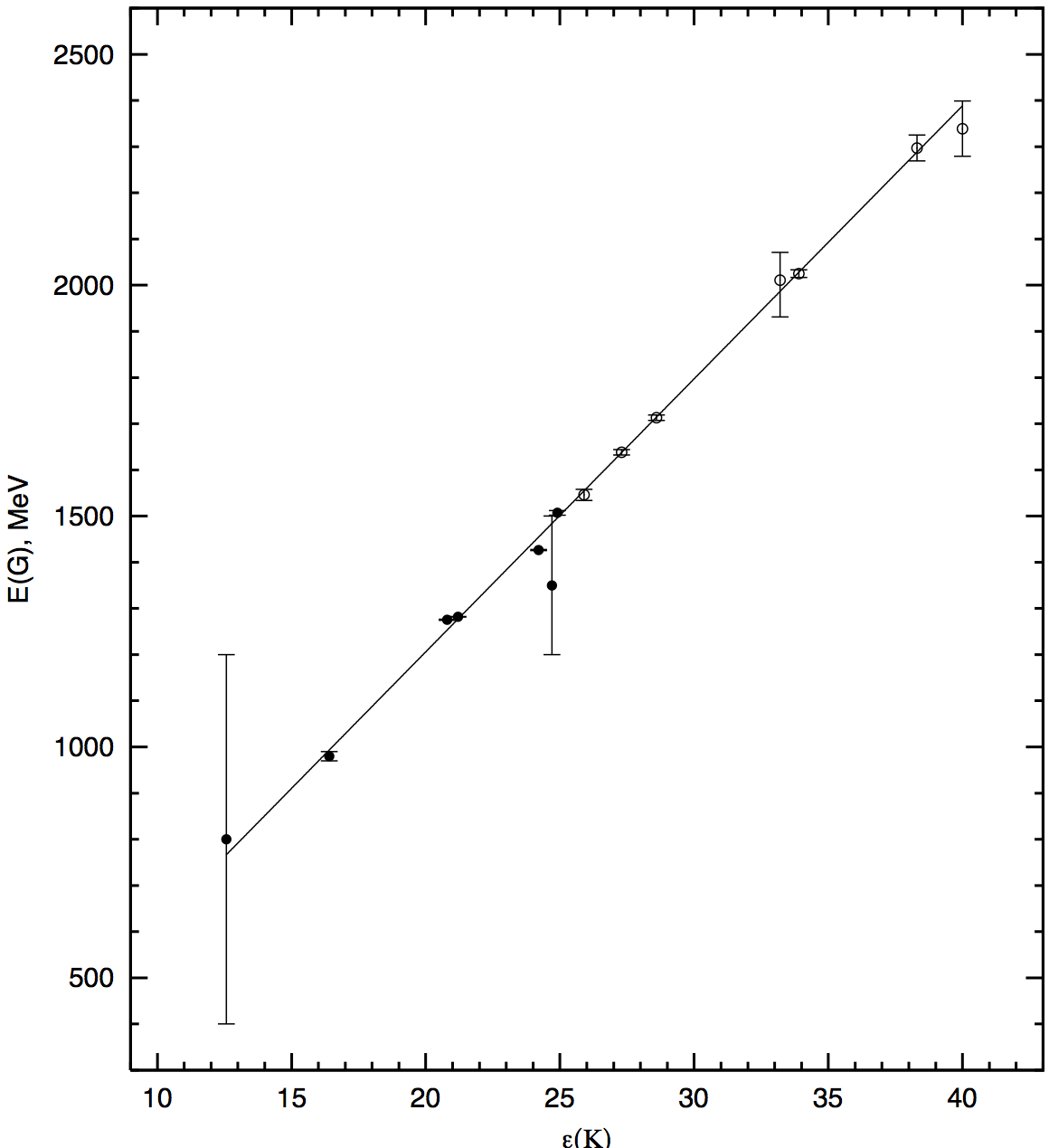
Figure 3: Relationship between glueball mass spectrum and the length-to-radius ratio of corresponding tight knot or link configurations.
For excited (J=0) glueball states, rotational energies are addressed through explicit calculation of the moment of inertia tensors for tight knots and links. Symmetry considerations enable analytic results in simple cases (e.g., the Hopf link), while more complex knots are treated via Monte Carlo integration.
Implications and Future Directions
The identified universal relationship between knot length and energy in quantum systems with quantized flux tubes implies that other such systems—ranging from superconductors to superfluids and atomic condensates—should exhibit analogous spectral behavior, with only a system-dependent scaling parameter. This underlines a direct topological underpinning for mass spectra in nonabelian gauge theories and potentially in engineered quantum materials.
Experimentally probing higher order quantum phases and relating (non-Gaussian) linking of field configurations to spectroscopically resolved states poses significant challenges, but the paper points to concrete experimental arrangements, such as generalized AB-type and Josephson-type setups, as pathways to verification.
Conclusion
This paper establishes a compelling framework connecting knot theory with physical observables in classical and quantum systems. The quantization of flux in quantum domains leads to tight knot spectra mapping to particle mass spectra, exemplified by the glueballs of QCD. The theoretical treatment of higher order linking generalizes familiar phase effects and predicts novel quantum phenomena. These insights foster a deeper topological characterization of quantum field theoretic spectra and motivate further exploration of knotted field configurations across physical systems.