Abstract: We analyze the (1+1) dimensional QCD (QCD_2) at finite density to consider a number of qualitative issues: confinement in dense quark matter, the chiral symmetry breaking near the Fermi surface, the relation between chiral spirals and quark number density, and a possibility of the spontaneous flavor symmetry breaking. We argue that while the free energy is dominated by perturbative quarks, confined excitations at zero density can persist up to high density. So quark matter in QCD$_2$ is an example of Quarkyonic matter. The non-Abelian bosonization and associated charge-flavor-color separation are mainly used in order to clarify basic structures of QCD_2 at finite density.
The paper demonstrates that confinement persists in QCD₂ at all densities due to the lack of enhanced color screening in one dimension.
It employs non-Abelian bosonization to separate U(1), color, and flavor sectors, revealing the emergence of chiral spirals near the Fermi surface.
The analysis shows that bulk thermodynamics is dominated by the inert deep Fermi sea, while surface excitations capture essential nonperturbative dynamics.
A (1+1)-Dimensional Example of Quarkyonic Matter: Analysis and Implications
Introduction and Motivation
The work presents a technical exploration of (1+1)-dimensional QCD (QCD2) at finite density, with a focus on qualitative properties such as confinement persistence, chiral symmetry breaking near the Fermi surface, the structure and interpretation of chiral spirals, and the role of flavor symmetry breaking under dense conditions. Situated within ongoing investigations of the so-called Quarkyonic matter—matter characterized by confined excitations at densities where perturbative quarks dominate energetics—the study leverages non-Abelian bosonization and charge-flavor-color sector separation to dissect these nonperturbative phenomena.
The theoretical context is set by McLerran and Pisarski's proposal of Quarkyonic matter, where confinement can persist in dense regimes beyond baryon percolation, with physical implications for phase structure and transport. The (1+1) setting is essential, given that in higher dimensions, phase space for screening grows with chemical potential, whereas in d=1 the corresponding enhancement is absent.
Structure of the Quark Fermi Sea and Confinement at Finite Density
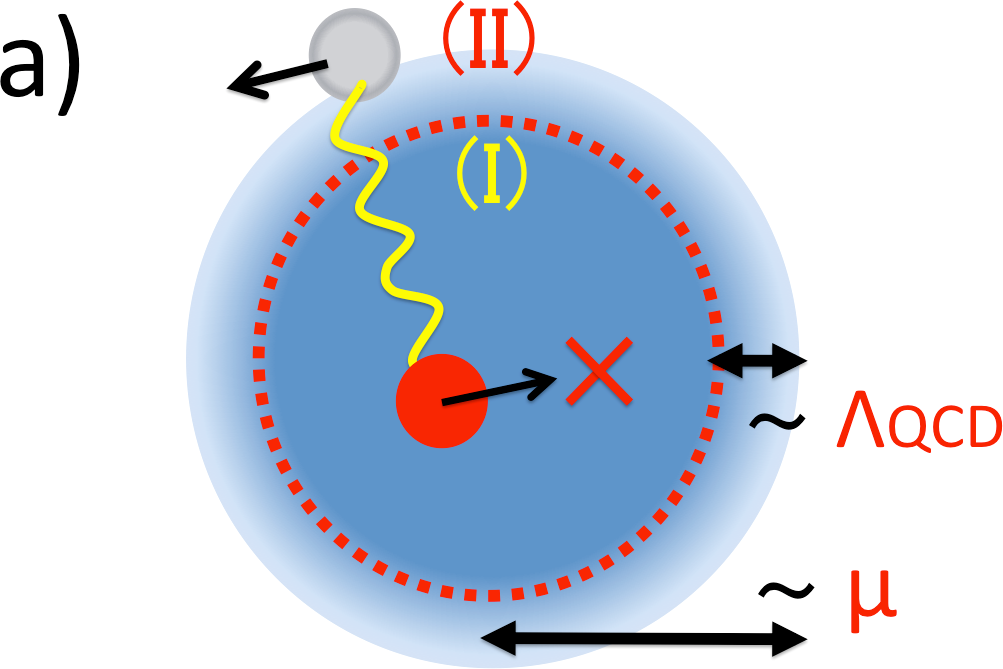
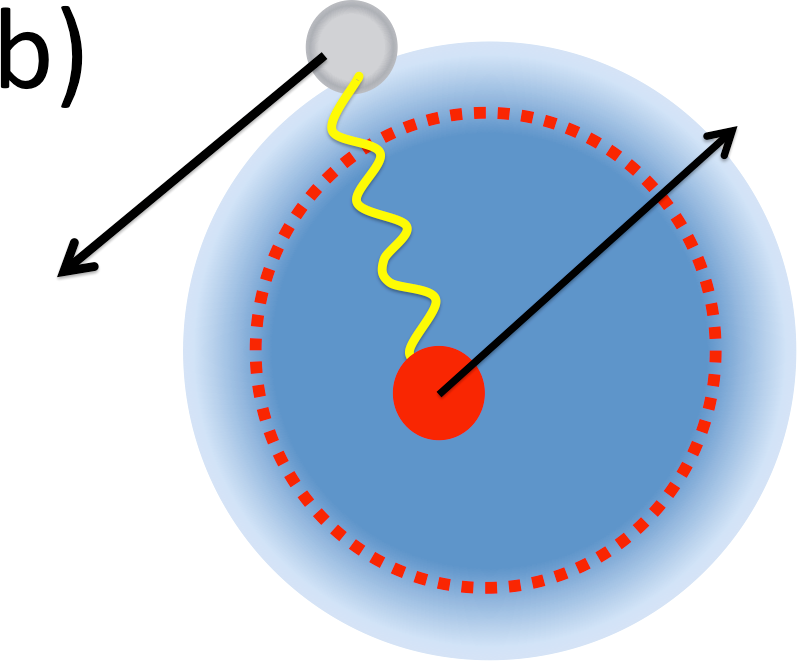
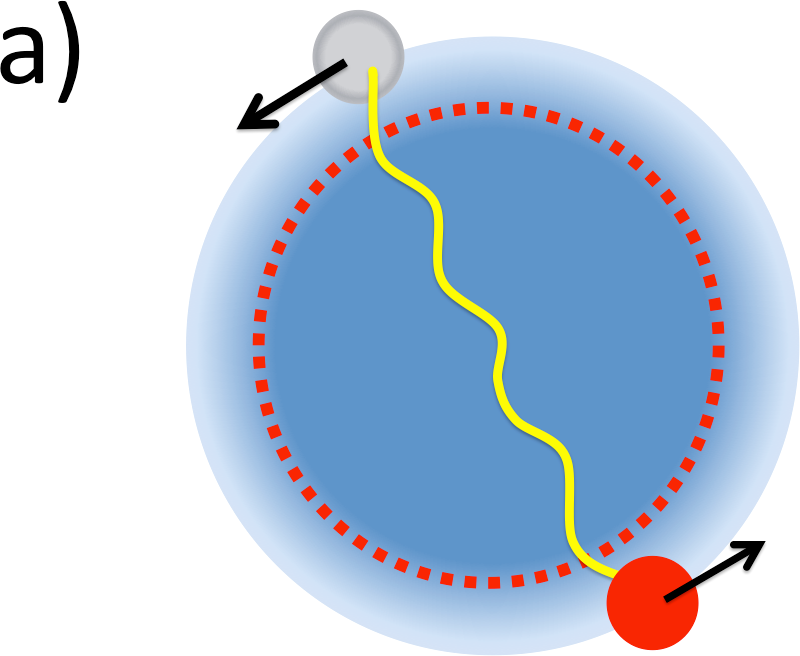
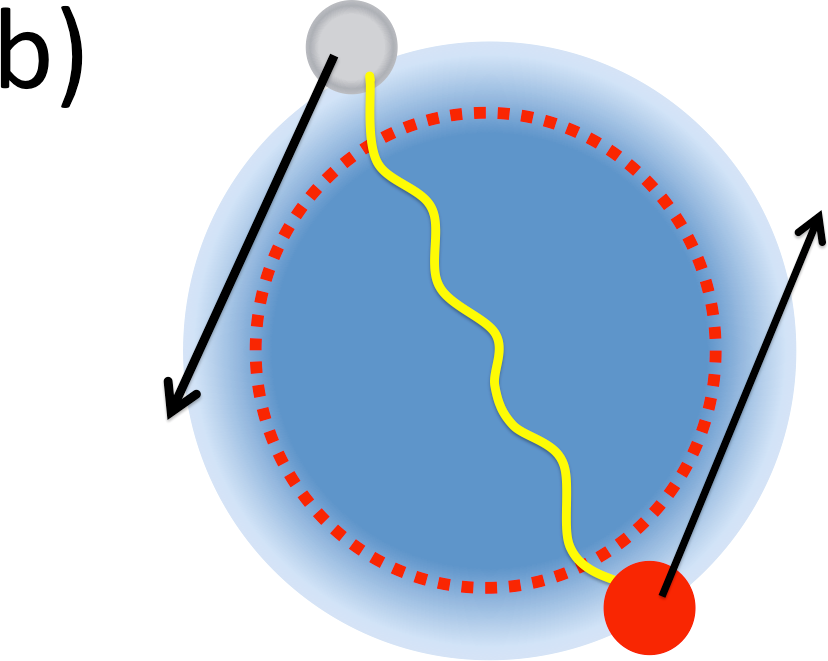
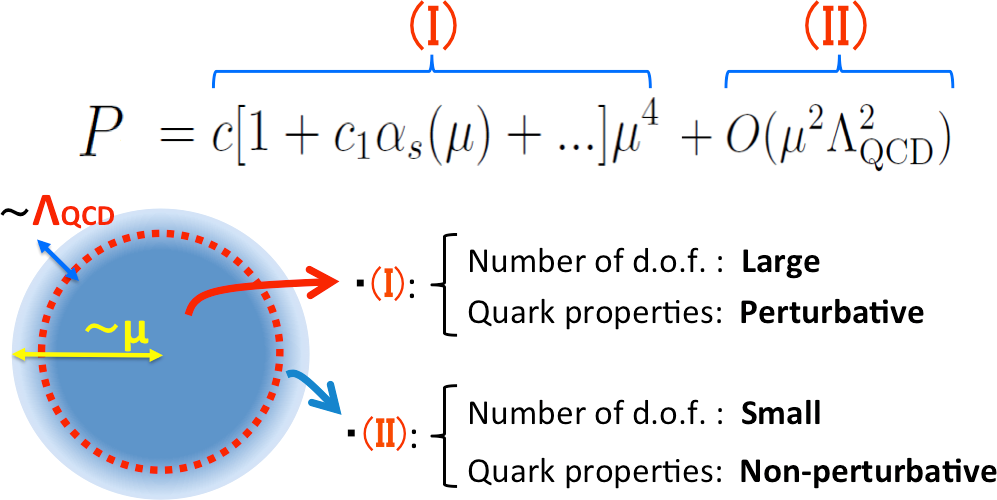
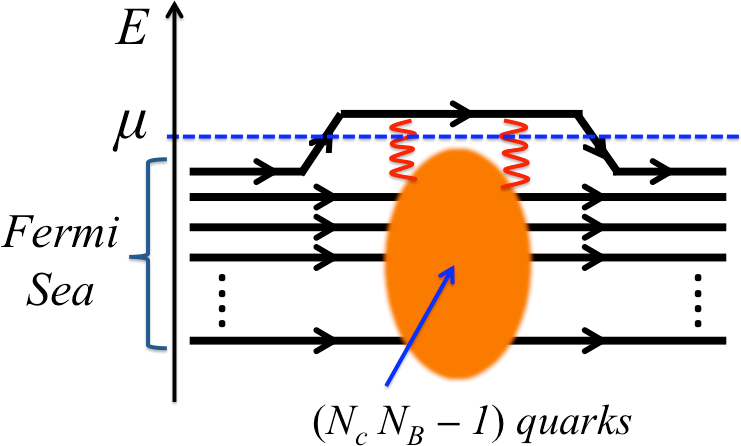
Quark matter properties are fundamentally altered in dense regimes. The analysis divides the Fermi sea into two regions: the deep Fermi sea (I), where quarks are inert under small-momentum exchange due to Pauli blocking, and the surface region (II), where low-momentum exchanges are allowed.
Figure 1: The scattering of quarks in the region (I), ∣p∣≲μ−Λ; Pauli blocking suppresses soft exchanges.
Pauli blocking in the deep Fermi sea suppresses nonperturbative effects, whereas surface quarks interact more readily and are susceptible to nonperturbative dynamics.
Figure 3: The scattering of quarks in the region (II), ∣p∣≳μ−Λ, allowing nonperturbative small-momentum exchange.
The dominant contribution to macroscopic quantities such as pressure comes from the interior (I) due to its larger phase-space volume, leading to the result that bulk thermodynamic quantities retain perturbative character even when excitations remain confined.
Figure 5: The pressure in dense QCD2 is bulk-dominated by region (I), validating perturbative calculations.
In (1+1)d, charge-color separation implies that the chemical potential only couples to quark number, not to color, so the color sector (and thus confinement) is left unaffected by increasing density. The analysis demonstrates explicitly that, for QCD2 with confinement at zero density, excitation confinement strictly persists up to arbitrarily high μ, as color screening is not enhanced in d=1.
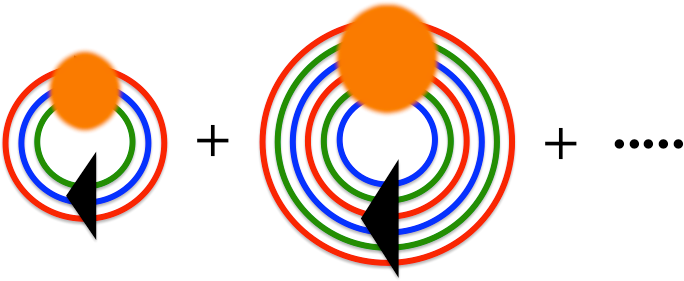
Figure 2: The uncorrelated sum of single quark loops (Fock term), highlighting the necessity of considering color-singlet diagrams.
Figure 4: The sum of color-singlet loops; in the dense regime, baryonic diagrams are insufficient, and general color singlet diagrams dominate.
Non-Abelian Bosonization and Charge-Color Separation
Non-Abelian bosonization is crucial in QCD2 as it enables separation of quark number (U(1)), flavor, and color degrees of freedom. In the chiral limit, the bosonized theory cleanly decouples into separate actions for the U(1) (quark number), SU(Nc) (color), and SU(Nf) (flavor) degrees. The quark chemical potential, coupling solely to quark number, leaves color and flavor unaffected, maintaining the confined nature of excitations independently of the density.
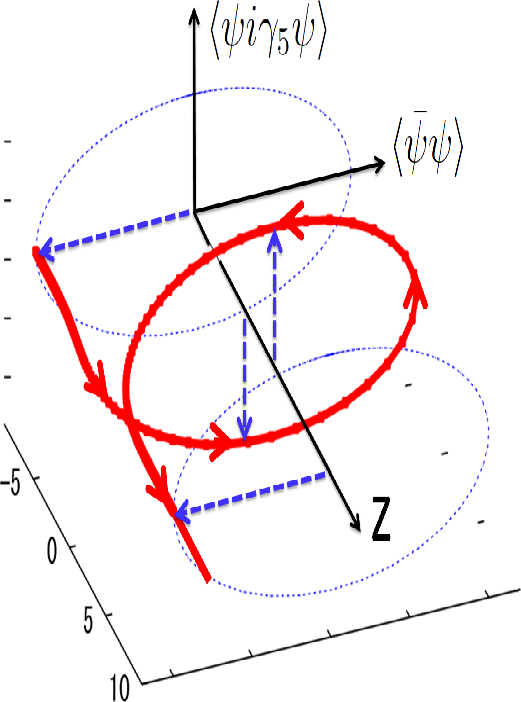
Chiral condensates are realized as factorizable products of color and charge sectors; the phase of the chiral condensate is determined by the U(1) part (rotating with φ), while the modulus (set by the color sector) is density-independent.
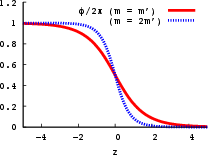
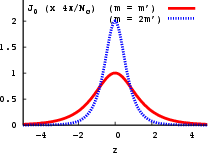
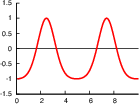
Figure 6: Profiles of the bosonized field ϕ(z) and quark number current j0(z) for a single baryon configuration.
Baryons, Chiral Spirals, and the Onset of Quarkyonic Matter
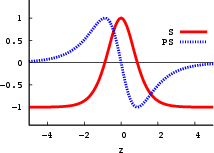
Single baryon states arise as topological solitons within the sine-Gordon model resulting from bosonization. The baryon carries quantized topological charge, with a nontrivial winding of the ϕ field, and its spatial distribution is sharply localized.
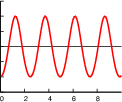
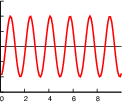
Figure 7: Real and imaginary (scalar and pseudoscalar) chiral condensate densities illustrating the chiral spiral structure around a baryon.
Baryonic interactions at large Nc are pure repulsion, with no subleading attractive part due to the absence of scalar exchanges—the repulsion grows with the quark number charge, remaining unmitigated at high density.
At finite density, the canonical approach reveals that for high densities, the ground state is uniform in quark number, and chiral condensate exhibits spatially periodic modulation with wavelength ∼1/2pf, i.e., the chiral spiral structure. As density increases, the amplitude of associated modulations diminishes relative to the homogeneous background.
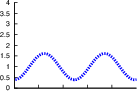
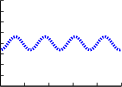
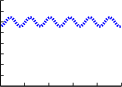
Figure 8: Evolution of quark number density and scalar chiral density as functions of z for increasing quark density, showing the transition from a solitonic to a uniform configuration.
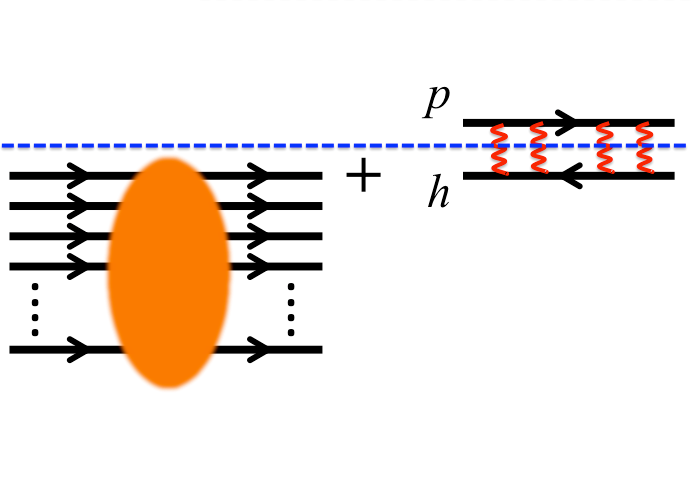
This structure is best understood via a particle-hole excitation picture—overlapping baryons induce an extensive, nearly uniform density with small residual chiral inhomogeneity, rather than discrete baryonic excitations.
Figure 9: Schematic for a particle-hole excitation; the equivalent to a baryonic excitation (left) recast as a collective particle-hole excitation in the Fermi sea (right).
Flavor, Chiral Spirals, and Vector Symmetry Breaking
With two flavors (Nf=2), the potential for flavor-breaking chiral spirals arises. However, in QCD2 with equal masses, the energy is minimized by condensates maintaining vector SU(2)V symmetry; flavor-breaking condensates (e.g., ψˉγ5τfψ) are suppressed at high density by mφ2/μ2. Thus, chiral spirals in the high-density regime are primarily in the U(1) channel.
Chiral Symmetry Breaking, Explicit Breaking, and Model Dependence
An explicit mass term plays a key role as a disturbance. Chiral spirals are suppressed by rapidly oscillating (with 2μz) terms in the mass Lagrangian; as μ increases, these terms become energetically irrelevant, allowing spiral structures to persist. The analysis extends to comparing continuous and discrete symmetry chiral models: in continuous symmetry (e.g., NJL2), chiral spirals form for arbitrarily small chemical potential, while in discrete models (e.g., Gross-Neveu), chiral spirals and associated baryonic matter emerge only beyond a finite threshold.
In higher dimensions, this suppression generalizes: the transverse kinetic terms, which couple different chirality components, limit the applicability of (1+1)d chiral spiral intuition to local “patches” on the Fermi surface.
Conclusion
The paper rigorously demonstrates that in (1+1)-dimensional QCD, Quarkyonic matter, defined by simultaneous dominance of bulk perturbative quark contributions and persistence of confined excitations, is natural and robust at all densities. This is directly linked to the unique properties of phase space and color screening in d=1.
The bosonized framework exposes not only the technical underpinnings but also highlights the limitations of baryonic and mean-field pictures at finite density, advocating for a particle-hole plus mesonic excitation basis for such strongly interacting dense media.
These results provide a concrete model where the Quarkyonic proposal can be realized unambiguously, offering qualitative templates for understanding similar phenomena in more realistic (higher-dimensional) QCD, though with critical caveats regarding the necessity of accounting for enhanced screening and suppressed confinement in d>1.
Future theoretical work should aim at extending this framework to include 1/Nc corrections, possible mechanisms of color superconductivity, and nontrivial flavor dynamics, as well as systematic investigation of the transition between nuclear, Quarkyonic, and deconfined matter.
Key Numerical and Conceptual Results:
Persistence of Confinement: In QCD2, confinement persists to arbitrarily high quark densities, with no density-driven enhancement of color screening.
Baryon Mass and Structure: Single baryon energy is E=(2mφ)/π, with solitonic field structure and chiral spiral correlations.
Chiral Spiral Structure: The period ∼1/(2μ), emerges naturally as the ground state at high density, stemming from coherent superpositions of particle-hole excitations near the Fermi surface.
Repulsive Interactions: Inter-baryon potential is purely repulsive, V(R)∼mφe−mφR at large separation.
Density Dependence: As density grows, baryonic and flavor-non-singlet structures are suppressed, while U(1) chiral spirals dominate; explicit mass terms suppress spiral formation at moderate density but become irrelevant at large μ.
References
For detailed technical developments and further conceptual discussion, see “A (1+1) dimensional example of Quarkyonic matter” (1106.2187).