- The paper establishes that nonequilibrium electron distributions induce two metastable superconducting states—global and bimodal—with distinct transport characteristics.
- It employs a combination of spatially-resolved tunneling spectroscopy and Keldysh-Usadel quasiclassical modeling to capture variations in the local density of states and superconducting order.
- The findings reveal that current-conversion resistance near S/N interfaces is key in tuning superconducting stability, with important implications for low-dissipation device design.
Evanescent States and Nonequilibrium Phenomena in Driven Superconducting Nanowires
Introduction
The paper "Evanescent states and non-equilibrium in driven superconducting nanowires" (1202.2588) delivers a comprehensive theoretical and experimental investigation of nonlinear current transport in diffusive superconducting nanowires subject to nonequilibrium conditions imposed by normal reservoirs. Employing a combination of two-probe transport and spatially-resolved tunneling spectroscopy, alongside a framework rooted in quasiclassical kinetic equations, the authors elucidate the emergence of two distinct metastable superconducting states—the global and bimodal superconducting states—under current bias. The analysis systematically unveils how the charge (transverse) and energy (longitudinal) modes in the electron distribution function determine both the existence and transport characteristics of these nonequilibrium superconducting phases.
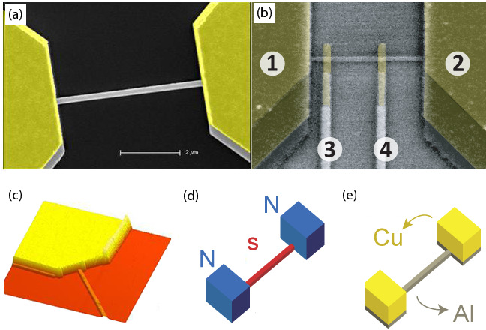
Figure 1: SEM and AFM characterization of a typical Al nanowire with normal reservoirs and tunneling probes.
Theoretical Framework
The system is modeled as a one-dimensional diffusive Al nanowire situated between two massive normal metal reservoirs. Nonequilibrium is induced via an applied bias, leading to electron injection from the reservoirs and generation of highly non-thermal electron distributions inside the wire. Owing to elastic-dominated transport (negligible inelastic electron-phonon/electron-electron scattering over device length), the distribution can be interpreted in terms of energy and charge modes, fL and fT, acting on the amplitude of the superconducting gap and inducing a charge imbalance, respectively.
The quasiclassical theory (employing Keldysh-Usadel equations) is solved for the pairing angle θ(E,x) and superconducting phase χ(x), together with coupled diffusion equations for fL and fT. This formalism captures evanescent quasiparticle states (with E<Δ) originating from Andreev processes and thoroughly treats the non-equilibrium reconstruction of the local density of states (DOS), the order parameter profile, and conversion resistance phenomena.
Numerical Results: Global and Bimodal Superconducting States
Simulations reveal two distinct classes of steady-state solutions depending on bias and thermal boundary conditions:
Global Superconducting State: Characterized by a uniform superconducting gap spanning the wire, yet with an order parameter suppressed near normal reservoirs due to proximity and non-thermal injection. Current transport exhibits finite resistance localized near the interfaces, associated with charge conversion regions of width ∼ξ. The energy mode fL remains spatially uniform, while the charge mode fT is restricted to the wire edges.
Bimodal Superconducting State: At higher bias or upon return from the normal state (hysteretic regime), the wire exhibits two disjoint superconducting domains nucleating at each end. The wire center remains normal, where fL is strongly nonthermal and gap suppression is maximal. The conversion to supercurrent is minimal and global resistance approaches the normal-state value. Superconductivity emerges locally where the proximity to equilibrium reservoirs reduces the non-equilibrium penalty.
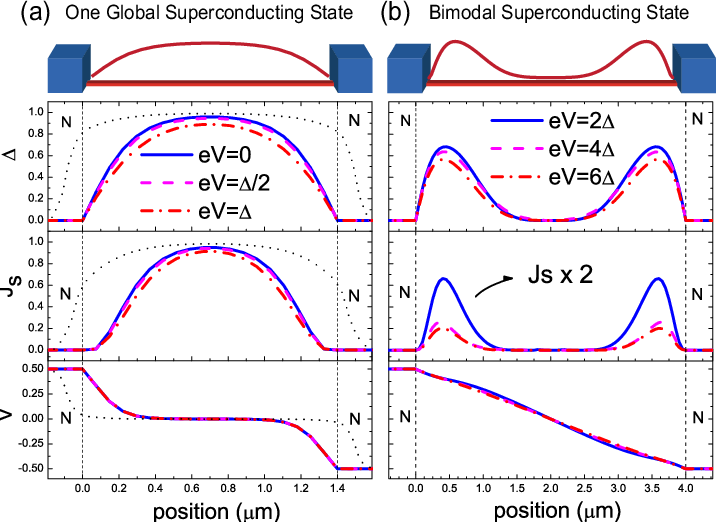
Figure 2: Schematic of the (a) global and (b) bimodal superconducting state, showing the spatial order parameter and current profiles.
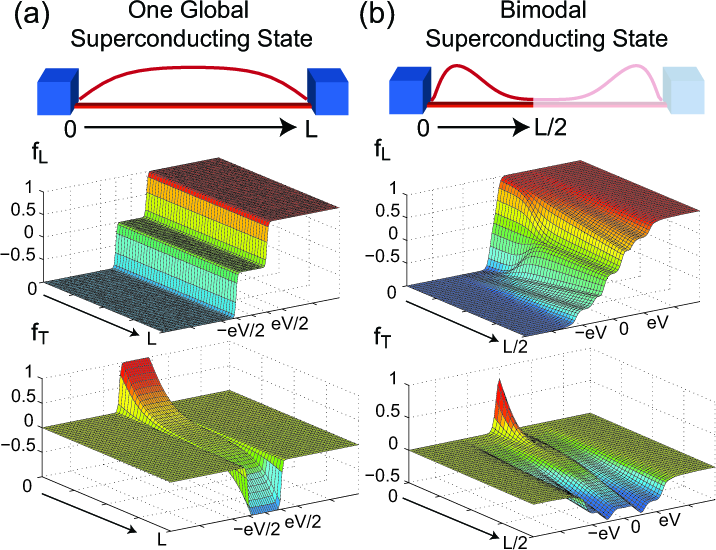
Figure 3: Spatial and energy dependence of fL and fT for (a) global and (b) bimodal states, highlighting edge-localized charge mode and central suppression in bimodal regime.
Experimental Implementation
The paper reports on a detailed sample fabrication protocol utilizing three-angle shadow evaporation to realize a set of Al nanowires with thick Cu reservoirs, ensuring robust thermalization and sharp normal-superconducting boundaries. Tunnel probes are incorporated for local DOS measurements.
IV characteristics and temperature-resolved transport data exhibit multiple critical currents, demarcating transitions between superconducting (both global and bimodal) and normal states. The resistance measured in the global phase closely matches the predicted current-conversion resistance (Rs), localized near the S/N interfaces.
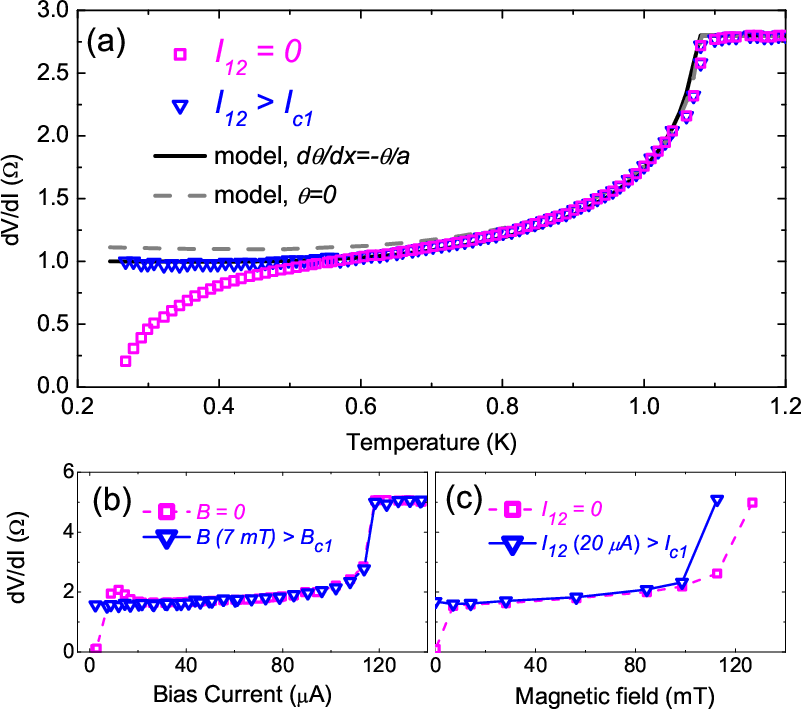
Figure 4: Two-probe resistance vs temperature demonstrating proximity-induced resistance plateau and its suppression with bias/magnetic field.
Local Spectroscopic Probes
Spatially-resolved tunneling spectroscopy was exploited to measure the local DOS and condensate chemical potential in various regimes. The measured DOS at the probe position matches theoretical predictions, provided series resistance is accounted for. In the bimodal state, the DOS transitions continuously from normal to gapped as bias decreases, confirming nucleation and growth of local superconducting order at wire termini.
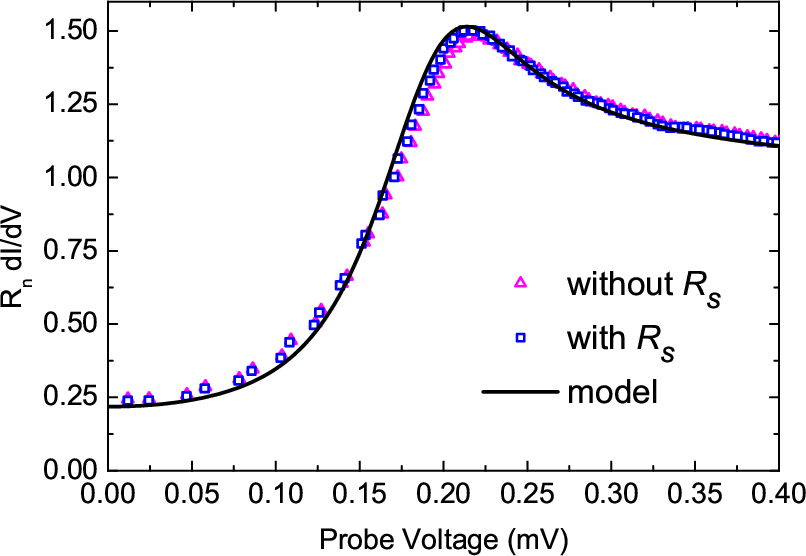
Figure 5: Differential conductance of tunnel probe showing the reconstructed local DOS for varying biases and the effect of series lead resistance.
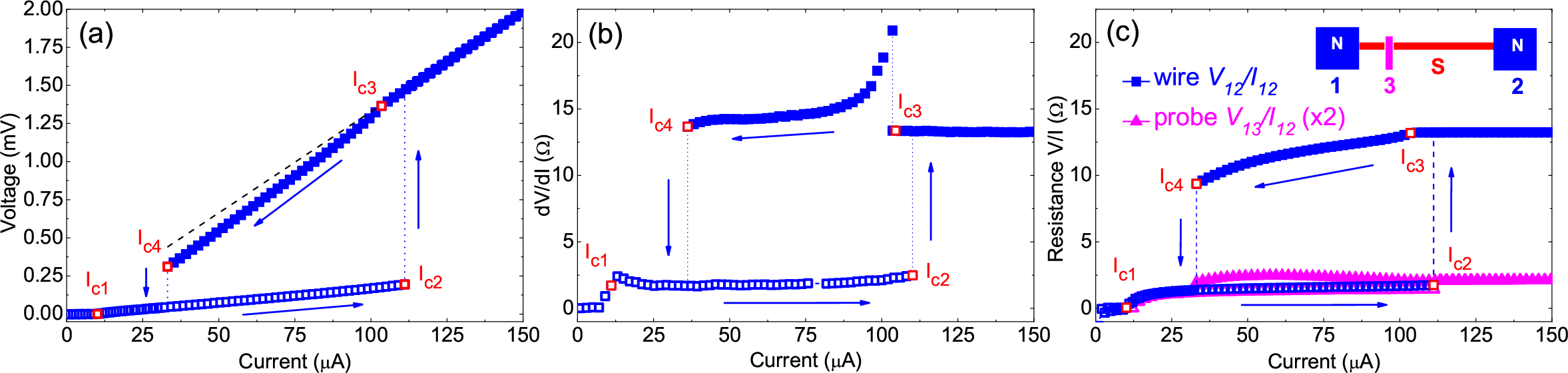
Figure 6: Nonlinear IV and differential resistance curves exhibit clear hysteresis with distinct critical currents, allowing identification of unique superconducting phases.
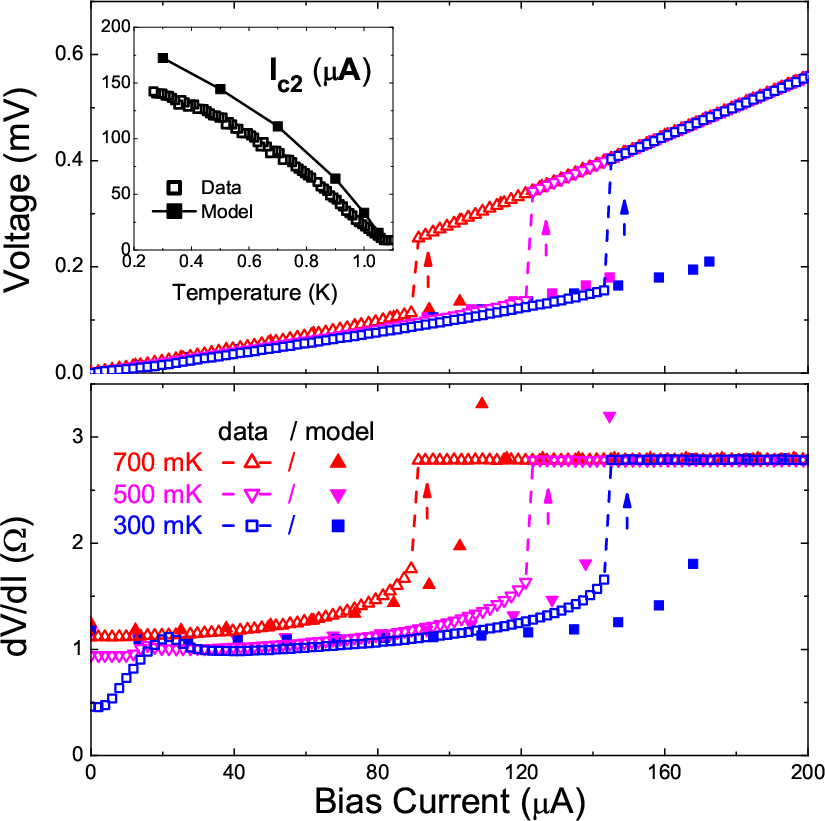
Figure 7: Temperature and current dependence of the nonlinear IV and differential resistance for a short nanowire, linking Ic with nonequilibrium physics.
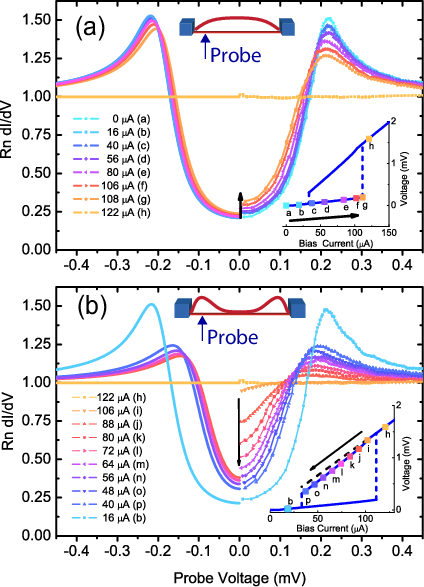
Figure 8: Local DOS in the (a) global and (b) bimodal superconducting states, mapping evolution under varying bias highlighting abrupt and continuous superconducting transitions.
Implications and Outlook
The results demonstrate that in mesoscopic superconducting wires attached to normal reservoirs, nonequilibrium electron distributions—not simple local heating—dominate the superconducting response under finite bias. The identification of the bimodal state, a nonequilibrium-induced phase-separated state with superconducting "blobs" at contacts and a normal center, establishes the intricate role of longitudinal (energy mode) non-equilibrium in gap suppression, independent of the phase slip or thermal phase transitions.
Numerically, the observed switching currents between the states are found to be significantly below the intrinsic depairing currents—a direct consequence of nonequilibrium electron populations, not pair-breaking by magnetic or current-induced phase-slip mechanisms.
The formalism and the findings directly generalize to practical device geometries in superconducting nanodevice and hot-electron bolometer (HEB) applications, where device resistance is dominated by nonequilibrium conversion at S/N interfaces and by the energy relaxation length. In materials with shorter inelastic relaxation (e.g., NbN rather than Al), the crossover between thermal and strongly nonthermal distribution functions alters the stability and manifestation of the bimodal regime, with strong relevance for designing low-dissipation superconducting circuits and detectors.
Conclusion
This work delivers a rigorous, quantitatively validated picture of nonequilibrium-induced metastability in driven superconducting nanowires. By integrating Keldysh-Usadel theory, spatially-resolved DOS measurements, and nonlinear transport, the research establishes that two distinct superconducting phases—global and bimodal—arise from the competition of energy and charge mode non-equilibrium, governed by device geometry, interface transparency, and thermalization efficacy. These results have substantial implications for understanding resistance mechanisms, stability, and switching phenomena in mesoscopic superconductors under bias, informing future theoretical extensions and device engineering in nonequilibrium superconducting hybrid systems.