- The paper presents a comprehensive review of the Kondo effect in graphene, highlighting how pseudogap behavior alters impurity screening.
- It employs advanced theoretical models, including Anderson and Kondo frameworks with ab-initio and numerical renormalization group methods.
- It reveals the impact of particle-hole asymmetry and doping on quantum phase transitions and the nonuniversal behavior of Kondo temperatures.
The Kondo Effect for Magnetic Impurities in Graphene: Theory, Models, and Experiment
Introduction
This paper, "The Physics of Kondo Impurities in Graphene" (1208.3113), presents a comprehensive review of the theoretical framework and phenomenology for Kondo physics in graphene systems. The study examines both the underlying theoretical models (Anderson and Kondo impurity models in the context of graphene's Dirac electrons) and the rich spectrum of quantum phase transitions and multi-scale crossovers emergent in pseudogap systems with vanishing density of states (DOS) at the Fermi level. Substantial attention is also given to microscopic realization, ab-initio quantitative modeling, and the current state of experimental verification or contradictions.
Graphene as a Pseudogap Host for Kondo Impurities
Graphene exhibits a two-dimensional honeycomb lattice with π-electrons possessing a linear dispersion near the Dirac points K and K′, resulting in a DOS vanishing at the Fermi energy as ρ(ω)∼∣ω∣ for charge-neutral graphene. This semimetallic character fundamentally alters the impurity physics with respect to the conventional metallic Kondo effect.
Depending on the type and realization of impurity moment—magnetic adatoms (e.g., Co, NiH) or lattice defects (vacancies, hydrogen/fluorine adatoms)—the hybridization function may inherit peculiar energy dependence and strong particle-hole asymmetry. The formation of local moments in graphene and their effective coupling to Dirac carriers require careful ab-initio modeling (DFT, DFT+U, DMFT, etc.) and can admit different symmetry classes (e.g., effective SU(2) vs. SU(4) or multi-orbital physics).
Pseudogap Kondo Model: Phase Diagram and Criticality
The theoretical foundation relies on mapping the local impurity problem to a Kondo model coupled to a pseudogap DOS of the form ρ(ω)∝∣ω∣r. For r=1, corresponding to graphene, the RG structure and criticality differ sharply from the metallic case (r=0).
Schematic RG flows illustrate this landscape:
(Figure 1)
Figure 1: Schematic RG flow diagrams for the pseudogap Kondo model, showing topology restructuring as a function of the DOS exponent r.
For 0<r<r∗≈0.375, and for particle-hole symmetry, a continuous quantum phase transition separates unscreened (LM) and partially screened (SSC) phases, controlled by a symmetric critical fixed point (SCR). As r increases to r=1, particle-hole asymmetry becomes a relevant perturbation and a new asymmetric critical fixed point (ACR) emerges, responsible for separating the LM and asymmetric strong coupling (ASC) phases in the generic case.
The amplification of particle-hole asymmetry for realistic impurity models is thus not a perturbative correction but a primary driver of the quantum critical topology at r=1, categorically relevant for graphene.
(Figure 2)
Figure 2: RG flow diagrams for the particle--hole symmetric Anderson model. Different values of r govern the stability of strong-coupling and local-moment fixed points.
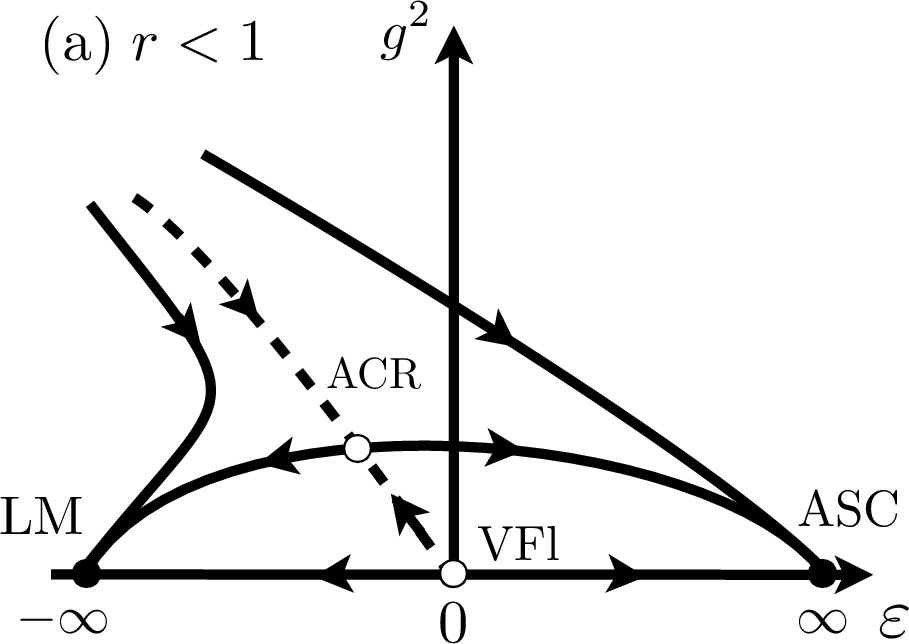
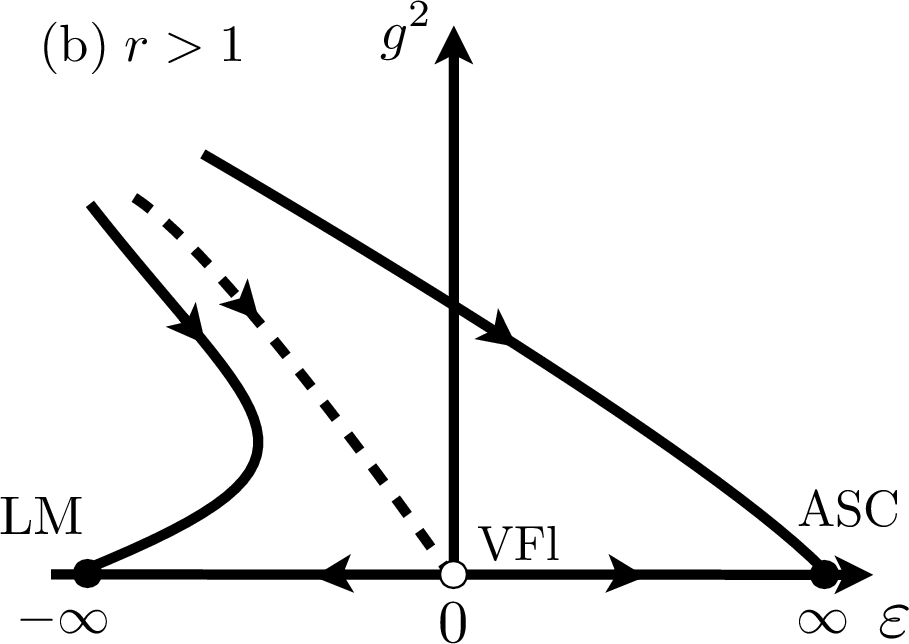
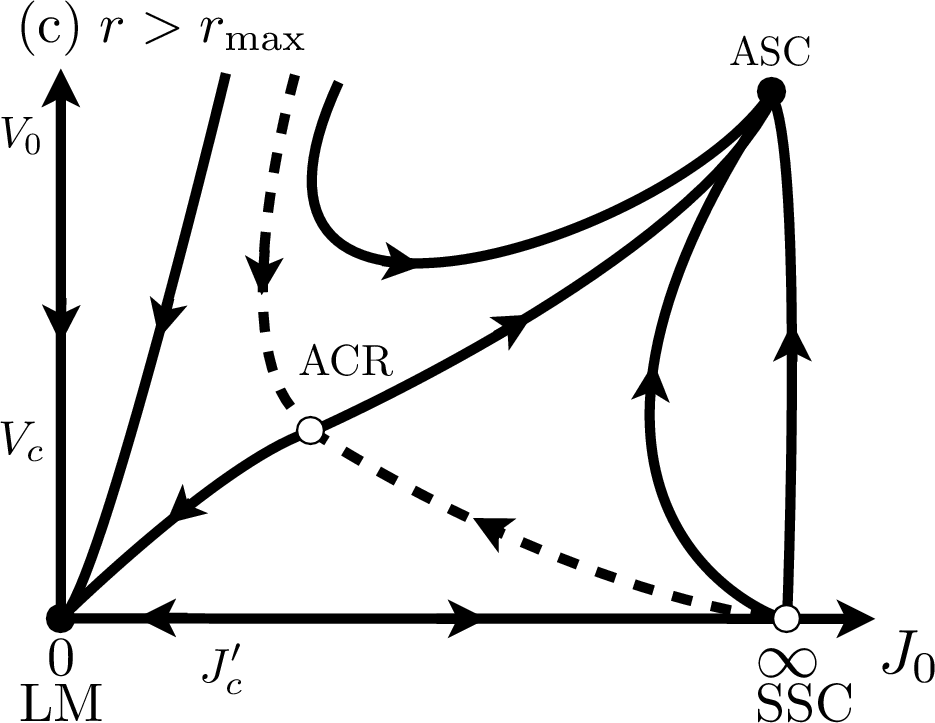
Figure 3: RG flow for the asymmetric Anderson model, highlighting the role of high particle-hole asymmetry at r≈1.
Implications for Screening and Observable Quantities
Unlike in conventional metals, Kondo screening in graphene is weak and highly tunable by carrier doping (chemical potential μ). At charge neutrality, there exists a genuine quantum phase transition, and the Kondo temperature TK is suppressed for small J0. Away from neutrality, finite DOS at EF reestablishes Kondo screening but the nature of the crossover is asymmetric with respect to electron/hole doping. The doping dependence of TK is both highly nonuniversal and crucially susceptible to the sign of μ.
Numerical renormalization group (NRG) studies, incorporating realistic DFT-derived hybridizations, yield calculated spectral functions and doping-dependent TK:
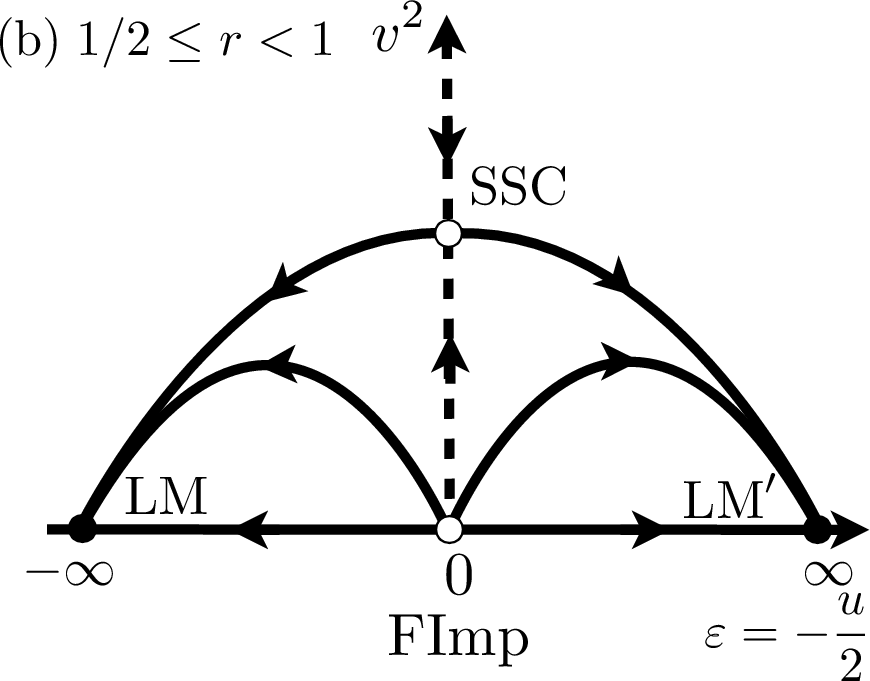
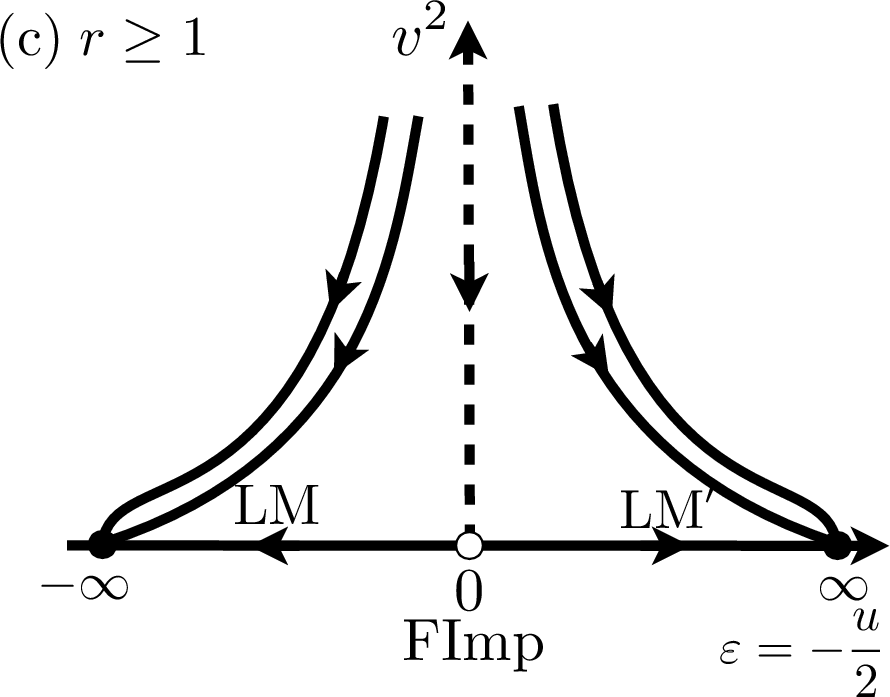
Figure 4: NRG results for the impurity spectral function for different Kondo couplings, showing the absence of a symmetric Kondo resonance at μ=0 and recovery near EF at finite doping.
Figure 5: Kondo temperature TK for vacancy moments in irradiated graphene samples as a function of gate voltage; extractable from resistivity scaling in transport.
These observations demonstrate a stark departure from universal one-parameter scaling known from the metallic Kondo regime. Instead, multi-scale behavior, crossover phenomena, and quantum critical scaling dominate.
Experimental Status and Complications
Transport and STM experiments with Co adatoms and vacancy-induced moments in graphene have provided some evidence consistent with Kondo screening (e.g., finite TK inferred from resistivity minima and STM resonance splitting under magnetic field). Nonetheless, the empirical data, especially the doping dependence of TK near charge neutrality, often contradict predictions from the pseudogap Kondo theory—showing a much weaker gate voltage dependence of TK than expected and in some cases absence of clear Kondo signatures. Factors such as substrate-induced electron-hole puddles, bulk electron-electron interactions, and cluster formation of adatoms complicate interpretation, leading to sizable uncertainties on the true parameter regime and realization of pseudogap Kondo fixed points in experiment.
Connections to Impurity Physics in Other Dirac Systems
The conceptual framework constructed for graphene directly generalizes to quantum impurity problems in other hosts with pseudogap-like or nodal quasiparticles, including d-wave superconductors, Dirac surface states of topological insulators, and certain gapless spin liquids. The RG critical structure, upper critical "dimension" at r=1, and role of particle-hole symmetry/asymmetry are universal. The possibility of observing boundary quantum criticality, Kondo-disorder-driven NFL states, and impurity-induced order is widely pertinent.
Conclusion
This review provides an authoritative synthesis of theory and numerical results for the Kondo effect in graphene, highlighting the substantive differences introduced by a vanishing low-energy DOS and carrier tunability. The emergence of quantum phase transitions, nontrivial fixed-point structure, and nonuniversal crossover physics challenges conventional wisdom from metallic systems. However, clear quantitative experimental verification remains elusive due to disorder, inhomogeneities, and the complexity of real impurity configurations.
Future progress hinges on improved materials control (minimizing puddle inhomogeneity and adatom clustering), precision spectroscopy, and ab-initio theory capable of making sharper, impurity-specific predictions. Insights from graphene will transfer to the broader context of quantum impurity physics in topological and strongly correlated Dirac materials.