- The paper rigorously derives the Boltzmann equation by establishing convergence from the BBGKY to the Boltzmann hierarchy using hard spheres and short-range potentials.
- It employs explicit cluster expansions and uniform a priori bounds to control recollisions and pathological particle trajectories in the kinetic limit.
- The results extend Lanford's theorem, providing a solid mathematical foundation for the emergence of irreversible behavior from reversible microscopic dynamics.
Rigorous Derivation of the Boltzmann Equation from Many-Particle Systems
Introduction
The monograph "From Newton to Boltzmann: hard spheres and short-range potentials" (1208.5753) provides a comprehensive, mathematically rigorous study of the derivation of the Boltzmann equation from deterministic many-body dynamics. Specifically, it deals with systems of N particles, either interacting as hard spheres or via short-range repulsive potentials, and establishes the convergence to the Boltzmann equation under the Boltzmann-Grad scaling limit. The work gives special emphasis to the control of pathological configurations (notably recollisions), the construction and convergence of the relevant hierarchies (BBGKY and Boltzmann), and explicit uniform a priori estimates, addressing foundational questions in non-equilibrium statistical mechanics posed since Hilbert.
Microscopic Dynamics and Low-Density Scaling
The N-particle dynamics are governed either by Newton's equations with hard-core exclusion (for hard spheres) or by Hamiltonian evolution with smooth, compactly supported, monotonic, repulsive pair potentials. The trajectories consist of free motion concatenated by pairwise interactions. The particle system is analyzed under the Boltzmann-Grad limit, i.e., N→∞ and interaction range ε→0 such that Nεd−1=1, ensuring a spatially rarefied regime with a finite mean free path.
This regime is fundamentally different from mean-field (low-density, long-range) scaling, and yields a kinetic limit in which binary collisions dominate and multiple or grazing collisions become negligible with probability tending to zero.
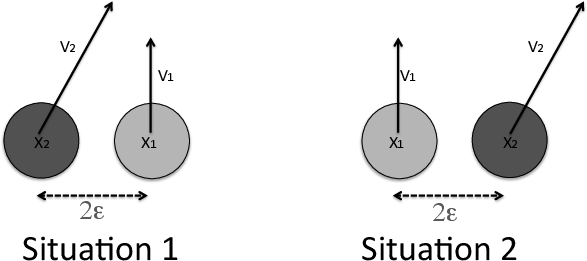
Figure 1: Illustration of instability: two configurations differing by an O(ϵ) translation can have drastically different collision histories due to precise impact parameters.
The hard sphere case is pedagogically central, as its singular interaction structure facilitates explicit constructions and geometric analysis of collision trees, while the case of smooth potentials requires elaborate cluster and scattering estimates for non-instantaneous, yet still spatially localized, interactions.
The BBGKY and Boltzmann Hierarchies
Beginning from Liouville's equation for the N-particle distribution, marginals are defined, and their evolution forms the BBGKY hierarchy. The interaction structure in the hard sphere and potential cases leads to hierarchies with strongly localized or truncated collision operators, respectively.
- For hard spheres, collisions are instantaneous and specified via measure-preserving boundary conditions reflecting at the contact surface.
- For short-range potentials, encounters of two particles within the support of the potential give rise to correlated velocities, necessitating cluster decompositions.
The derivation shows that, in the Boltzmann-Grad scaling, higher-order collision terms (those involving more than binary interactions) become vanishingly small, allowing the transition to the Boltzmann hierarchy. The collision kernel in the limiting Boltzmann equation is shown to be given by either hard sphere geometry or via the cross-section dictated by the two-body scattering map for the potential.
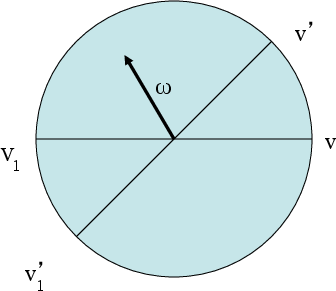
Figure 2: Parametrization of a collision by the deflection angle ω on the unit sphere, relevant for expressing the post-collisional map and the collision kernel in the Boltzmann equation.
Quantitative Control of Pathological Trajectories
A pivotal technical contribution of this work is the detailed analysis and estimation of sets of pathological (i.e., recollisional or "bad") trajectories. These are initial data yielding multiple interactions between the same set of particles within the kinetic time interval, which could potentially violate the statistical independence required for the validity of the Boltzmann equation.
The key result here is the quantitative geometric control over the measure of configurations and velocity arrangements that can lead to such recollisions, establishing their contribution as negligible in the limit. The analysis systematically combines geometric and measure-theoretic arguments to remove recollisions by restricting to "good" pseudo-trajectories.
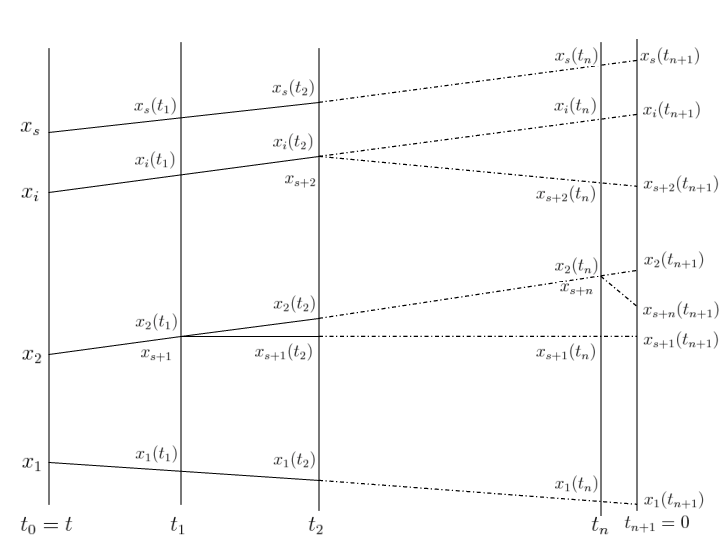
Figure 3: Schematic of a pseudo-trajectory (collision tree), highlighting the structure of collision history and the adjunction/removal of recolliding configurations in the hierarchy expansion.
The Cauchy Problem and A Priori Functional Bounds
The monograph provides, via analytic estimates, short-time existence and uniqueness for mild solutions of both the BBGKY and Boltzmann hierarchies in weighted supremum (grand-canonical) function spaces involving parameters controlling inverse temperature and chemical potential. Crucially, these a priori estimates are uniform in N under the scaling, ensuring that the convergence results are meaningful in the thermodynamic/low-density limit.
A significant technical detail is the choice of L∞-based norms for correlation functions, motivated by the need to control singularity formation and to maintain analytic-type continuity estimates with explicit loss parameters, as required for cumulant expansion control and dominated convergence arguments.
Main Theorems: Convergence to the Boltzmann Equation
The central results rigorously justify that, for chaotic (tensorized or convex combinations thereof) admissible initial data, the N-particle marginals converge, in the sense of observables (test-function-integrated distributions), up to a short time (a nontrivial fraction of the mean free time), to the solution of the corresponding Boltzmann equation.
For hard spheres:
- The limit equation is the spatially inhomogeneous Boltzmann equation with collision kernel b(w,ω)=(w⋅ω)+.
For short-range repulsive potentials (under suitable scattering assumptions):
- The collision kernel is explicitly characterized through the two-body scattering map and cross-section, ensuring the precise identification of the macroscopic collision dynamics.
These results generalize Lanford's celebrated theorem, extending to smoothly truncated potentials and providing a more detailed and self-contained analysis of the measure estimates, explicit convergence rates under regularity, and the treatment of initial data via conditioned ("coarse-grained") statistical states.
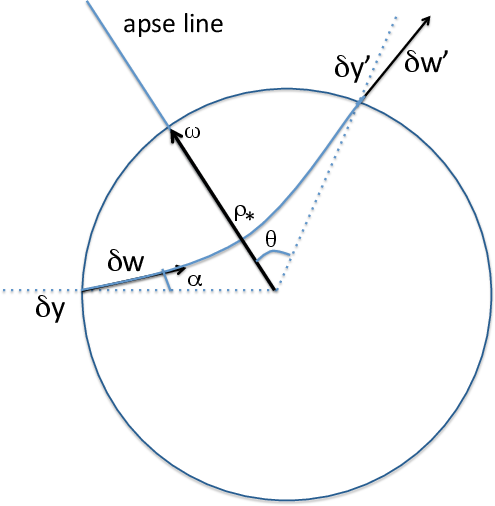
Figure 4: Example of reduced two-body dynamics under a compactly supported potential in spherical coordinates—crucial for quantifying the deflection angle and cross-section in the limiting kinetic operator.
Analysis of Two-Body Scattering and Cross-Sections
For systems with short-range potentials, the derivation investigates in detail the two-body scattering process. The precise parameterization of the cross-section as a function of the relative velocity and scattering angle is developed, including the regularity and invertibility of the angle-impact parameter map, which is essential for validating the structure of the limiting Boltzmann operator.
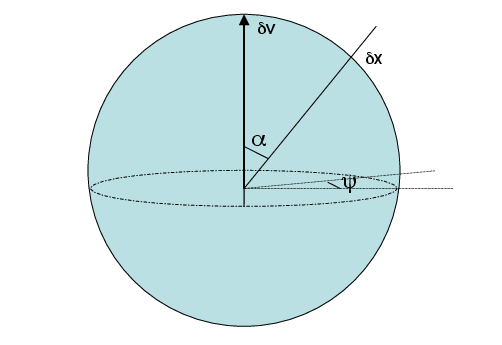
Figure 5: Spherical coordinates (ρ,Θ,ψ) parametrizing the two-particle scattering geometry, underpinning the rigorous formula for the collision kernel b(w,Θ).
The method extends to constructing cluster expansions, demonstrating that the probability of configurations involving "clusters" (i.e., more than binary effective collisions on relevant time-scales) decays exponentially and contributes negligibly to the kinetic limit. This argument is crucial for systems with non-instantaneous interactions, where the time-overlap of multiple particles is structurally more complex.
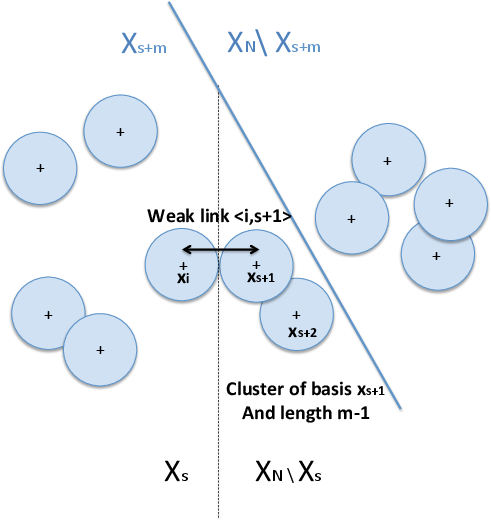
Figure 6: Visualization of a spatial cluster with weak links arising in multiparticle interactions; only certain combinatorial configurations persist in the kinetic limit.
Implications and Future Directions
These results rigorously clarify, for a broad class of short-range interactions, the mesoscopic emergence of irreversible kinetic behavior from reversible microscopic dynamics. The work identifies, with precise probabilistic and measure-preserving (Hamiltonian) arguments, the geometric origin of irreversibility and the loss of memory of initial correlations, thereby substantiating the foundational principles of the Boltzmann molecular chaos assumption.
On the theoretical side, the analysis presents robust and flexible methods—analytic hierarchy expansion, cluster and measure estimates, uniform a priori bounds—which have important implications for the study of hydrodynamic limits, fluctuation theory, and the precise characterization of the breakdown of the kinetic description beyond short kinetic times.
Practically, the justification of the Boltzmann equation under such minimal and physically relevant interaction assumptions provides rigorous foundations for computational and theoretical treatments of dilute gases and plasmas, and forms the basis for studying more exotic or even quantum kinetic systems.
Future developments spurred by this work are likely to address:
- Extension to longer time intervals, possibly via renormalization or stochastic methods;
- Potentials with weaker (noncompact) decay or including singularities (soft potentials, Coulomb interactions);
- Quantum generalizations and the derivation of quantum Boltzmann or Uehling-Uhlenbeck kinetics;
- Rigorous derivation of hydrodynamic equations (Euler/Navier-Stokes) from particle dynamics using intermediate kinetic scaling.
Conclusion
"From Newton to Boltzmann: hard spheres and short-range potentials" (1208.5753) establishes a mathematically complete derivation of the Boltzmann equation from deterministic N-body Newtonian or Hamiltonian dynamics with hard-sphere or smooth repulsive interactions, under the Boltzmann-Grad limit. The approach synthesizes hierarchy expansions, explicit geometric and cluster analysis, and advanced a priori functional bounds, providing quantitative control of pathological configurations, a precise characterization of the propagation of chaos, and clear identification of the emergence of kinetic irreversibility from reversible microscopic laws. The work sets a new technical standard for the rigorous treatment of the kinetic limit and informs future research directions in mathematical physics and statistical mechanics.