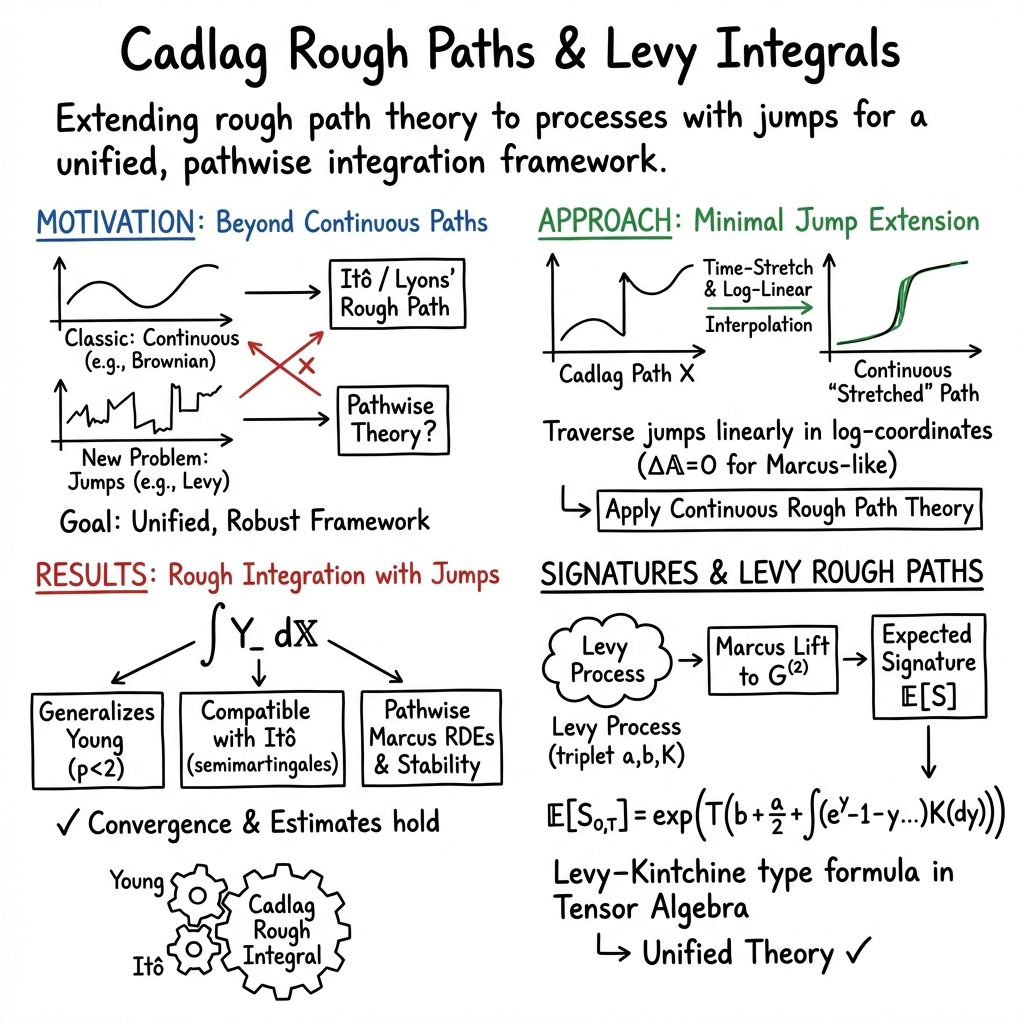
- The paper introduces a generalized rough integration method for jump processes by extending Lyons' theorem to discontinuous settings.
- It defines Levy rough paths with specific sub-ellipticity conditions, establishing criteria for lifting traditional Levy processes.
- The paper derives an explicit Levy–Kintchine type formula for the expected signature, bridging classical stochastic calculus and rough path theory.
The paper "General Rough Integration, Levy Rough Paths and a Levy--Kintchine Type Formula" (1212.5888) systematically investigates rough paths with jumps, particularly focusing on integrating against c`adl`ag processes, a class of stochastic processes characterized by their right-continuous paths with left limits. The authors extend Lyons' extension theorem to the jump setting, providing a pathwise approach to stochastic integration and introducing new classes of Levy rough paths characterized by sub-ellipticity conditions and integrability properties of the Carnot-Caratheodory norm with respect to the Levy measure.
Introduction to Rough Paths with Jumps
The paper starts by diving into the theory of rough paths in a jump setting, an area that has captured significant interest yet remains underexplored compared to continuous paths. Classical rough path analysis deals with continuous processes, but real-world data often exhibit jumps that require a more generalized framework. This work seeks to create a theory of general rough paths that can seamlessly integrate processes with jumps, offering practical applications such as financial models where jumps are commonplace.
General Rough Paths with Jumps
The authors define a general rough path over Rd characterized by its c`adl`ag nature and p-variation regularity, allowing for a structured extension theorem akin to Lyons' for continuous paths. They emphasize the development of general rough integration in a level-two setting, which is pivotal for probabilistic models, illustrating the algebraic and geometric constructs necessary for higher-dimensional jump processes.
Levy Rough Paths
A significant contribution is the introduction of Levy rough paths, which model stochastic processes with jumps through enhanced Levy processes. The paper lays out formal conditions under which a Levy process can be lifted to a rough path, utilizing properties of the Levy measure and the related sub-ellipticity conditions. Examples include multidimensional Levy processes, pure area Poisson processes, and processes with magnetic fields, showcasing practical models leveraged by Levy rough paths.
The authors derive an explicit formula for the expected signature of Levy processes, forming a central part of their analysis. This formula provides insight into the stochastic nature of rough paths with jumps and their underlying probability distributions. The Levy-Kintchine type formula illustrates how Levy rough paths extend traditional Levy processes to incorporate higher-order integration capabilities, creating a bridge between classical stochastic calculus and rough path theory.
Implications and Future Directions
Practically, the research has strong implications for stochastic modeling, particularly in finance where jumps play a pivotal role in modeling price changes and risk analysis. Theoretically, it opens pathways for further exploration into rough path theories in non-continuous domains, enhancing understanding of complex systems beyond classical methods.
Future work may explore the applications of rough path theory in machine learning, specifically for models that handle temporal data with abrupt changes. Additionally, exploring computational methods for simulating Levy rough paths could enhance their usability in real-time systems, potentially improving algorithmic trading or risk management models.
Conclusion
This paper contributes significantly to understanding rough paths in a jump setting by extending traditional methodologies and introducing robust analytical tools applicable to Levy processes. It amplifies rough path theory's reach, proving essential for both theoretical exploration and practical applications in stochastic analysis.