- The paper demonstrates that the Cooper pair phase coherence length collapses sharply at the SIT, supporting a fermionic transition mechanism.
- It employs precise magnetoresistance measurements on nanometer-scale honeycomb patterned a-Bi films to directly probe local phase coherence.
- The findings challenge the bosonic SIT model by highlighting the impact of film uniformity and disorder-induced pair breaking on transition behavior.
Collapse of the Cooper Pair Phase Coherence Length at a Superconductor-Insulator Transition
Introduction
The study of quantum phase transitions in two-dimensional (2D) systems remains central to understanding unconventional superconductivity and emergent insulating phases. The superconductor-to-insulator transition (SIT) has been widely described in terms of two paradigms: the "bosonic" scenario, in which Cooper pairs persist but lose global phase coherence, and the "fermionic" route, where the superconducting (SC) order parameter amplitude vanishes due to pair breaking, and Cooper pairs themselves disintegrate. This work, "Collapse of the Cooper pair phase coherence length at a superconductor to insulator transition" (1301.6155), provides a stringent experimental distinction between these SIT mechanisms in amorphous bismuth (a-Bi) films via local phase coherence measurements.
Theoretical Framework and Prior Studies
Quantum SITs in 2D superconducting films have been predominantly interpreted through the lens of the dirty boson model [Fisher, PRL 1990], where disorder drives spatial inhomogeneity, resulting in localized Cooper pair islands and yielding a so-called Cooper pair insulator (CPI) phase. In this scenario, while global SC is lost, finite-momentum, locally phase-coherent pairs survive into the insulating state. This is typically associated with a diverging phase coherence length, ξϕ, which decays gradually as the system is tuned deeper into the insulating regime. Alternatively, the fermionic SIT picture postulates that increasing disorder enhances Coulomb repulsion and suppresses the pairing amplitude, eventually driving ξϕ to zero at the critical point by destroying Cooper pairs outright.
Recent experiments have supported the bosonic picture by observing persistent gaps (via STM and tunneling) and local SC correlations in disordered films near SIT, with Little-Parks-like oscillations in magnetoresistance (MR) signaling the survival of phase-coherent Cooper pairs well into the insulating side [Sacepe et al., Nat Phys 2011]. However, other studies in amorphous elemental films remain consistent with a fermionic transition, with tunneling data indicating the vanishing of the SC gap at the critical point.
Experimental Approach
This study introduces a direct test of Cooper pair phase coherence utilising ultra-thin, uniform a-Bi films prepared on Si substrates patterned with nanometer-scale honeycomb arrays of holes. The motivation for this geometry is that Little-Parks oscillations emerge in MR when Cooper pair phase coherence extends over distances exceeding the inter-hole spacing (~100 nm). Uniformity in thickness is achieved through quench-deposition on atomically flat substrates, suppressing film granularity and potential inherent inhomogeneities.
Disorder is tuned via the film thickness, transitioning from insulating to superconducting behaviour, and sheet resistance (R□) is monitored as a function of temperature. The phase coherence in each regime is directly probed by MR measurements in perpendicular fields, searching for oscillations with a period determined by the flux quantum per hole.
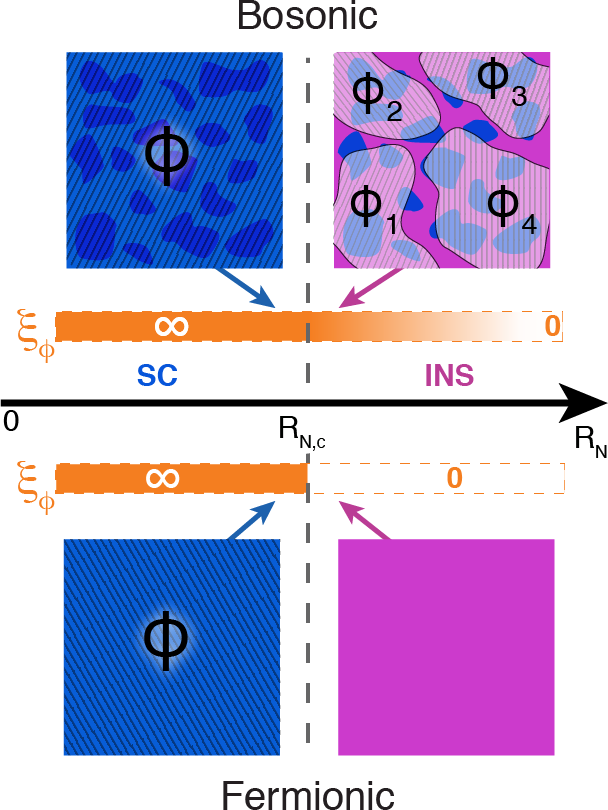
Figure 1: Schematic contrasting disorder-driven bosonic SIT, with emergent inhomogeneous islands, and fermionic SIT, where Cooper pair density vanishes uniformly; the orange bar signifies the phase coherence length, ξϕ.
Results
The films exhibit a disorder (thickness)-driven SIT, with the critical normal state sheet resistance RNc close to RQ=h/(2e)2—consistent with previous reports. However, in contrast to non-uniform films (e.g., those deposited on anodized aluminum oxide), uniform a-Bi films manifest Little-Parks MR oscillations exclusively in the superconducting state. As the system approaches the SIT critical point from the SC side, the amplitude of these oscillations (reflecting local phase coherence) rapidly diminishes and vanishes in the insulating regime.
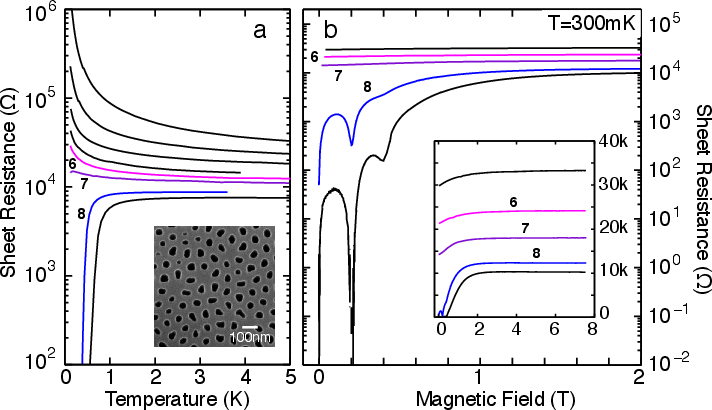
Figure 2: a) R□(T) for a series of Bi films patterned with holes, displaying SIT as a function of thickness; b) MR at low fields indicating the presence of Cooper pairs by periodic dips for SC films only; high-field MR lacks any giant peak signature of CPI.
The oscillation amplitude A (normalized by the local MR background) serves as a sensitive metric of local phase coherence. Its sharp onset below Tc in superconducting samples—and its disappearance at the critical resistance—demonstrate an abrupt collapse of ξϕ. This is in stark contrast to the algebraic decay predicted for the bosonic SIT, where oscillations should persist into the insulating state as long as Cooper pairs remain locally coherent. The absence of MR oscillations in the insulating regime thus provides compelling evidence that the phase coherence length vanishes sharply at the critical point.
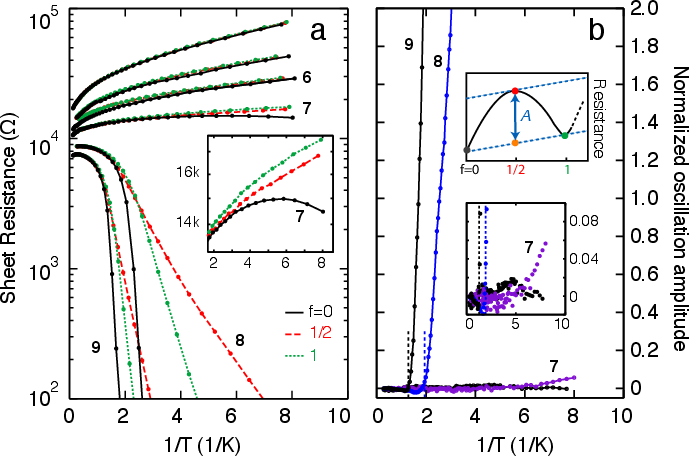
Figure 3: a) R□(T) at various fields for multiple films, illustrating the emergence and suppression of phase coherence; b) Normalized oscillation amplitude A/Rmid vs. inverse temperature reveals rapid growth in SC films and its absence in insulating films.
Discussion and Implications
These findings establish that the disorder-tuned SIT in atomically uniform a-Bi films is fundamentally distinct from CPI transitions in films with intrinsic inhomogeneity. The abrupt collapse of phase coherence is consistent with a fermionic SIT, characterized by vanishing order parameter amplitude (as corroborated by tunneling studies showing SC gap closure at the SIT). Consequently, these results necessitate the recognition of multiple distinct classes of disorder-driven SITs: bosonic transitions with persistent local pairs and fermionic transitions marked by complete Cooper pair destruction at the critical point.
This result challenges theoretical treatments positing universal, disorder-induced local pairing near SITs irrespective of microscopic details. It underscores the limitations of sheet resistance as a sole descriptor for the SIT and highlights a potential role for Coulomb repulsion and microscopic uniformity in governing the nature of the transition.
The study also implies that care must be taken when applying the CPI paradigm to nominally homogeneous systems and that morphology—specifically, film uniformity—has a decisive impact on the quantum critical behaviour.
Conclusion
This work provides robust phase-coherence-sensitive evidence for a sharp collapse of the Cooper pair phase coherence length at the SIT in homogeneously disordered a-Bi films, favoring the fermionic mechanism for the SC-INS transition in such systems. The demonstration of at least two distinct SIT classes—a phase-coherence-preserving bosonic route versus a pair-breaking fermionic scenario—has far-reaching implications for theoretical modeling and the interpretation of SIT phenomena in both conventional and unconventional 2D superconductors.
Future investigations should systematically explore the crossover between these mechanisms, the effect of controlled inhomogeneity, and implications for other systems (e.g., high-Tc cuprates, transition metal dichalcogenides) where disorder, phase coherence, and electron correlations interplay to determine the ground state.