- The paper demonstrates high-precision measurement of second- and third-order Zeeman shifts using a laser-microwave double-resonance technique in a Penning trap.
- It employs advanced QED calculations to accurately account for fine- and hyperfine-structure contributions in boronlike ions, reaching precision at the ppb level.
- The research paves the way for enhanced atomic metrology and future experiments on ions such as Pb81+ and Bi82+ at facilities like HITRAP.
Overview of the Paper
The paper "Experimental access to higher-order Zeeman effects by precision spectroscopy of highly charged ions in a Penning trap" presents an innovative approach utilizing laser-microwave double-resonance spectroscopy to study higher-order Zeeman effects in highly charged ions. Conducted in a Penning trap environment, this research seeks to obtain high-precision measurements of Zeeman splittings in fine- and hyperfine-structure levels of ions by leveraging quantum electrodynamics (QED) calculations. This study focuses on 40Ar13+ ions and preliminarily addresses the experimental preparations within the ARTEMIS (AsymmetRic Trap for the measurement of Electron Magnetic moments in IonS) experiment.
Higher-Order Zeeman Effects
The Zeeman effect, known for lifting the degeneracy of energy levels in an external magnetic field, includes linear and nonlinear components. This research explores the second- and third-order contributions to this effect in highly charged ions. Detailed QED calculations for boronlike ions, such as Ar13+, reveal significant contributions to spectroscopic measurements on the ppb level. These calculations further show that while first-order shifts dominate, secondary and tertiary effects contribute to the observable splitting, providing a nuanced understanding of magnetic moment interaction and fine-structure transitions.
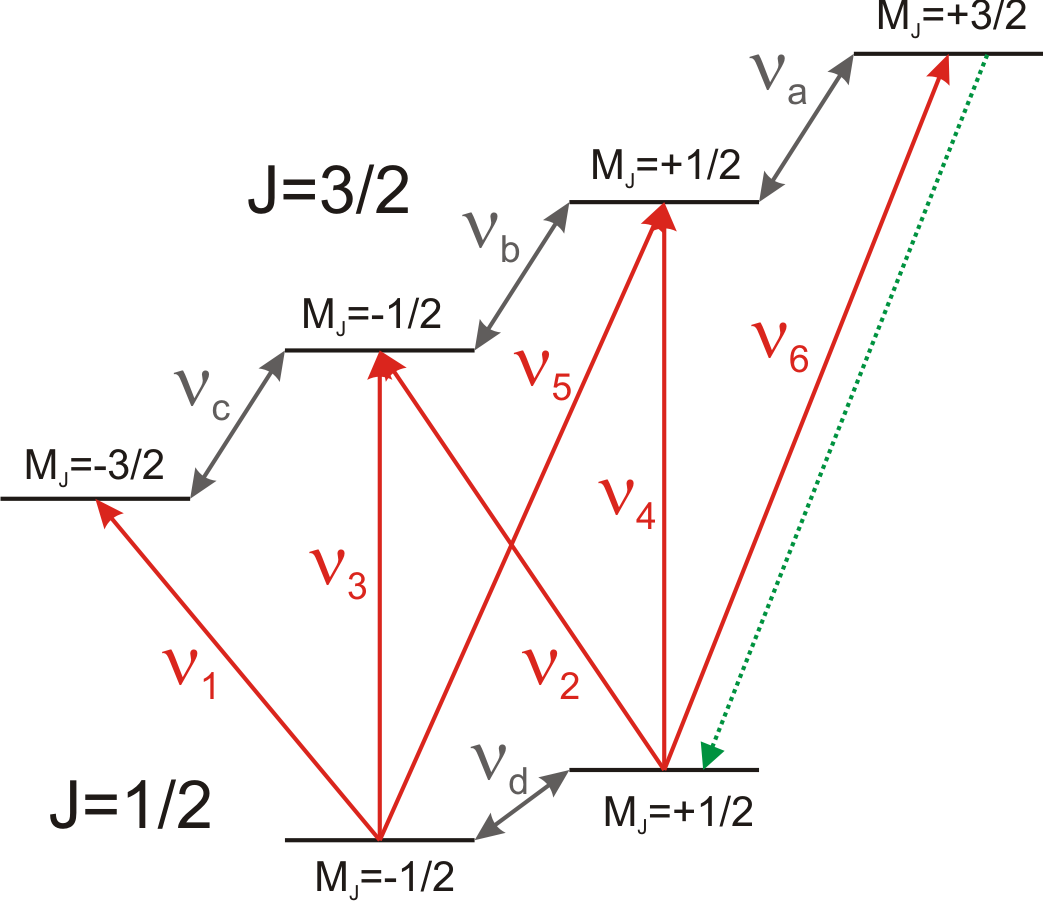
Figure 1: Spectroscopy of the $2\,^2\!P_{1/2}$-$2\,^2\!P_{3/2}$ fine-structure transition in boronlike argon, indicating excitation and spontaneous decay pathways along with microwave transition representations.
Methodology and Experimental Design
The experimental setup employs a Penning trap to maintain highly charged ions in a stable state at liquid helium temperatures, with an ultra-cooled environment provided by a pulse-tube cryocooler. The combination of laser and microwave spectroscopy is crucial, as it allows the measurement of both optical transitions and microwave-induced Zeeman splittings with high precision. The ARTEMIS experiment is designed to reach spectroscopic accuracies at the order of ppb and higher using double-resonance techniques, thus offering experimental access to nonlinear Zeeman contributions.
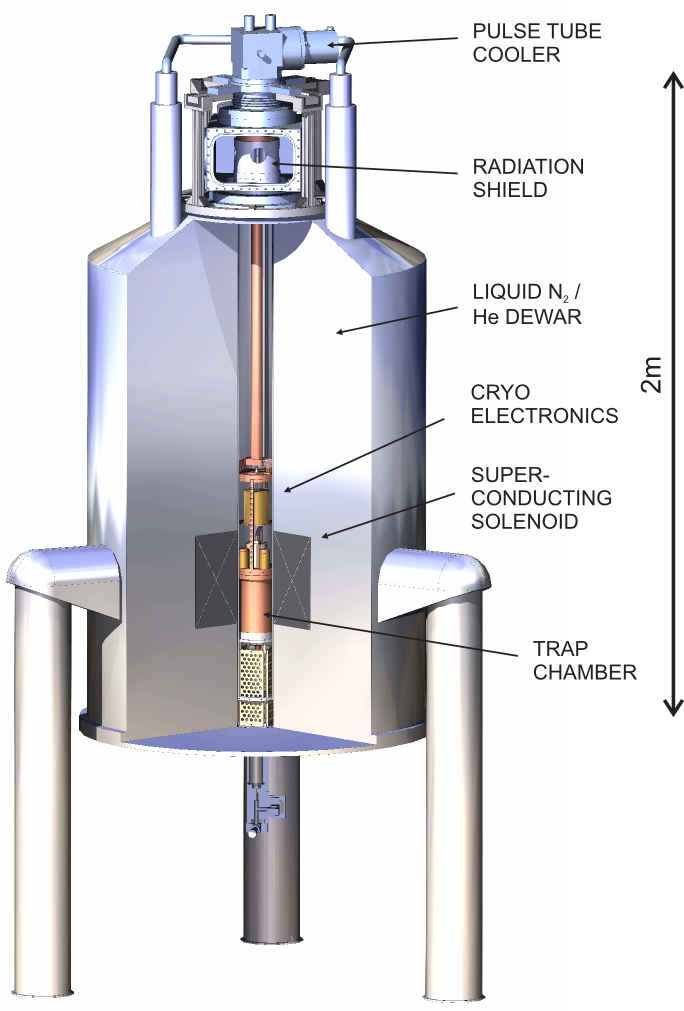
Figure 2: Schematic drawing of the experimental setup including the superconducting magnet and the trap.
Computational Analysis
Advanced QED computations have been employed to ascertain the values of the gJ factors and the corresponding energy level contributions affected by the Zeeman effect. These calculations involve a particularly rigorous consideration of electron-nuclear interactions in highly charged ions, emphasizing the significance of relativistic and QED corrections. Precision in such calculative models is essential for matching the high-resolution experimental data anticipated from the ARTEMIS endeavor.
Implications and Future Prospects
The implications of these findings are considerable for the domain of atomic physics and, specifically, in refining our understanding of electron interactions in strong magnetic fields. The research underpins potential developments in precision metrology and enhanced spectroscopic methods for evaluating atomic structures. The anticipated extension of this framework to ions such as 207Pb81+ and 209Bi82+ suggests a future utilization of the HITRAP facility at GSI, Germany, reinforcing the foundational role of this research in evolving spectroscopic technology.
Conclusion
In conclusion, this paper approaches the Zeeman effect in highly charged ions from a sophisticated experimental lens, intersecting with computational precision through QED contributions. The methodological advancements posited by this study advance the repository of knowledge concerning atomic structure and magnetic interactions, opening avenues for both theoretical exploration and practical metrological advancements. The ARTEMIS experiment's strategic design promises to yield unprecedented insights into higher-order effects, positioning it as a pivotal investigational tool within precision spectroscopy.