- The paper introduces an analytic solution of the temporal Fokker-Planck equation with time-dependent diffusion and drift terms.
- It employs a power-law ansatz to capture both subdiffusive and superdiffusive regimes in anisotropic media.
- The model extends to N dimensions, offering a scalable framework for analyzing diffusion phenomena in complex physical systems.
Analytic Physical Model of Anisotropic Anomalous Diffusion
Introduction
The study presented in "Analytic physical model of anisotropic anomalous diffusion" provides an analytical solution to the temporal Fokker-Planck equation, focusing particularly on 2D and 3D cases, while also generalizing to N spatial dimensions. By proposing a temporal power-law for anisotropic diffusion coefficients, the model allows for the characterization of both normal and anomalous diffusion processes, inclusive of drift terms. This framework contributes to a deeper understanding of diffusion phenomena observed in diverse contexts such as environmental sciences and biological systems.
Analytic Solution of the Temporal Fokker-Planck Equation
The paper derives an exact analytical solution to the temporal Fokker-Planck (FP) equation in one dimension, with extension to multiple dimensions. The 1D temporal FP equation, given by:
∂t∂ρ(x,t)=2D(t)∂x2∂2ρ(x,t)−V(t)∂x∂ρ(x,t),
provides a basis for the exploration of diffusion with temporally varying coefficients. The solution assumes a Gaussian form with time-dependent mean and variance, effectively incorporating integrals over diffusion and drift coefficients:
ρ(x,t)=N[x;x0+IV(t),σ0x2+ID(t)].
The generalized form in higher dimensions involves a product of Gaussian distributions, each associated with specific spatial coordinates, allowing the treatment of anisotropic diffusion with different coefficients for each dimension.
Anisotropic Anomalous Diffusion Analysis
The research extends into the field of anisotropic anomalous diffusion by assuming power-law dependency for diffusion coefficients. The power-law ansatz is articulated as:
$\bD(t) \equiv \left[C_x\,\alpha_x\,(t-t_0)^{\alpha_x-1},\ C_y\,\alpha_y\,(t-t_0)^{\alpha_y-1},\ C_z\,\alpha_z\,(t-t_0)^{\alpha_z-1}\right] \;.$
This model facilitates the exploration of subdiffusion (α<1) and superdiffusion (α>1), with constraints ensuring physical validity—namely, positive α values to avoid divergent variance.
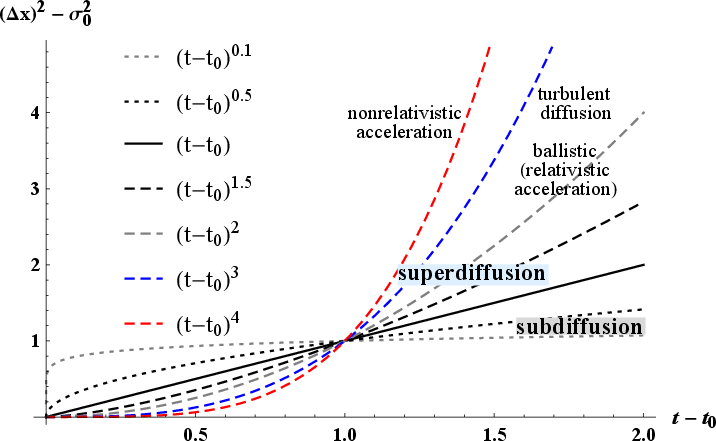
Figure 1: Variance of the position about the mean from integrating the power-law ansatz of the current paper [see Eqs.~(\ref{eq:powerlaw}) and (\ref{eq:powerlawint})].
Volume Growth Rate in N-dimensional Spaces
The study presents an expression for the N-dimensional volume of uncertainty (VOU), addressing both isotropic and anisotropic cases. The general growth rate, derived from the power-law characterization of diffusion, is shown to follow:
VOU(t)∼tNα/2,
indicating a dependence on the aggregate of diffusion exponents across dimensions. This scaling law encompasses phenomena like turbulent diffusion, providing a flexible framework for analyzing complex diffusive processes.
Conclusion
This work advances the theoretical understanding of diffusion processes by providing a comprehensive, analytically tractable model that accounts for both anisotropic and anomalous diffusion in multiple dimensions. The implications are broad, supporting the analysis of diverse physical systems and offering insights for further studies into complex diffusive behaviors. Future research may contemplate the incorporation of interaction potentials and explore higher-order spatial derivatives to refine the model’s applicability to a wider class of physical phenomena.