- The paper confirms that the avoidance zone hosts clusters with half-light radii ≥7 pc and luminosities between M_V −10 and −8, overturning prior selection biases.
- The study employs high-resolution HST imaging and Keck/DEIMOS spectroscopy to accurately measure cluster sizes and verify memberships in early-type galaxies.
- Spectral and color analysis indicates that these red, metal-rich clusters likely stem from disk environments or merger remnants, prompting a reassessment of formation models.
Filling the Gap: A New Class of Old Star Cluster?
Introduction
The structural diversity of old star clusters—ranging from globular clusters (GCs) to ultra-compact dwarfs (UCDs) and faint fuzzies (FFs)—poses enduring questions regarding their formation, evolution, and interrelationships. Historically, various types of long-lived star clusters have been viewed as distinct populations, each occupying different regions in size–luminosity parameter space. Recent work summarized by Brodie et al. (2011) consolidated these distributions, revealing a notable "U-shaped" trend but also a conspicuous deficiency of systems in intermediate radii and luminosities: the so-called "avoidance zone" (1306.5245). Understanding whether this gap is real or a consequence of observational selection biases carries significant implications for theories of star cluster formation and the possible existence of new cluster classes.
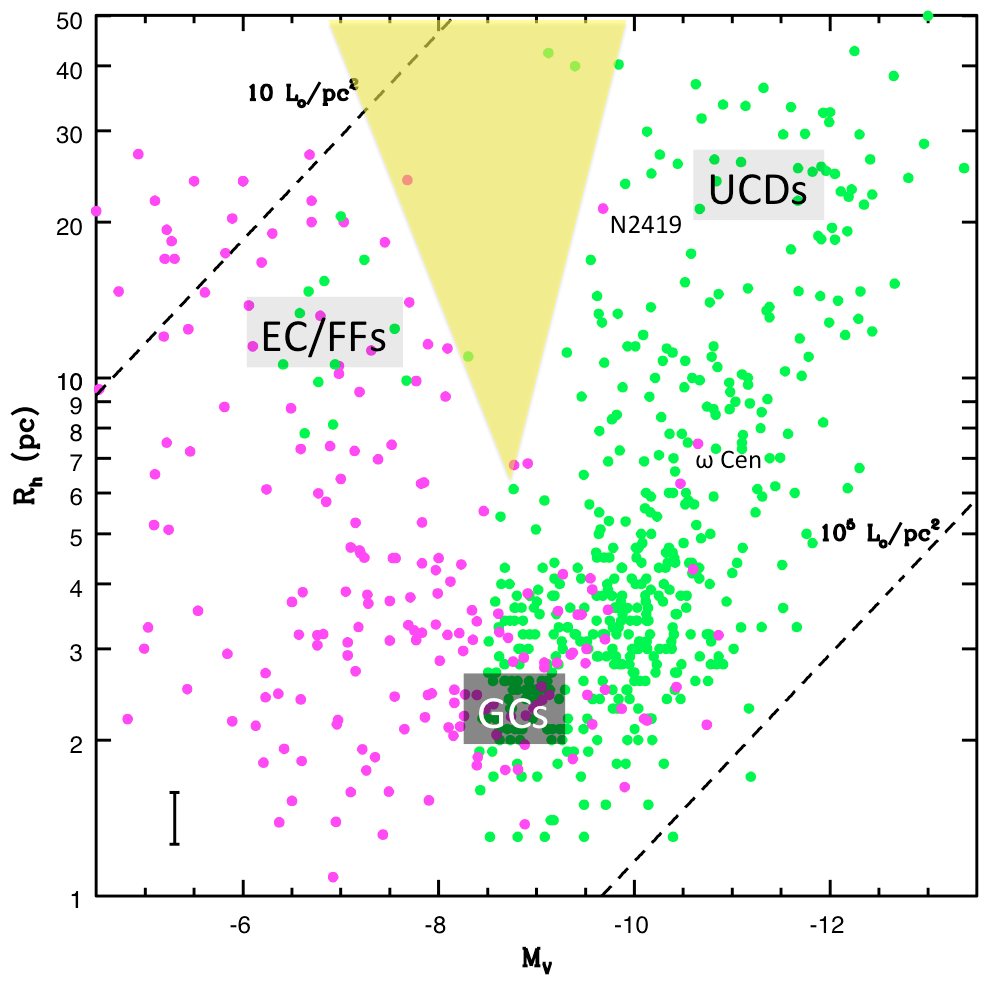
Figure 1: Size–luminosity diagram for old star clusters showing the U-shaped distribution and the yellow-shaded 'avoidance zone'.
Data Acquisition and Methodology
To test the reality of the avoidance zone, the study combines high-resolution imaging from the Hubble Space Telescope (HST) with deep Keck/DEIMOS spectroscopy. Candidate clusters were selected in three early-type galaxies (NGC 4278, NGC 4649, NGC 4697) based on color-magnitude diagrams using HST g- and z-band images, and size measurements were rigorously vetted via visual inspection and ISHAPE modeling. Radial velocities confirm their association with host galaxies, eliminating background contamination. The spatial resolution achieved allows precise size measurements (down to 1-2 pc at distances of 11–17 Mpc), enabling robust discrimination of cluster properties across a wide luminosity baseline.
Results: Filling the Gap
The principal result is the spectroscopic confirmation of numerous old star clusters within the previously unpopulated avoidance zone. Clusters with half-light radii Rh≳7 pc and −10≲MV≲−8 are present, providing strong evidence that the absence noted in earlier works reflects sensitivity limitations, particularly at low surface brightness, rather than an intrinsic deficiency.
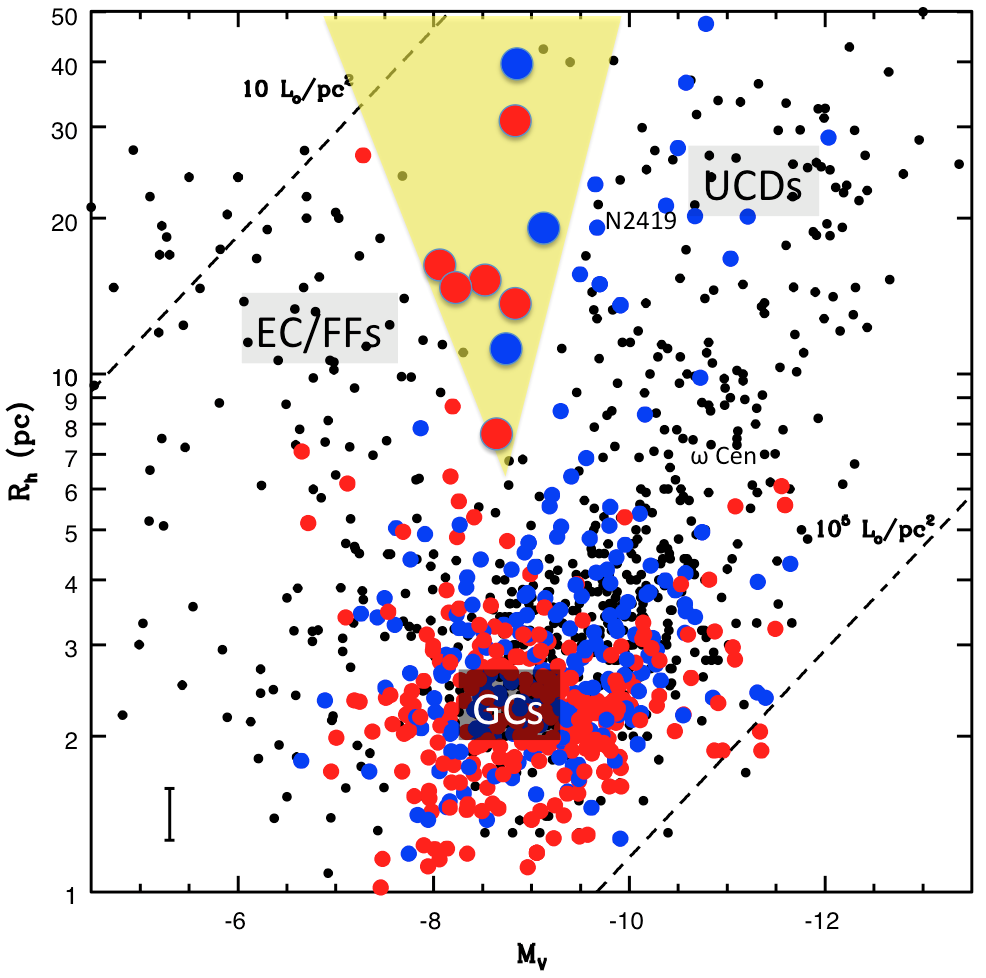
Figure 2: Updated size–luminosity diagram including newly confirmed clusters (red and blue points, color-coded by (g–z) metallicity proxy), explicitly occupying the avoidance zone and extending the sequence to lower luminosity and surface brightness.
Analysis of intrinsic colors provides further insight: clusters populating the avoidance zone are predominantly red (i.e., metal-rich with (g−z)>1.1), which emphasizes their relation to FFs and diffuse star clusters (DSCs) known from metal-rich disk environments. In contrast, higher-luminosity, extended objects (UCDs) are mainly blue and metal-poor. This bifurcation in color distribution supports a formation/environmental dichotomy for extended clusters, with the avoidance zone objects likely arising from disk environments or merger remnants.
Among the confirmed objects are noteworthy extremes, including clusters with luminosity and size comparable to NGC 2419—the Milky Way's largest GC—and others spanning up to 50 pc in Rh, considerably extending the parameter space. The largest cluster identified (D68 in NGC 4649) presents MV=−10.8 and Rh=47 pc, combining a massive stellar population with unusually low surface density.
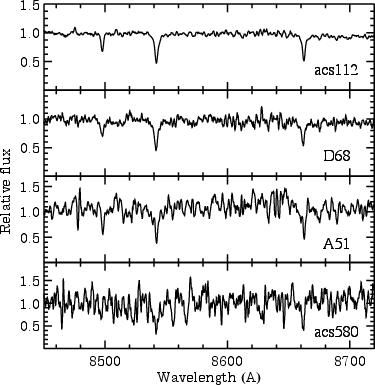
Figure 3: Keck/DEIMOS spectra of selected star clusters showing CaT absorption features used for precise radial velocity determination, validating cluster membership in the host galaxies.
Theoretical Implications
The existence of a continuous distribution of sizes, luminosities, and densities among old clusters contradicts predictions from several leading formation models. For instance, scenarios positing that UCDs are simply overgrown GCs or stripped nuclei of dwarf galaxies typically predict well-defined size–mass relations. Similarly, simulations addressing merging star cluster complexes under tidal influences reproduce broader size–luminosity spreads but typically yield upper limits to cluster sizes that are not supported by the new observational data.
The data also do not support a clean demarcation between ECs/FFs and UCDs; instead, extended, lower-luminosity, metal-rich clusters (particularly those in the avoidance zone) appear naturally connected to FFs and DSCs seen in disk galaxies. Host galaxy signatures (e.g., NGC 4278’s HI ring, NGC 4649’s external rotation and possible merger remnants, and NGC 4697’s possible S0 classification) further support interaction-driven or disk-related origins for these extended clusters.
Practical Implications and Future Directions
The demonstration that old, long-lived clusters exhibit a continuous range of structural properties necessitates reassessment of both observational strategies and theoretical models. Observationally, statistical completeness in the cluster census, particularly for low surface brightness and/or intermediate-size objects beyond the Local Group, will require deeper photometric and spectroscopic surveys. Theoretically, formation scenarios must abandon assumptions of strict size–mass trends and account for broader environmental and evolutionary factors, including galaxy interactions and disk dynamics.
The classification boundaries between GCs, UCDs, FFs, and DSCs are therefore, to some degree, artificial. Models must accommodate a range of cluster formation channels active in diverse galactic contexts. Additionally, the metallicity dichotomy evidenced in the avoidance zone implies that chemical enrichment histories and environmental processes (e.g., mergers, tidal influences, disk instabilities) play a crucial role.
Conclusion
This investigation empirically fills the star cluster avoidance zone, establishing a continuous range of size, luminosity, and density properties for old clusters in early-type galaxies. Most clusters previously believed absent in this domain are, in fact, present but red and metal-rich, linking them to the faint fuzzy population rather than representing a new class. The results challenge theoretical models reliant on strict size–luminosity or size–mass relations and underscore the complexity of star cluster formation across galactic environments. Future work, especially with next-generation deep surveys, will refine the picture of cluster demographics and origin scenarios, potentially identifying further low surface density systems and elucidating their evolutionary connections.