- The paper details a comprehensive analysis of YFeO₃ spin dynamics using inelastic neutron scattering and a four-sublattice Hamiltonian.
- The study achieves excellent agreement with experimental dispersion data by precisely extracting exchange and anisotropy parameters.
- The identification of a hidden magnon branch underscores the need for quantum corrections to improve classical spin-wave models.
Inelastic Neutron Scattering Investigation of YFeO3 Spin Dynamics
Introduction
The systematic study of spin dynamics in rare-earth orthoferrites offers critical insight into their magnetic interactions, anisotropies, and emergent phenomena relevant to spintronic and multiferroic applications. This paper presents a thorough characterization of the spin wave excitations in YFeO3 via inelastic neutron scattering, employing a comprehensive four-sublattice model to describe the interplay of weak ferromagnetic and hidden antiferromagnetic orders. YFeO3, with its nonmagnetic yttrium sublattice, serves as an ideal system for isolating the magnetic behavior of Fe3+ ions, facilitating clean analysis of exchange and anisotropic interactions without complications from rare-earth magnetism or spin reorientation transitions.
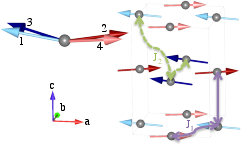
Figure 1: Magnetic unit cell of YFeO3, showing Fe3+ sites, nearest (purple) and next-nearest (green, dashed) neighbor exchange interactions, and axes of weak ferromagnetism and antiferromagnetism.
Experimental Techniques
High-purity polycrystalline and single crystal YFeO3 samples were synthesized via solid-state reaction and grown using optical floating zone methods. Inelastic neutron scattering measurements were performed utilizing the Cold Neutron Chopper Spectrometer (CNCS) and Fine Resolution Chopper Spectrometer (SEQUOIA) at the Spallation Neutron Source. Incident energies covered both low-energy (CNCS, 3.15 meV) and high-energy (SEQUOIA, 99.34 meV) excitations, enabling the investigation of spin dynamics up to 80 meV with high resolution (≤0.06 meV at base temperature).
Four-Sublattice Model and Spin Hamiltonian
The theoretical description is based on a full four-sublattice Hamiltonian incorporating nearest-neighbor (J1) and next-nearest-neighbor (J2) isotropic exchange, two Dzyaloshinskii–Moriya (DM) interactions (D1, D2) generating canting along the c and b axes, and two single-ion easy-axis anisotropies (Ka, Kc). The four-sublattice formalism captures both the primary G-type AFM ground state, weak ferromagnetism along c, and weak antiferromagnetism along b. The parameter space was constrained using known canting angles, with D1 and D2 determined by linearized expressions connecting canting to DM interactions.
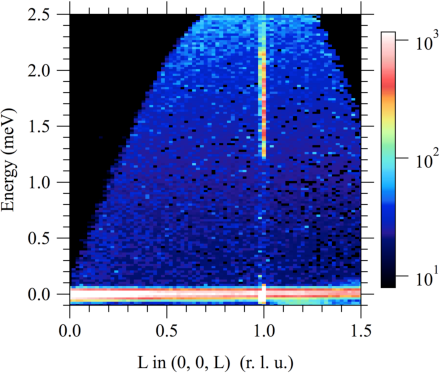
Figure 2: Spin wave energy gap in YFeO3 measured by inelastic neutron scattering.
Spin wave energies and intensities were computed under the 1/S approximation and compared directly with experiment through convolution with instrumental resolution and Fe3+ magnetic form factors.
Spin Wave Dispersion: Experimental and Theoretical Results
Neutron scattering revealed detailed spin wave dispersions along several high-symmetry directions in reciprocal space at low temperature. The model achieves excellent agreement with most observed dispersion branches, successfully fitting the data with J1=−4.77 meV, J2=−0.21 meV, D1=0.074 meV, D2=0.028 meV, Ka=0.0055 meV, and Kc=0.00305 meV. Notably, the values for J1 are systematically lower than fits obtained under two-sublattice or long-wavelength-only approximations, reflecting the necessity of the complete four-sublattice framework for accurate parameter extraction.
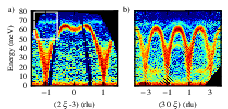
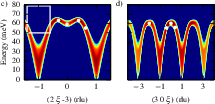
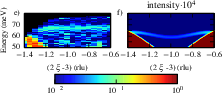
Figure 3: Measured and calculated spin wave dispersion along several high-symmetry directions, highlighting correspondence between experiment and theory and the presence of additional branches attributable to the hidden order.
A salient result is the detection of an additional magnon branch consistent with the hidden antiferromagnetic order, inaccessible to two-sublattice models. While the calculated intensity for this branch is orders of magnitude weaker than experiment, its energy position and systematic appearance validate the need for full four-sublattice modeling. Modest discrepancies—specifically, underestimation of this intensity and a ≤9 meV shift in branch energy—are attributed to the neglect of quantum fluctuations in the present classical treatment.
Influence of Reciprocal Space and Selection Rules
Intensity analysis along different L values in reciprocal space (e.g., (2,ξ,−3) vs.\ (2,ξ,−2)) demonstrates strong modulation governed by the underlying symmetry and the folding of the magnetic zone due to sublattice doubling. Commensurate changes in intensity and selection rules are evident, directly connected to whether the Bragg point is Q-type (even, odd, odd) or O-type (even, even, even), in agreement with prior theoretical expectations.
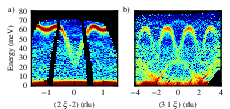
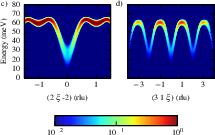
Figure 4: Measured and calculated spin wave dispersion along further directions, illustrating reciprocal space dependence of magnon intensities and effect of phonon backgrounds.
Implications and Future Directions
The results highlight the necessity of full magnetic symmetry analysis for orthoferrites, especially when extracting exchange and DM parameters for attempts to understand spin reorientation phenomena and magnetoelectric coupling in the broader RFeO3 family. Discrepancies between experiment and classical linear spin-wave theory for the "hidden" magnon branch suggest quantum corrections are required for quantitative accuracy. Moreover, the methodology and fitting procedure provide a platform for future investigations of related systems featuring additional magnetic rare earth ions, spin reorientation transitions, or nontrivial structural distortions.
The detection and analysis of otherwise silent modes also carry implications for nonlinear optical and THz spectroscopy, where such excitations may be exploited for device applications or as signatures of multiferroic coupling.
Conclusion
Comprehensive inelastic neutron scattering and four-sublattice modeling elucidate the spin dynamics of YFeO3, establishing precise exchange and anisotropy parameters and validating the presence of hidden magnetic order through observation of additional magnon branches. The study demonstrates the imperative of rigorous magnetic symmetry analysis and sets a foundation for exploration of more complex rare-earth orthoferrites, especially those manifesting spin reorientation or strong magnetoelectric phenomena.