An Introduction to QBism with an Application to the Locality of Quantum Mechanics
Abstract: We give an introduction to the QBist interpretation of quantum mechanics. We note that it removes the paradoxes, conundra, and pseudo-problems that have plagued quantum foundations for the past nine decades. As an example, we show in detail how it eliminates quantum "nonlocality".
Paper Prompts
Sign up for free to create and run prompts on this paper using GPT-5.
Top Community Prompts
Explain it Like I'm 14
An easy-to-read guide to “An Introduction to QBism with an Application to the Locality of Quantum Mechanics”
1) What is this paper about?
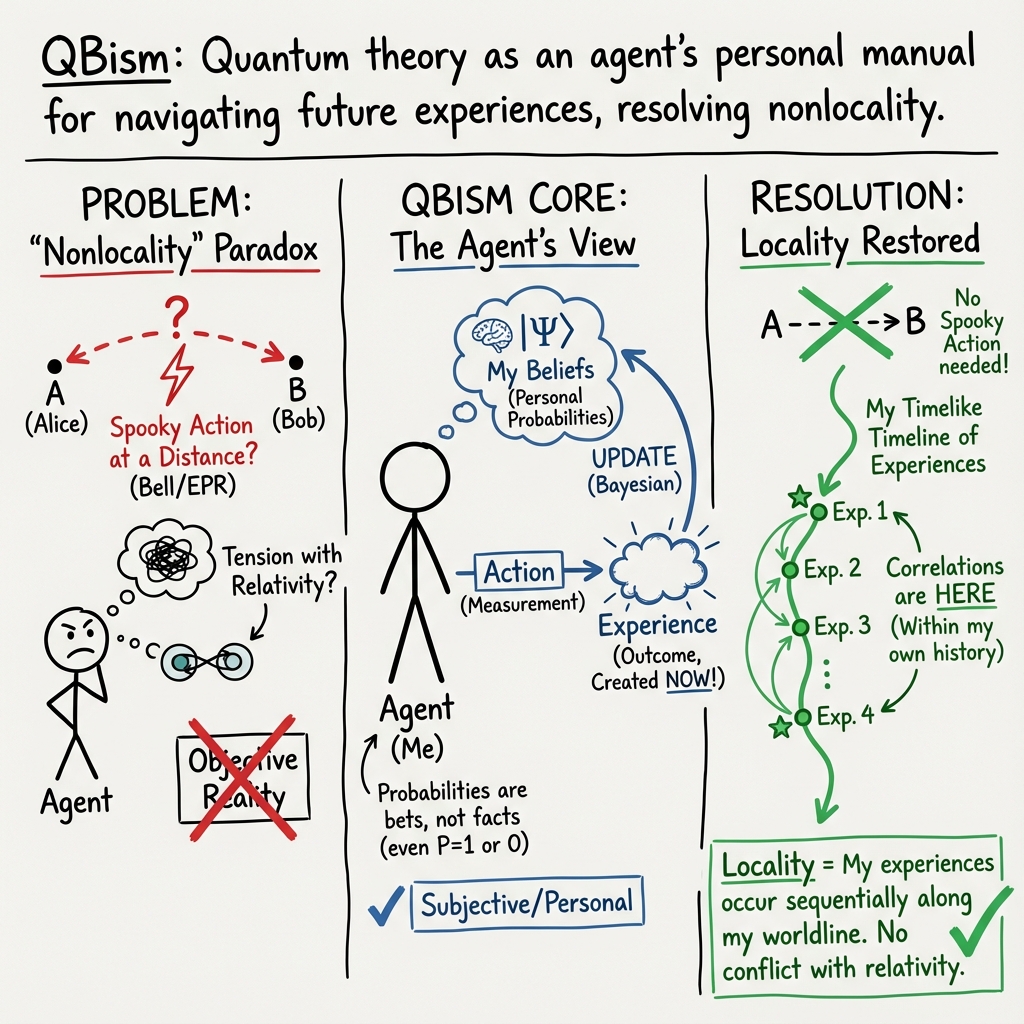
This paper explains a way of looking at quantum physics called QBism (short for Quantum Bayesianism). The main idea is simple: quantum theory is a personal tool any scientist can use to organize their expectations about what they will experience when they act on the world (for example, when they do an experiment). The authors argue that if you take this point of view seriously, famous “paradoxes” of quantum mechanics disappear—especially the idea of “spooky action at a distance” (nonlocality).
2) What questions are the authors trying to answer?
In friendly terms, the paper asks:
- What exactly is QBism, and how does it differ from other interpretations of quantum mechanics?
- What does a “measurement” really mean?
- What are probabilities in quantum theory—facts about the world, or personal judgments?
- Does quantum mechanics really require spooky, faster‑than‑light influences between faraway places? Or is that a misunderstanding?
- How does this view help clear up long-standing confusion, like the “measurement problem” and the EPR/Bell nonlocality debates?
3) How do they approach the problem?
This is not a lab experiment paper—it’s a careful rethink of concepts, backed by logic and famous thought experiments. Here’s the approach in everyday language:
- Agents and experience: The authors talk about “agents” (think: a person like Alice or Bob who does experiments). An agent uses quantum theory to plan actions and to set expectations for what they might experience next.
- Measurements as actions: A measurement isn’t a magic window revealing a pre‑existing answer. It’s more like pressing a button in a game: your action brings about an outcome for you, the player. In QBism, a measurement outcome is the specific experience you have after you act.
- Probabilities as personal bets: QBism uses the “personalist” idea of probability. A probability isn’t a property of the world by itself; it’s your degree of belief. Imagine betting on rain: your probability of “70% chance” means you’d accept certain bets because you’re that confident. A rule called “Dutch-book coherence” says your probabilities should be internally consistent so no clever bookie can guarantee you’ll lose money no matter what happens.
- Quantum states as beliefs: Because probabilities are personal, the quantum state (often called the wavefunction) is also your personal summary of beliefs about possible experiences. “Collapse of the wavefunction” just means you update your beliefs after you learn something—exactly like changing your weather forecast once you look out the window.
- Classic thought experiments, re-read: The paper re-examines things like Wigner’s friend and the EPR/Bell scenarios. The key move is to track whose experience we’re talking about. For example, Wigner’s friend inside the lab experiences an outcome; Wigner outside doesn’t—until he hears the report. There’s no contradiction if you remember that outcomes are personal experiences, not agent‑independent facts floating “out there.”
- Locality and relativity: The authors argue that quantum theory, understood as a tool for single agents to organize their own experiences along their paths through spacetime, does not require any faster‑than‑light influences.
4) What are the main results and why do they matter?
Here are the core claims, explained simply:
- Outcomes are created in experience, not revealed: If Alice presses a button on a device, the outcome “appears” for Alice when she experiences it. It didn’t exist as a fixed, agent‑independent fact beforehand. This dissolves confusion in scenarios where different people (agents) don’t yet share the same information.
- Probability 1 is still a belief, not a guarantee from nature: Even if you’re 100% sure something will happen, that’s still your judgment, not proof of a hidden mechanism forcing that result. This counters a key assumption behind certain arguments for nonlocality (like EPR): thinking that “certainty” means there must be a pre‑existing element of reality.
- Don’t add invisible ingredients: Some nonlocality arguments rely on extra “hidden variables” (often called λ) that never show up in any agent’s experience and aren’t part of quantum theory. QBism says: if it never appears in experience and isn’t in the theory, don’t use it to explain the data. Removing these invisible add‑ons removes the need for spooky explanations.
- Locality restored: In QBism, quantum correlations live within an agent’s stream of experiences, which unfold over time along that agent’s path (not between far‑away, space‑like separated events that no single agent can directly experience at once). Because of this, quantum mechanics doesn’t require faster‑than‑light effects. It fits peacefully with relativity.
- The “measurement problem” softens: If a measurement is just an action whose outcome is a new experience for an agent, then the mysterious “collapse” is simply belief updating. That removes the sense that something physically dramatic and ill‑defined is happening in the world at the moment of measurement.
Why it matters:
- It offers a clear, consistent way to think about quantum theory without paradoxes.
- It keeps quantum mechanics compatible with Einstein’s relativity (no superluminal influence needed).
- It gives practical guidance: use the theory to make good, coherent bets about your experiences, and stop chasing ghostly explanations that never appear in anyone’s data.
5) What could this change or influence?
If scientists adopt this viewpoint, a few things follow:
- A rebalancing of “subject” and “object”: Science would explicitly include the role of the user (the agent) and their experiences. This doesn’t mean “anything goes.” It means recognizing that theories are tools for agents to organize and update expectations, based on what they actually observe.
- Clearer conversations about quantum information: In fields like quantum computing and cryptography, where probabilities and information are central, treating quantum states as beliefs can sharpen how we reason and design protocols.
- Less time on pseudo‑problems: Many famous debates sprang from treating probabilities as objective things or from assuming outcomes exist independently of any agent’s experience. QBism encourages focusing on questions that connect to what agents can actually do and learn.
- Harmony with relativity: By keeping quantum correlations within an agent’s time‑ordered experiences, the alleged conflict between quantum mechanics and the speed limit of light dissolves.
In short, the paper argues that quantum theory is best understood as a user’s manual for making coherent, personal predictions about experiences that result from actions. Viewed that way, big paradoxes shrink or vanish, and the theory’s astonishing success looks less mysterious and more like a skillful way of navigating the world we live in.
Collections
Sign up for free to add this paper to one or more collections.