- The paper demonstrates that quantum exchanges stabilize the cluster crystal phase in soft-core bosons, inverting effects observed in hard-core systems.
- It employs continuous-space path integral quantum Monte Carlo with the worm algorithm to map phase boundaries and superfluid transitions.
- Results show that exchange effects broaden the stability window of droplet crystals, guiding experimental designs in ultracold Rydberg gases.
Exchange-induced Crystallization in Soft Core Bose Systems
Introduction and Context
The study addresses quantum phase transitions in two-dimensional assemblies of bosons interacting via a soft-core pair potential, with particular attention to the impact of quantum-mechanical exchange statistics on crystallization. Traditional understanding asserts that quantum exchanges weaken crystalline order, a phenomenon well established in hard-core Bose systems like 4He, where exchanges favor a fluid or supersolid phase. This work demonstrates that the situation is fundamentally reversed for soft-core interactions: exchanges stabilize cluster crystal phases, expanding their region of thermodynamic stability compared to the case where quantum statistics is neglected.
Model and Physical Setting
The system analyzed consists of N spinless bosons of mass m, constrained to two dimensions, with periodic boundary conditions. The Hamiltonian incorporates a kinetic term and a pairwise potential
v(r)=rc6+r6v0
The potential models interaction between Rydberg atoms in the blockade regime, creating a tunable soft core. The soft-core nature allows non-negligible overlap of bosonic wavefunctions and hence macroscopic occupation of spatial regions, supporting cluster crystal (droplet crystal) phases wherein unit cells are multiply occupied. The key control parameters are the dimensionless interaction strength V0=mv0/(ℏ2rc4) and the density ρ, with α=V0ρ controlling the phase diagram.
Computational Methodology
The phase diagram and superfluid properties are determined via continuous-space path integral quantum Monte Carlo, leveraging the worm algorithm. The simulation framework samples particle worldlines, inherently accommodating quantum exchanges and generating unbiased ground- and finite-temperature properties of the Bose system. Parallel simulations with distinguishable particles ("boltzmannons") are employed to isolate exchange-induced effects.
Results: Structure and Superfluidity
Direct inspection of worldline configurations reveals unambiguous differences between Bose and boltzmannon systems. For the regime where the core is soft (V0≲20), worldlines show the spontaneous emergence of a cluster crystal with significant occupancy per site in the Bose case; the boltzmannon case produces the same crystal at zero temperature but with critical differences at finite temperature.
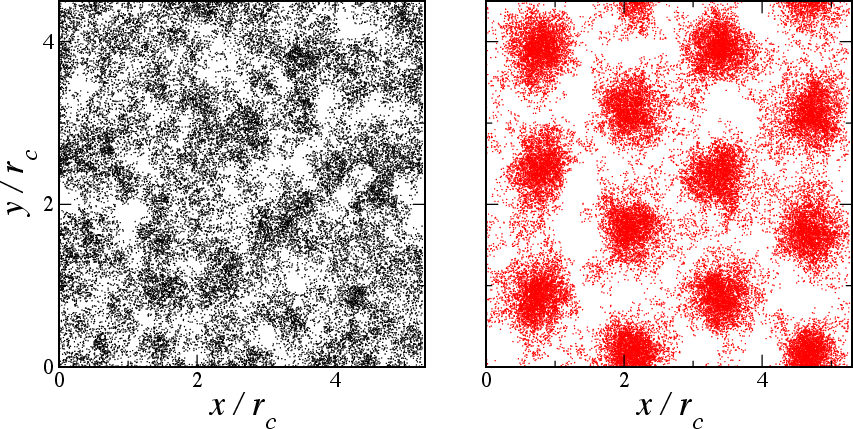
Figure 1: Particle worldline snapshots contrasting boltzmannon and Bose statistics; prominent droplet crystal structure emerges in both, but exchange-induced effects manifest in finite-T stability.
Superfluid density fS as a function of α confirms three distinct regimes: uniform superfluid (fS≈1), a supersolid cluster crystal (fS finite but <1), and an insulating cluster crystal (fS≈0). All data collapse onto universal curves for fixed density and temperature scaling.
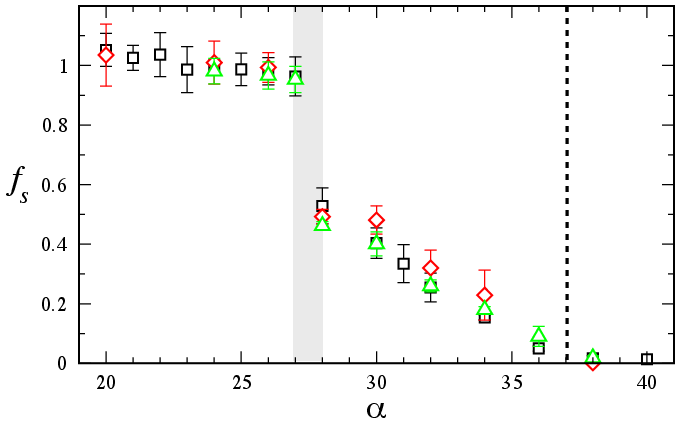
Figure 2: Zero-temperature superfluid fraction as a function of the renormalized interaction parameter α, illustrating abrupt transitions between fluid, supersolid, and insulating phases.
Thermal evolution of the supersolid is characterized by analyzing fS(t), where t=T/ρ is the reduced temperature. The finite-T transition from cluster crystal to fluid fits the predictions of Berezinskii-Kosterlitz-Thouless (BKT) theory. The numerical BKT critical temperature is sharply elevated in the Bose case compared to the boltzmannon reference.
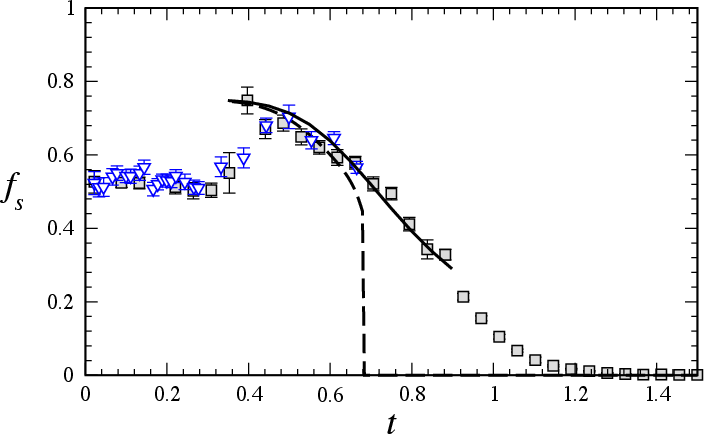
Figure 3: Superfluid fraction versus reduced temperature for two densities, capturing the thermal melting of the supersolid and exhibiting collapse consistent with BKT theory.
Phase diagrams in the (α,t) plane are constructed for both quantum statistics. The Bose system supports four regimes: normal fluid (NF), uniform superfluid (SF), superfluid droplet crystal (SDC, i.e., supersolid), and insulating droplet crystal (IDC). In sharp contrast, the boltzmannon system lacks superfluidity and exhibits a significantly smaller cluster crystal stability window.
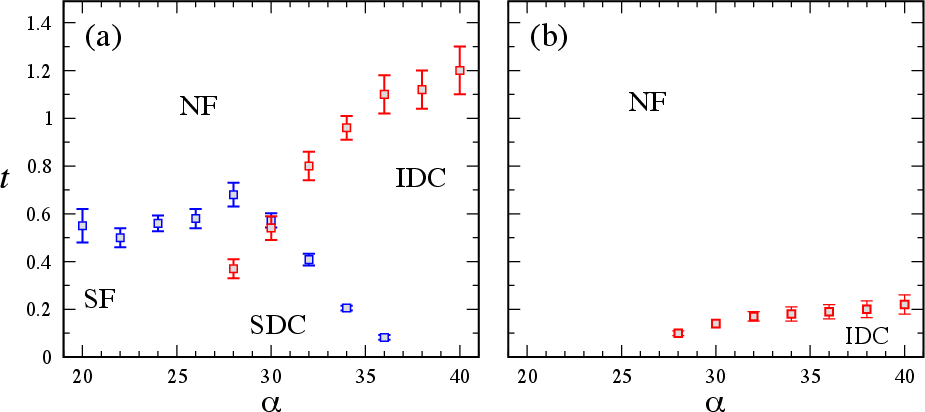
Figure 4: Phase diagrams for Bose (left) and boltzmannon (right) statistics in (α,t) space, demonstrating substantial broadening of the cluster crystal regime due to exchanges.
Discussion of Contradictory and Significant Claims
A pivotal outcome is that quantum exchanges stabilize crystalline order in soft-core Bose systems, directly inverting the effect observed in hard-core cases where exchanges expand the fluid regime. This stabilization is attributed to the free energy gain from local Bose-Einstein condensates within each cluster, as opposed to the delocalized permutation cycles responsible for fluid stability in hard-core systems. The entropic argument put forth is that, at low temperature, the normal fluid and the cluster crystal possess comparable entropy because exchanges dominate within droplets, making the lower energy cluster crystal thermodynamically preferred.
Numerical results unify fluid, supersolid, and insulating solid behaviors in a single parameter regime, with phase boundaries identified sharply through superfluid density and structure markers. The strong statistical agreement across densities and the direct comparison to the boltzmannon system render the exchange effect quantitatively robust.
Theoretical and Experimental Implications
These findings extend the theoretical framework for establishing phase boundaries in interacting Bose systems, firmly establishing that quantum statistics can either suppress or promote crystalline order, depending not on generic quantum parameters but on the precise character of the interparticle repulsion. For experimental ultracold atomic systems (notably Rydberg gases), the results provide guidance for tuning interaction parameters to access and probe cluster crystal and supersolid phases. The work delineates the conditions for observing novel quantum phases with entangled local condensates and highlights the necessity of explicitly accounting for exchange effects when predicting phase diagrams in soft-core systems.
From a broader perspective, these results urge reconsideration of longstanding assumptions about quantum melting and crystallization, particularly for designer potentials enabled by modern atomic physics. Extensions to higher dimensions, systems with long-range tails, and spinful particles pose open avenues for further exploration.
Conclusion
This study rigorously demonstrates that quantum mechanical exchanges in soft-core bosonic systems crucially impact the nature and stability of crystalline order, inverting the effect found in hard-core systems. The comprehensive quantum Monte Carlo analysis establishes that exchanges stabilize the cluster crystal, extending its thermodynamic domain compared to the case of distinguishable particles. These effects are robust for experimentally relevant potentials in ultracold atomic systems, redefining the phase diagram topologies accessible in bosonic matter with finite-range repulsion, and suggest new possibilities for engineering phases with desired quantum order parameters.