Published 19 Dec 2014 in math.CA and nlin.SI | (1412.6364v1)
Abstract: We study the zeros of exceptional Hermite polynomials associated with an even partition $\lambda$. We prove several conjectures regarding the asymptotic behavior of both the regular (real) and the exceptional (complex) zeros. The real zeros are distributed as the zeros of usual Hermite polynomials and, after contracting by a factor $\sqrt{2n}$, we prove that they follow the semi-circle law. The non-real zeros tend to the zeros of the generalized Hermite polynomial $H_{\lambda}$, provided that these zeros are simple. It was conjectured by Veselov that the zeros of generalized Hermite polynomials are always simple, except possibly for the zero at the origin, but this conjecture remains open.
The paper establishes that real zeros of exceptional Hermite polynomials follow the semi-circle law after appropriate scaling.
It demonstrates that complex zeros converge to those of a generalized Hermite polynomial under the assumption of simple zeros.
Numerical validations support the theoretical results, highlighting potential applications in mathematical physics and signal processing.
Zeros of Exceptional Hermite Polynomials
The paper "Zeros of exceptional Hermite polynomials" (1412.6364) explores the distribution of zeros of exceptional Hermite polynomials associated with even partitions. It addresses several conjectures concerning the asymptotic behavior of both regular (real) and exceptional (complex) zeros. The research findings affirm that the real zeros follow the semi-circle law after an appropriate scaling, while the non-real zeros converge to the zeros of the generalized Hermite polynomial Hλ, assuming these zeros are simple.
Exceptional Hermite Polynomials
Exceptional orthogonal polynomials arise from Sturm-Liouville problems with missing eigenpolynomial degrees, resulting in a finite number of gap indices in the degree sequence. The exceptional Hermite polynomials are constructed as Wronskian determinants of classical Hermite polynomials, adjusted according to an even partition λ. The associated orthogonality measure manifests through a modified weight function involving a product of Hermite polynomials and an exponential term. This modification influences the zeros of the polynomials, which are split into regular (real) and exceptional (complex) types.
Asymptotic Behavior of Real and Complex Zeros
The authors provide two main theorems characterizing the asymptotic distribution of zeros. The real zeros, on contraction by a factor of 2n, adhere to the semi-circle law, akin to classical Hermite zeros:
The exceptionality of these polynomials emerges in the behavior of the complex zeros. Notably, it is shown that these converge to the zeros of Hλ as the degree n increases, under the presumption of simplicity:
∣zj−zk,n∣≤nC
This convergence asserts that exceptional zeros are influenced predominantly by the partition structure, and their alignment can be leveraged for precise mathematical modeling in domains where orthogonal polynomial approaches are crucial.
Numerical and Analytical Validation
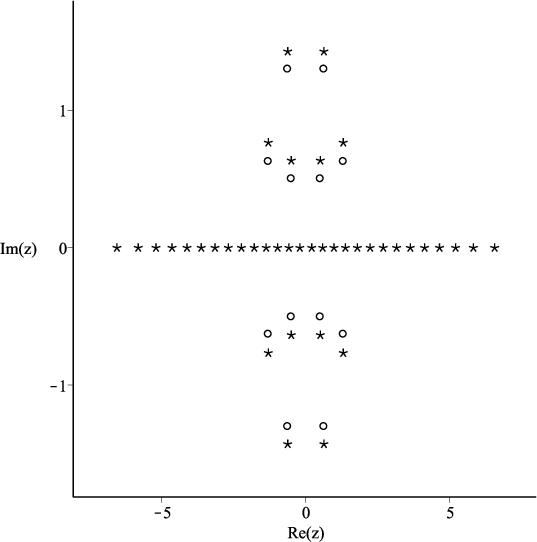
Figure 1: Plot of the zeros of Hλ with λ=(4,4,2,2) (open circles) together with the zeros of the corresponding exceptional Hermite polynomial of degree 40 (stars).
Numerical experiments corroborate the theoretical findings, as depicted in Figure 1. This figure visualizes how the non-real zeros of an exceptional Hermite polynomial P40 are attracted to those of the generalized Hermite polynomial Hλ, confirming the theoretical predictions for ∣λ∣=12 with real zeros distributed according to the semi-circle law mentioned earlier.
Implications and Future Directions
The results elucidate unique properties of exceptional Hermite polynomials, with possible applications in mathematical physics, particularly in quantum mechanics and signal processing, where eigenfunction distributions are relevant. Future work may extend these findings to other families of exceptional polynomials like Laguerre or Jacobi, further exploring the hypothesis of simplicity of zeros, and exploring geometric and dynamic systems analyses influenced by the algebraic structures illuminated in this study.
Conclusion
The paper bridges theoretical understanding and practical numerical verification, enhancing familiarity with the zeros' distribution of exceptional Hermite polynomials. The work not only confirms theoretical conjectures through rigorous analysis but also supports these findings with visual numerics, facilitating deeper exploration into the arithmetic and geometric theory of exceptional orthogonal polynomials.
“Emergent Mind helps me see which AI papers have caught fire online.”
Philip
Creator, AI Explained on YouTube
Sign up for free to explore the frontiers of research
Discover trending papers, chat with arXiv, and track the latest research shaping the future of science and technology.Discover trending papers, chat with arXiv, and more.