- The paper presents a novel approach by decoupling leader election and transaction serialization to improve blockchain scalability.
- It demonstrates through experiments that Bitcoin-NG reduces transaction latency to near network propagation time and achieves optimal mining power utilization.
- The protocol maintains robust security by mitigating attacks like selfish mining while using innovative fee distribution incentives.
Bitcoin-NG: A Scalable Blockchain Protocol
Introduction
The paper "Bitcoin-NG: A Scalable Blockchain Protocol" (1510.02037) presents an innovative approach to the scalability challenges inherent in Bitcoin-derived blockchain protocols. Bitcoin-NG is designed to enhance scalability while preserving Bitcoin's core security and trust assumptions. The protocol aims to address the trade-offs between throughput and latency that limit traditional blockchain protocols by introducing novel mechanisms for leader election and transaction serialization.
Core Contributions
Bitcoin-NG's contribution lies in its restructuring of the traditional blockchain protocol by dividing it into two distinct planes: leader election and transaction serialization. This bifurcation allows for continuous transaction processing, addressing latency limitations. The protocol designates epochs during which a single leader is responsible for serializing transactions. Leader election remains a secure, infrequent process, preserving Byzantine fault tolerance.
A distinctive feature of Bitcoin-NG is the decoupling of the block propagation and validation process. It introduces two types of blocks: key blocks, which are used for leader election, and microblocks, which encapsulate transaction data. This design allows for increased transaction throughput and reduced latency, as microblocks can be generated and disseminated more rapidly than traditional full blocks.
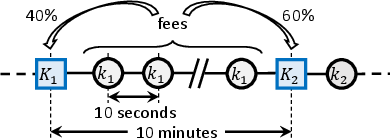
Figure 1: Structure of the Bitcoin-NG chain. Microblocks (circles) are signed with the private key matching the public key in the last key block (squares).
Experimental Evaluation
The paper details extensive experimental analyses executed on an emulated network, demonstrating Bitcoin-NG's performance under conditions that simulate 15% of the current Bitcoin network. These experiments highlight Bitcoin-NG's scalability advantages; it is bandwidth-limited by node capacity and latency-limited by network propagation time, rather than inherent protocol constraints. Key metrics such as consensus delay, fairness, and mining power utilization are employed to quantitatively evaluate the protocol's performance.
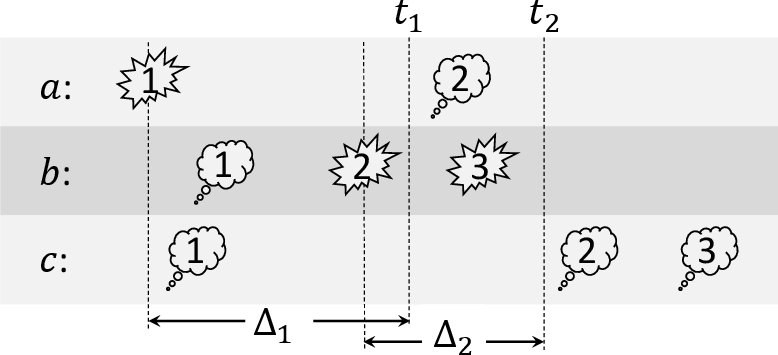
Figure 2: Point-consensus delay example illustrating the consensus delay between Bitcoin nodes.
Bitcoin-NG demonstrates optimal latency and throughput, outperforming traditional Bitcoin under similar conditions. The protocol achieves approximately $3.5$ transactions per second, with transaction inclusion latency reduced to near network propagation time. Scalability is further supported by optimal mining power utilization, achieved through strategic division of transaction fees between current and subsequent key block leaders.
Security Implications
A significant portion of the paper is dedicated to security analysis, ensuring that Bitcoin-NG maintains Bitcoin's essential security properties. The protocol is resistant to common blockchain vulnerabilities such as selfish mining and double-spending attacks. Importantly, microblocks do not contribute to the blockchain's weight, circumventing speculative branch extensions that could otherwise incentivize malicious behavior.

Figure 3: Key block fork illustrating the resolution of forks through subsequent key block generation.
Remuneration and incentive structures are carefully crafted to promote honest participation. The fee distribution model, wherein leaders receive 40% of transaction fees and subsequent leaders 60%, is designed to deter strategic delay of transaction inclusion.
Implications and Future Work
Bitcoin-NG represents a significant step forward in blockchain scalability, with potential implications extending far beyond the current scope of cryptocurrencies. Its ability to scale with network and node improvements positions it as a foundational protocol for future decentralized applications, including smart contracts and digital asset exchanges.
Looking ahead, Bitcoin-NG could integrate with other approaches such as inclusive blockchains or side chains to further enhance transaction efficiency and security. Future research may also explore real-world deployment challenges, particularly in accommodating rapid shifts in network conditions or participant behavior.
Conclusion
Bitcoin-NG addresses fundamental scalability issues facing existing blockchain technologies by decoupling leader election from transaction processing, allowing for significantly improved throughput and reduced latencies. While maintaining the security paradigms of the original Bitcoin protocol, Bitcoin-NG sets a robust foundation for advancing blockchain technology to support broader applications and larger scales. Its contribution lies not only in enhancing the practical performance of blockchain systems but also in providing a new framework for consensus protocol evaluation and innovation.