- The paper presents a deep, wide-field near-infrared survey of Orion A using VISTA, cataloging approximately 800,000 sources to enhance star formation statistics.
- The methodology employs a custom data reduction workflow with superior astrometric calibration and noise mitigation to improve photometric accuracy and image resolution.
- The results refine estimates of embedded and foreground stellar populations and identify new young objects, providing a robust basis for future IMF and star formation research.
Introduction and Survey Motivation
The "VISION - Vienna survey in Orion I. VISTA Orion A Survey" (1601.01687) presents the deepest and most spatially extensive near-infrared (NIR) survey of the Orion~A molecular cloud to date. Orion~A is the nearest site of high-mass star formation, and its complex structure, including the ONC and multiple embedded clusters, has made it a prime laboratory for star formation studies. Despite its central importance, existing datasets have lacked either sufficient depth, uniformity of sensitivity, or contiguous sky coverage—limitations this work seeks to overcome rigorously.
The VISION survey leverages the VISTA telescope's NIR capabilities and custom data reduction to deliver a ∼18.3 deg2 map in the J, H, and KS bands, yielding a catalog of ∼800,000 sources. This represents an order-of-magnitude increase over 2MASS in comparable area, pushing the completeness limits to 20.4, 19.9, and 19.0 mag in J, H, and KS respectively, with sub-arcsecond median image quality. The resulting legacy dataset offers an unprecedented empirical basis for statistical and individual analyses of embedded and foreground populations, extinction, and star formation efficiency.
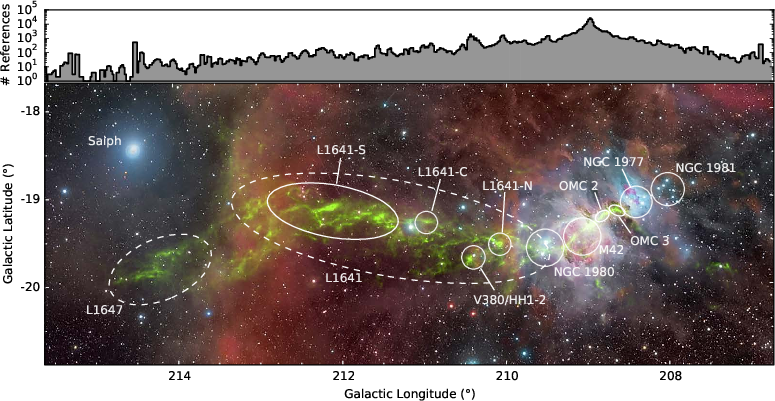
Figure 1: Composite of optical data overlayed with Planck-Herschel column density measurements, showing attention biases and key regions across Orion~A.
Observational Strategy and Data Processing Advances
VISION utilized VISTA/VIRCAM's array configuration to mosaic Orion~A with 11 tiles per band, optimizing spatial coverage and dynamic range by employing careful dithering and overlapping strategies. Notably, regions affected by strong nebular emission (e.g., the ONC) were subject to tailored observing sequences to preserve photometric fidelity. An additional control field at similar galactic latitude enabled robust foreground/background statistical analyses.
Critically, the survey eschews reliance on the standard CASU pipeline, instead implementing a bespoke reduction workflow designed to maximize image quality, photometric homogeneity, and artifact rejection. The pipeline's modifications include superior resampling kernels, per-tile gain harmonization relative to 2MASS, removal of bilinear interpolation-induced systematics, high-order astrometric registration (≲70 mas typical global errors), and advanced background modeling to handle the challenges posed by variable sky conditions and residual instrumental signatures. These choices yield a median FWHM improvement of ~20% over standard products and demonstrably cleaner noise properties.
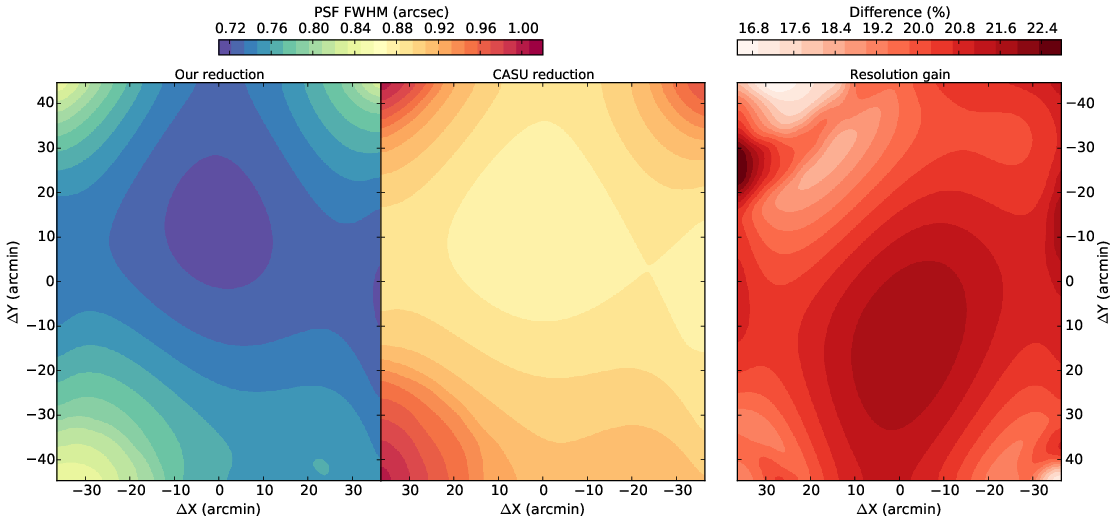
Figure 3: Comparison of FWHM/PSF size between VISION custom reduction and the standard CASU pipeline, demonstrating enhanced resolution in the VISION data.
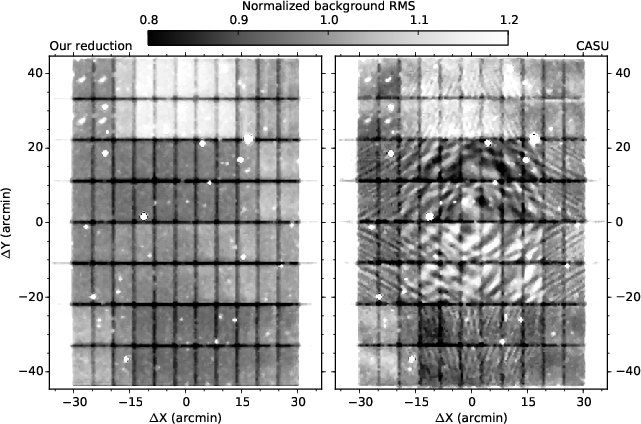
Figure 5: RMS noise map comparison highlighting the mitigation of spatially correlated noise in VISION relative to pipeline reductions.
Photometric Catalog Construction and Morphological Classification
Source detection was performed using SExtractor across the full combined mosaics, followed by rigorous artifact rejection procedures. The bright source regime utilized 2MASS photometry to avoid nonlinearity and saturation issues, ensuring photometric consistency across the entire dynamic range.
Morphological classification combined SExtractor neural net outputs with a curve-of-growth approach, cross-validated with SDSS source catalog entries where available. This robustly isolates extended (galaxy) from point-like (stellar/YSO) sources to beyond KS=18 mag, permitting clean delineation of the galactic and extragalactic populations even in regions of variable seeing.
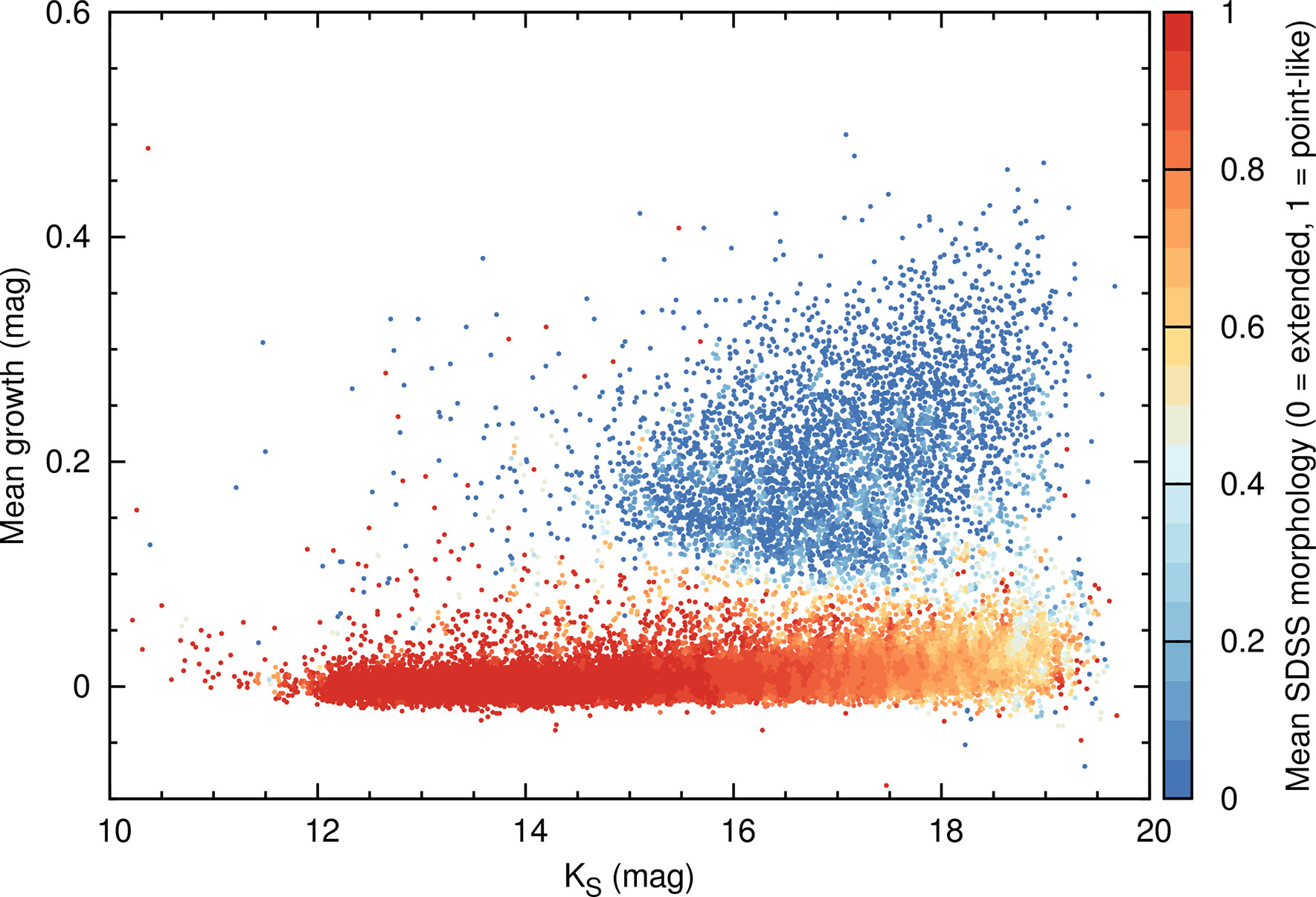
Figure 7: Demonstration of curve-of-growth-based separation between galaxies and point sources; color indicates mean SDSS morphological index.
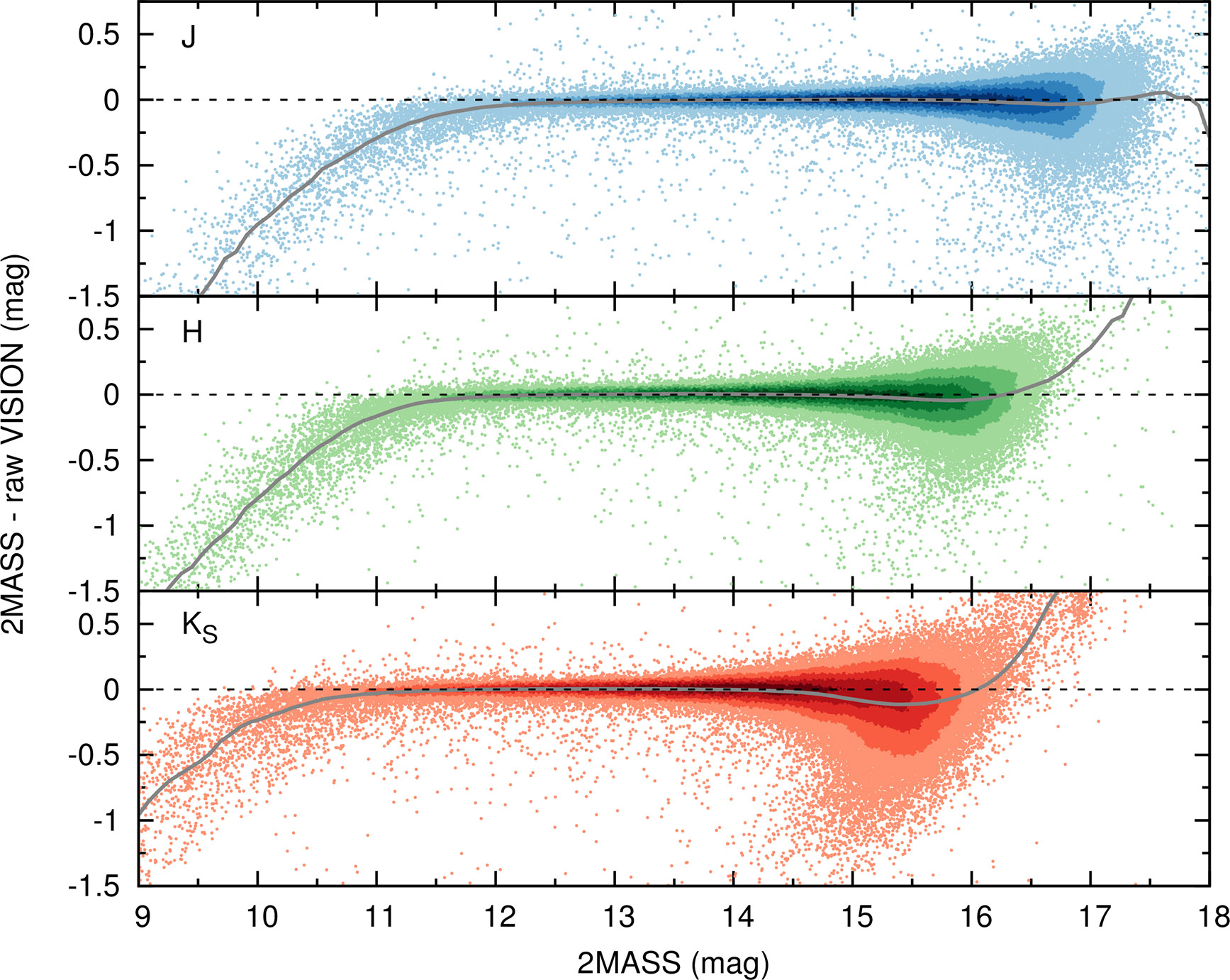
Figure 2: VISION versus 2MASS photometry, illustrating the replacement of VISION bright-end measures with uncontaminated 2MASS values to preserve accuracy.
The source catalog achieves essentially full completeness to at least KS∼19 over the field, and recovers essentially all Spitzer disk YSOs and most protostars identified in prior mid-IR work ([2012AJ....144..192M]). Notably, ∼30% of detected objects are classified as extended, attesting both to extragalactic background populations and to the survey's sensitivity.
Color-magnitude and color-color diagrams for the Orion~A and control field exhibit the anticipated main sequence, M dwarf branch, and well-defined galaxy locus. Heavy extinction pushes many Orion~A sources to redder colors, as expected for an embedded star forming region.
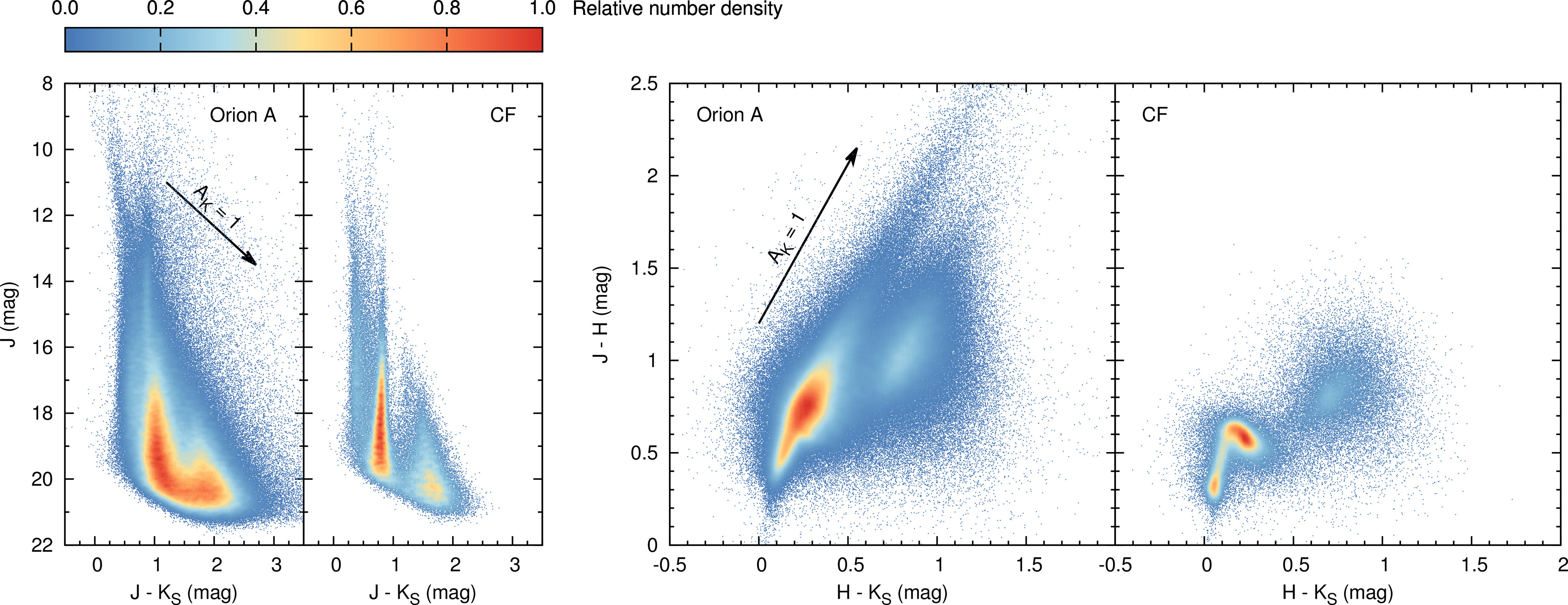
Figure 10: Color-magnitude and color-color diagrams for Orion~A and control field, showcasing heavy extinction and the distinct stellar and galaxy loci.
Survey completeness and coverage are highly variable locally due to observing conditions and nebular contamination near the ONC, but globally surpasses existing large-scale surveys (2MASS, UKIDSS) in both depth and photometric quality.
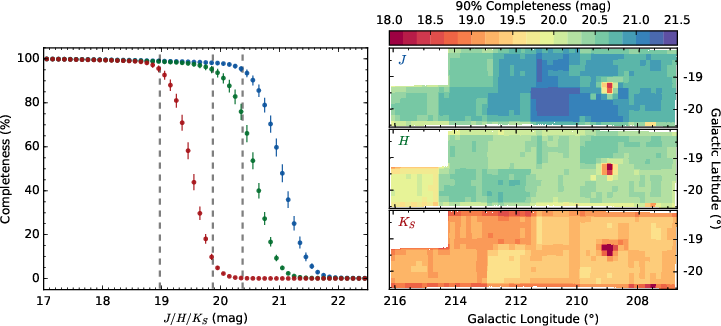
Figure 4: Survey completeness as a function of magnitude and spatial position in all three bands.
A principal application presented is a robust statistical deconstruction of the Orion~A young population and related foreground groups using the KS-band luminosity function (KLF), in combination with extinction corrections (NICER) and the Besançon Galactic model as a reference for the expected field star count.
By comparing the dereddened Orion~A KLF to both the scaled control field and Galactic model, an excess of ∼3000 sources to KS=13 mag is measured, which is ascribed to embedded and young foreground populations.
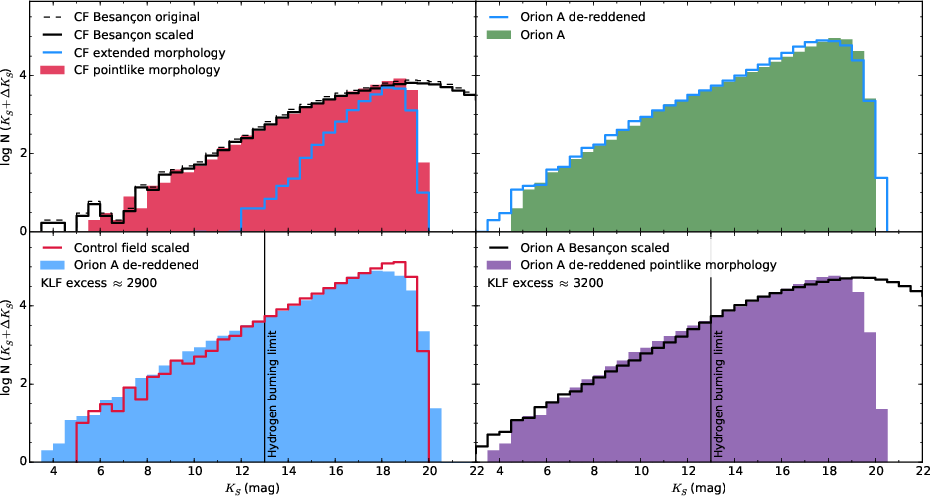
Figure 13: KLFs for Orion~A, control field, and Besançon model, illustrating the significant excess in Orion~A due to recent and ongoing star formation.
The analysis explicitly separates field foreground, young foreground (e.g., NGC 1980 and minor groups), and the embedded cloud population, by leveraging zero-extinction star densities in high-column regions—where the cloud itself blocks background contamination. The number of young foreground sources (not accounted for by Galactic field) is 700±100, while Orion~A's embedded YSO count is estimated at $2300-3000$, consistent with Spitzer-based counts and allowing for completeness and contamination correction. The results also confirm the presence of multiple, spatially distinct young foreground groups, with new candidate groups identified in the eastern regions.
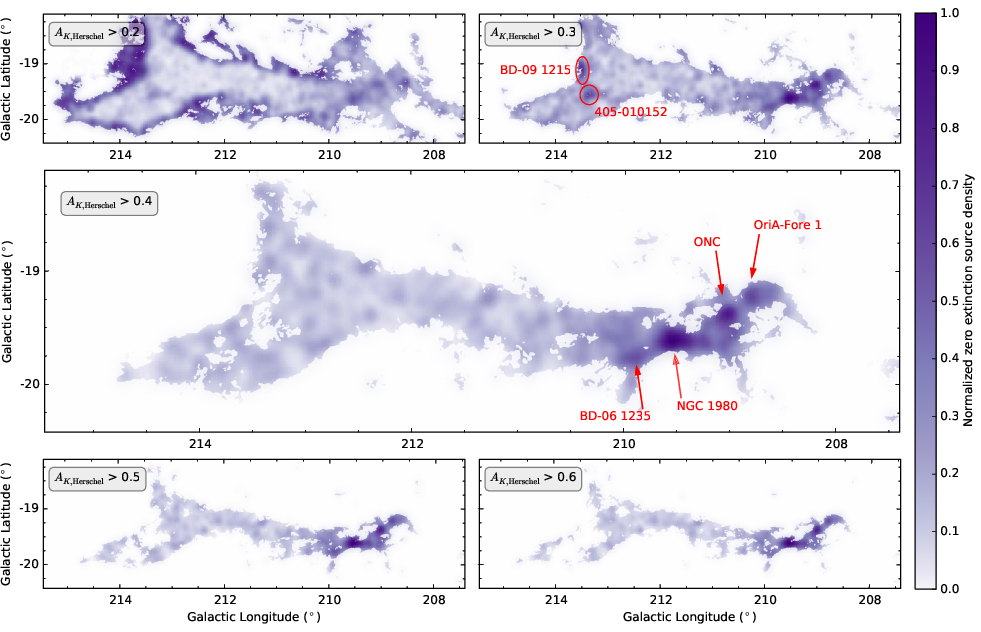
Figure 6: Foreground zero-extinction stellar density maps superposed on column density thresholds, highlighting clustering toward NGC 1980/ONC and new candidate foreground groups.
These population statistics allow refined constraints on the history and propagation of star formation across Orion~A, supporting scenarios where feedback from recent but slightly older foreground populations has triggered sequential or spatially varying star formation in the cloud's dense western regions.
Additional Value: High-Quality Imaging and Discovery of New Objects
Beyond statistical population studies, the survey enables identification and morphological study of individual YSOs and galaxies at unprecedented detail in Orion~A. Several new YSO candidates, as well as candidate galaxy clusters, are identified based on morphology and source density, supplementing existing catalogs and facilitating further spectroscopic follow-up.
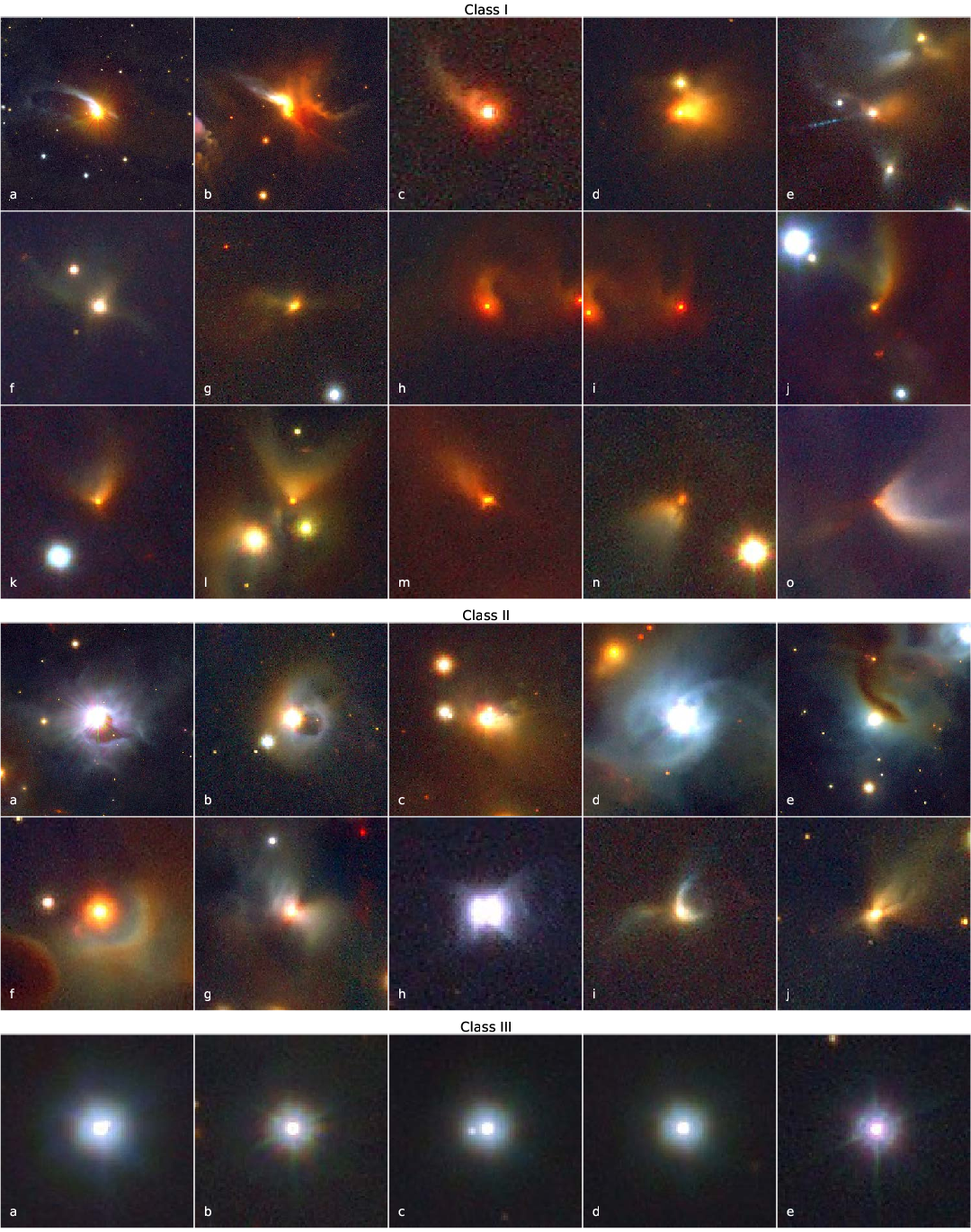
Figure 8: Postage stamp images of selected YSOs, classified by evolutionary class based on prior literature.
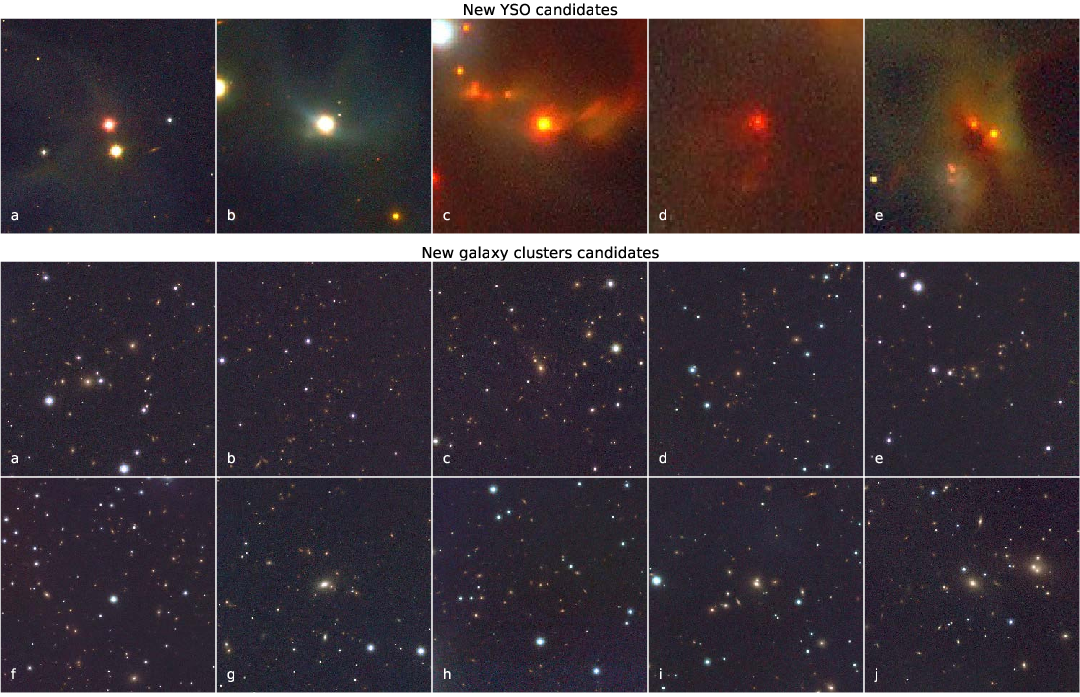
Figure 9: Newly identified YSO candidates and galaxy cluster candidates as revealed by VISION's spatial resolution and source density mapping.
The availability of a full-resolution, artifact-corrected, multi-band L-RGB image mosaic (in HEALPix format), together with robust catalog access, further underscores the utility of the dataset for both large-scale statistical analyses and detailed studies of individual objects.
Conclusion
The VISION VISTA Orion~A survey establishes a critical new benchmark for NIR studies of massive star formation. Its unique combination of resolution, depth, sky coverage, and catalog reliability enables precise population studies, unbiased YSO identification, and targeted follow-up over virtually the entire cloud. Population analyses verify previous findings regarding embedded and foreground populations, provide more accurate statistics, and reveal new substructures for further investigation. Practically, this dataset will inform IMF estimates, spatial distribution studies, foreground subtraction for other surveys, and future time-domain studies of variable young stars. The community-accessible catalog and images will be a foundational resource for ongoing theoretical and observational exploration of star formation processes.
Reference:
"VISION - Vienna survey in Orion I. VISTA Orion A Survey" (1601.01687).