- The paper demonstrates that user mobility has a more significant detrimental effect on channel aging than phase noise in massive MIMO systems.
- The authors employ an autoregressive LMMSE channel estimation model to evaluate SINR performance with MRT and RZF precoders in both single-cell and multi-cell setups.
- The study highlights that mitigating phase noise is crucial in low-mobility scenarios to enhance downlink rates and achieve power efficiency.
Introduction
The paper examines the impact of channel aging on the performance of massive MIMO systems, focusing on the degradation caused by user mobility and phase noise. It introduces a joint model that incorporates these phenomena to evaluate performance using MRT and RZF precoders. The study reveals how user movement and phase noise jointly influence channel aging, emphasizing that user mobility has a more significant detrimental effect on system performance compared to phase noise.
System Model
The model considers a single-cell setup where a base station (BS) equipped with M antennas communicates with K single-antenna users. The work extends the basic channel model by incorporating phase noise into the channel vector as a multiplicative factor. The phase noise, modeled by a Wiener process, affects both the transmitter and receiver, leading to a time-varying channel affected by mobility (Doppler shift) and hardware imperfections (phase noise).
Channel Estimation and Aging
The channel estimation uses an LMMSE approach, which assumes constant channel and phase noise during training. The paper presents an autoregressive model of channel aging, where the channel at time n is a combination of the initial channel and a noise term accounting for the channel's evolution. This approach highlights that phase noise accumulates over time and contributes to channel aging similarly to Doppler effects.
The performance evaluation focuses on the deterministic equivalents (DEs) of the SINRs for MRT and RZF precoding under the influence of both user mobility and phase noise. The analysis explores the asymptotic behavior as M,K→∞ with a fixed ratio K/M=β, demonstrating that these approximations match well with simulation results even for moderate system sizes.
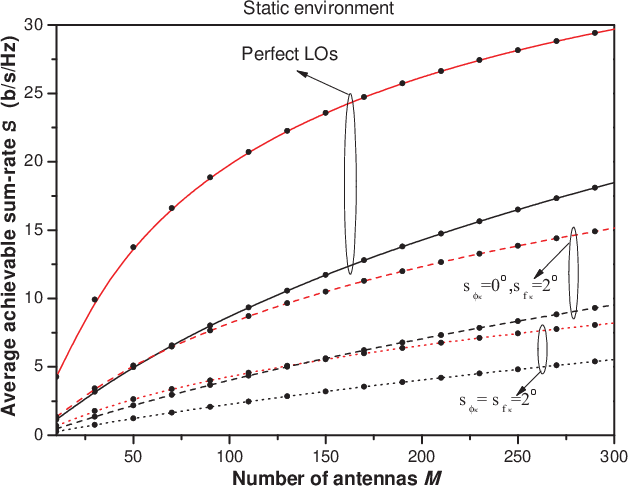
Figure 1: Simulated and DE downlink sum-rates with MRT and RZF precoders in a static environment versus the number of BS antennas for various values of phase noise. Red and black lines correspond to the theoretical sum-rates with RZF and MRT precoding, respectively, while the black bullets refer to the simulation results.
Numerical Results
The numerical results show that RZF generally outperforms MRT in terms of achievable rates and required transmit power. The detrimental impact of phase noise becomes negligible at higher Doppler shifts, emphasizing that Doppler-induced channel variation is the dominant factor in channel aging. This conclusion suggests that efforts to mitigate the phase noise are more critical in static or low-mobility environments.
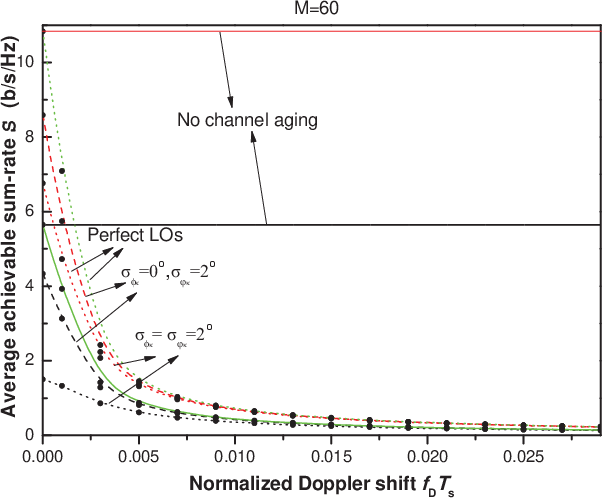
Figure 2: Required transmit power to achieve 1 bit/s/Hz per user with MRT and RZF precoders in a static environment versus the number of BS antennas and various values of phase noise. Red and black lines correspond to the theoretical sum-rates with RZF and MRT precoding, respectively, while the black bullets refer to the simulation results.
Multi-Cell Extension
The study extends to a multi-cell scenario, illustrating that channel aging impacts both intra- and inter-cell interference. The performance degradation due to channel aging in a cellular layout behaves similarly to that in a single-cell environment, with inter-cell interference further degrading performance due to pilot contamination.
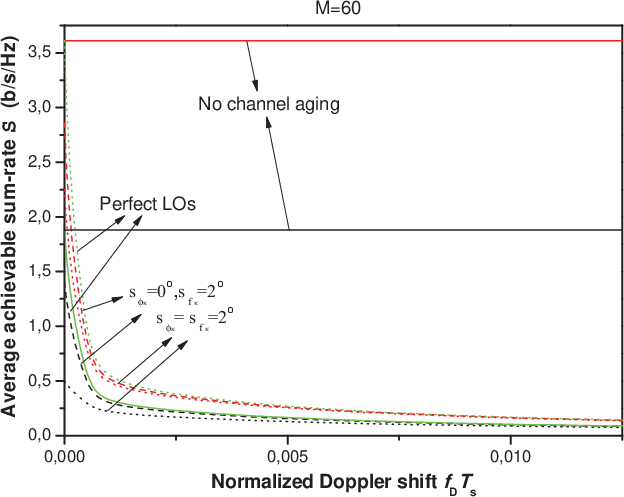
Figure 3: Simulated downlink sum-rates with MRT and RZF precoders in a cellular setting with L=7 when M=60 as a function of the normalized Doppler shift for various values of phase noise. Red and black lines correspond to the simulated sum-rates with RZF and MRT precoding, respectively. The green "solid" and "dot" lines mirror a scenario with channel aging but not phase noise in the cases of MRT and RZF, respectively. Lines parallel to the x-axis represent scenarios with no channel aging.
Conclusion
The study underscores the significance of considering both phase noise and Doppler effects in evaluating the performance of massive MIMO systems. It highlights the need for phase noise mitigation in low-mobility scenarios and suggests the potential for significant power savings by exploiting the scaling behavior of massive MIMO. The insights provided can guide the design and optimization of real-world systems, ensuring robust performance despite channel aging effects.