- The paper presents a new FFT-enabled pseudo-spectral approach for solving the Laplace-Beltrami equation and computing the Hodge decomposition on toroidal surfaces.
- It utilizes Fourier basis projection and stabilization techniques to achieve superalgebraic convergence and high spectral accuracy.
- The method demonstrates computational efficiency with O(N^2 log N) complexity and robust performance on stellarator-relevant geometries.
Pseudo-Spectral Methods for the Laplace-Beltrami Equation and Hodge Decomposition on Surfaces of Genus One
Introduction
This paper develops high-order pseudo-spectral methods to efficiently solve the Laplace-Beltrami equation and to compute the Hodge decomposition of tangential vector fields on smooth, closed surfaces of genus one embedded in R3. These computational tasks are essential in various domains, including plasma physics, fluid dynamics, computer graphics, and machine learning. The presented approach targets applications where accurate representation and manipulation of vector fields on such surfaces are critical, with a specific emphasis on the geometry of stellarator devices in plasma physics.
Mathematical Foundations
The formulation is centered on surfaces of genus one, parametrized as doubly periodic (toroidal) coordinate systems. Scalar and tangential vector fields on the surface are projected onto Fourier bases, facilitating high-order spectral discretization. The surface differential operators—gradient, divergence, curl, and Laplace-Beltrami—are precisely defined in terms of the surface metric tensor. These are discretized via the discrete Fourier transform, with the resulting algorithms exhibiting superalgebraic convergence for smooth functions and surfaces.
The Laplace-Beltrami operator, which is central to subsequent computations, is shown to be rank-one deficient on closed surfaces. This deficiency is managed through the computation of mean-zero functions and a stabilized linear system formulation. The discrete problem, once set up, is efficiently preconditioned using the inverse “flat torus” Laplacian, allowing the application of iterative solvers with FFT-based acceleration.
Harmonic Vector Fields and Nullspace Computation
The Hodge decomposition requires the identification of a basis for the space of harmonic vector fields—those that are both divergence-free and curl-free. On genus one surfaces, this space is two-dimensional. The computation involves solving a 2N2×2N2 system for the nullspace of the discretized divergence and curl operators. The randomization and augmentation strategy, employed to guarantee invertibility and extract elements from this nullspace, builds upon efficient iterative solvers preconditioned by their flat torus analogs.
Hodge Decomposition Algorithm
Given a vector field, the algorithm computes its orthogonal decomposition into a gradient (curl-free), a co-gradient (divergence-free), and a harmonic component. The scalar potentials for the former two are obtained by solving Laplace-Beltrami equations with right-hand sides constructed using surface divergence and curl operations. The coefficients of the harmonic component are calculated via a small linear system using inner products with the computed basis of harmonic fields.
The method achieves O(N2logN) complexity, benefiting from the FFT structure at every stage. The overall decomposition is thus both high-order accurate and computationally scalable for large grid sizes.
Numerical Results
The efficacy of the method is established through numerical experiments on a non-axisymmetric, genus one surface constructed via Garabedian coordinates to mimic stellarator geometry, as illustrated immediately below.
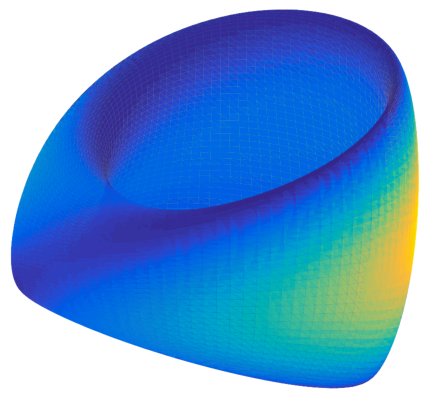
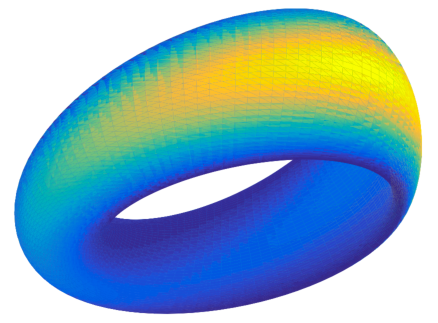
Figure 1: Two views of the genus one surface used in the numerical examples, representative of stellarator geometries.
The Laplace-Beltrami solver demonstrates rapid convergence: for increasing resolutions from N=47 to N=767, L2 errors drop from O(10−2) to O(10−13) with iteration counts remaining bounded, indicating robust preconditioning and spectral accuracy. Likewise, the computation of harmonic vector fields presents similar error profiles for both divergence and curl, attesting to the spectral fidelity of the nullspace extraction process.
The final vector field decomposition employs a field composed of superposed potential and rotational components, restricted to the toroidal surface. The algorithm delineates the Hodge components—curl-free, divergence-free, and harmonic—with sup-norm errors diminishing to machine precision with resolution, as shown in the table of errors and the component visualizations.
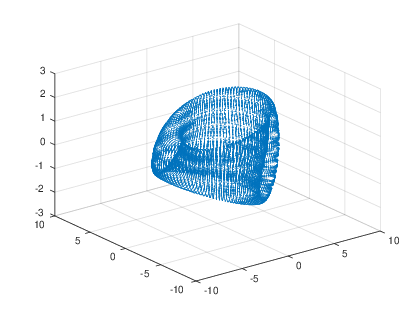
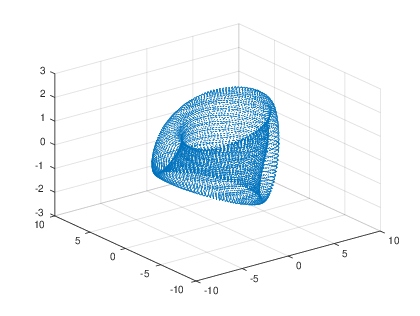
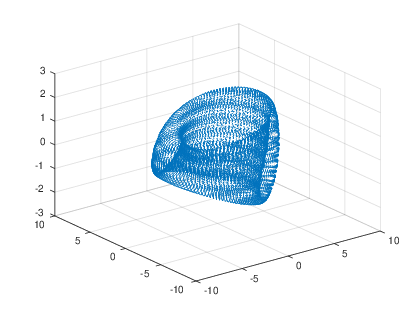
Figure 2: The various components of the Hodge decomposition—curl-free (top left), divergence-free (top right), and harmonic (bottom)—for a tangential vector field on the genus one surface.
Implications and Future Directions
Practically, these methods provide a computationally efficient and highly accurate toolkit for handling PDEs and vector calculus on toroidal geometries. In plasma physics, this is pivotal for surface field computations in stellarator equilibria and for further modeling tasks where surface-adapted representations are essential. Theoretically, the work demonstrates that spectral accuracy and favorable complexity can be retained for non-Euclidean geometries when global parametrizations and FFTs are harnessed.
Notably, while the methods are robust and optimal for genus one surfaces, their extension to more general geometries (higher genus or non-globally-parametrizable surfaces) is not addressed. Adaptivity and local refinement, important for handling localized phenomena and geometric singularities, are also not incorporated. Future developments are expected to focus on overcoming these restrictive assumptions, potentially by combining patchwise spectral techniques, nonuniform FFTs, or hybridization with finite element and integral equation methods, thereby extending high-order spectrally-accurate Hodge calculus to arbitrary surfaces.
Conclusion
A high-order, FFT-enabled pseudo-spectral scheme for solving the Laplace-Beltrami equation and Hodge decomposition on genus one surfaces is presented. The approach delivers superalgebraic accuracy and computational efficiency, with strong implicit error control and robust iterative performance. While presently limited by the requirement of global parametrization and genus one topology, the framework provides a foundational advance for surface PDE and vector field analysis in computational physics and geometric data processing, with clear avenues for future generalization and adaptivity.