- The paper introduces a model-free framework that derives sharp sub- and superreplication bounds for VIX futures using S&P 500 smile data.
- It establishes a dual optimization problem with no duality gap, revealing risk-neutral joint distributions for asset and VIX prices.
- It demonstrates that functionally generated portfolios can significantly improve the classical lower bound while maintaining tight upper bound estimates.
Model-Free Bounds for VIX Futures
This paper introduces a method for deriving sharp, model-free bounds for VIX futures prices using S&P 500 smiles. The approach involves formulating the sub/superreplication of the VIX via static positions in S&P 500 vanilla options and dynamic trading in the S&P 500 and forward-starting log contracts. The paper also presents a dual problem of minimizing/maximizing certain risk-neutral expectations and demonstrates that it yields the same value as the primal problem.
Replication and Arbitrage
The paper addresses the challenge of replicating the VIX, which, unlike its squared value, cannot be perfectly replicated. Model-free sub/superreplication using S&P 500 options leads to lower/upper bounds on the VIX futures price. The classical approach uses only log-contract prices, but the authors aim to incorporate full S&P 500 smile information at two maturities by including vanilla options and allowing dynamic trading in the S&P 500 and forward-starting log contracts. This leads to the formulation of a linear programming (LP) problem for sub/superreplication.
The paper defines two types of arbitrage: S-arbitrage, which involves trading only in the S&P 500 and its vanilla options, and (S,V)-arbitrage, which also includes trading in the forward-starting log contract at time T1. The authors demonstrate the equivalence of the absence of these two types of arbitrage, indicating that the possibility of trading the forward-starting log contract at T1 does not introduce additional restrictions in the model-free setting. This equivalence leads to the existence of risk-neutral joint distributions for (ST1,ST2,VIXT1), which then constitute the domain of an optimization problem dual to sub/superreplication.
Duality Theorem and Risk-Neutral Measures
The paper introduces a dual problem involving the minimization/maximization of risk-neutral expectations. This problem is related to martingale optimal transport but falls outside the standard framework because the third marginal distribution of the VIX is not prescribed. A key contribution is the proof of a duality theorem that establishes the absence of a duality gap between the primal and dual problems. This theorem holds for a general option payoff f(ST1,ST2,VIXT1), not just the VIX itself. The dual problem is formulated as:
Dsuper≡μ∈MV(μ1,μ2)supEμ[V],Dsub≡μ∈MV(μ1,μ2)infEμ[V],
where MV(μ1,μ2) represents a set of probability measures on the extended space (+∗)2×R+, and V is the VIX at time T1.
The paper characterizes the market smiles for which the classical bounds for the VIX future are optimal. The lower bound is optimal if and only if μ1=μ2, which is rarely the case in practice. The characterization for the upper bound is more complex, involving a convex-order condition or, equivalently, the presence of a model with constant forward volatility within the dual domain.
Functionally Generated Portfolios
To address the numerical challenges of finding hedging portfolios, the paper introduces a family of functionally generated portfolios. These portfolios are determined by a one-dimensional convex/concave function and a constant, providing a balance between flexibility and tractability. It is shown that the lower price bound obtained by these portfolios improves upon the classical one as soon as μ1=μ2, and the generating function can be explicitly chosen in an inverse "hockey stick" form.
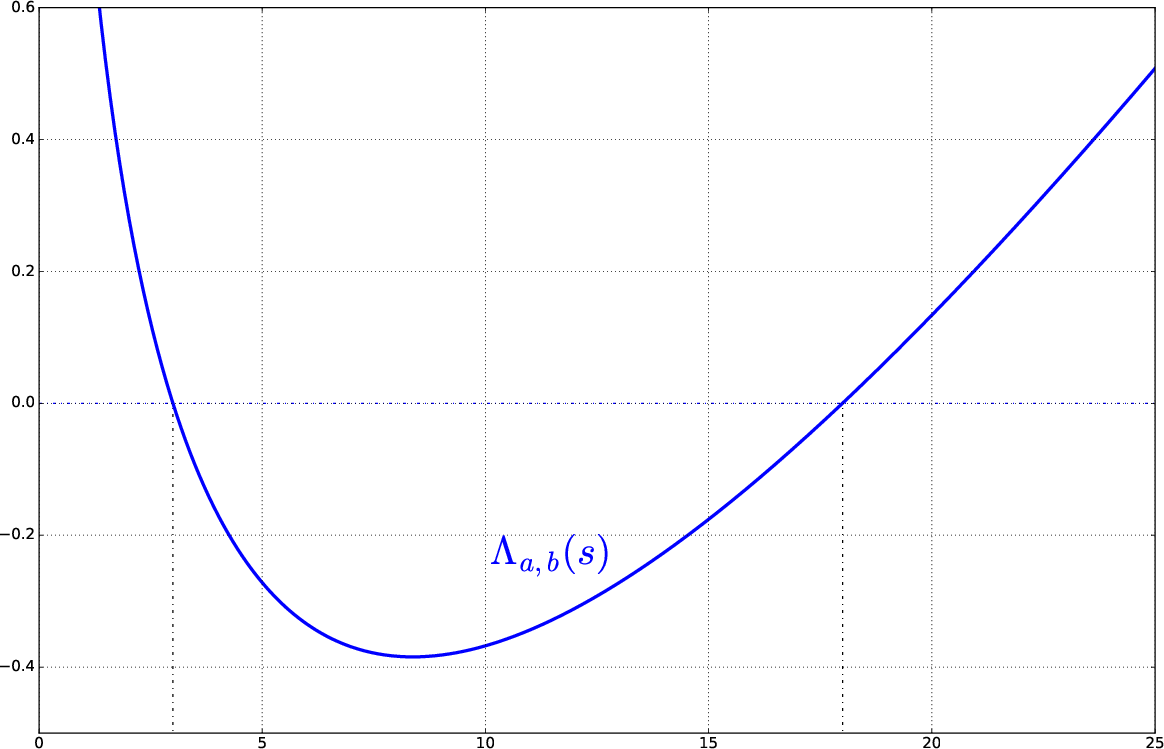
Figure 1: Graph of Λa,b for a>0, demonstrating its bounded nature from below on R+∗ when a>0.
Bernoulli Distribution and Compact Support
The paper studies specific families of smiles and corresponding portfolios. In the case where μ2 is a Bernoulli distribution, the market becomes "complete," allowing for VIX future replication. Sufficient conditions are presented for the classical upper bound to be suboptimal when μ2 is a general distribution with compact support. Examples are also discussed where the classical upper bound is already sharp.
Numerical Experiments and Results
Numerical experiments using smiles from market data and SABR model-generated smiles are presented. The classical bounds are compared against bounds obtained from functionally generated portfolios and those computed by an LP solver. The results show that the classical lower bound can be significantly improved by functionally generated portfolios, with the LP solver offering only marginal improvement. The classical upper bound, however, is shown to be surprisingly sharp for typical smiles. The use of piecewise linear maps and a cut square root as generating functions is explored, with the latter providing the best approximation in experiments. The results of the numerical experiments are summarized in the table below.
\begin{table}[]
\caption{Numerical results}
\begin{tabular}{|c|c|c|c|}
\multicolumn{2}{|c|}{} & \begin{tabular}[c]{@{}c@{}SABR model, \ T1=2 months\end{tabular} & \begin{tabular}[c]{@{}c@{}Market smiles as of \ May 5, 2016; T1=10 days \end{tabular} \ \hline
\multirow{ 5}{*}{Lower bound} & Classical lower bound & 0\% & 0\% \
\cline{2-4}
& Piecewise linear profiles (N=1 kink) & 4.6\% & 4.4\% \
\cline{2-4}
& Piecewise linear profiles (N=10 kinks) & 5.2\% & 7.2\% \
\cline{2-4}
& Cut square root & 6.0\% & 7.8\% \
\cline{2-4}
& Lower bound from LP solver & 7.2\% & 8.4\% \ \hline \hline
\multicolumn{2}{|c|}{Classical upper bound} & 22.8\% & 16.7\% \ \hline \hline
\multicolumn{2}{|c|}{Upper bound from LP solver} & 22.8\% & 16.7\% \ \hline
\end{tabular}
\label{tab:numerical_results}
\end{table}
Conclusion
The paper provides a comprehensive framework for determining model-free bounds for VIX futures, utilizing S&P 500 smiles. The theoretical results, supported by numerical experiments, demonstrate the potential for significant improvements over classical bounds, particularly for the lower bound. The introduction of functionally generated portfolios offers a practical approach to hedging VIX futures, balancing tractability with accuracy. The sharp bounds and hedging strategies developed contribute to a better understanding and management of volatility risk in financial markets.