- The paper demonstrates that a low-lying orbital excitation (~15 meV above the ground state) is crucial for the temperature-dependent IR spectral split in Cs3C60.
- It employs DFT and symmetry-restoration techniques to accurately model adiabatic states and compute the IR spectra of the molecular Mott system.
- The study highlights the significant role of dynamic Jahn-Teller coupling and electron-phonon entanglement in shaping the correlated physics of fulleride insulators.
Nanoscale Orbital Excitations and the Infrared Spectrum of A15-Cs3C60
Introduction and Physical Context
The study addresses the manifold orbital, spin, and vibrational degrees of freedom in the Mott insulating state of the high-symmetry molecular crystal A15-Cs3C60. While Mott physics in transition metal oxides has established the relevance of orbital excitations, the situation in molecular Mott insulators (MMIs), where site symmetry is typically higher and the intra-site interactions are substantially reduced, remains underexplored. The interplay between electron correlations, Jahn-Teller (JT) coupling, and site symmetry is specifically acute in fulleride MMIs, where the effective atomic character emerges due to the Mott localization at the molecular scale.
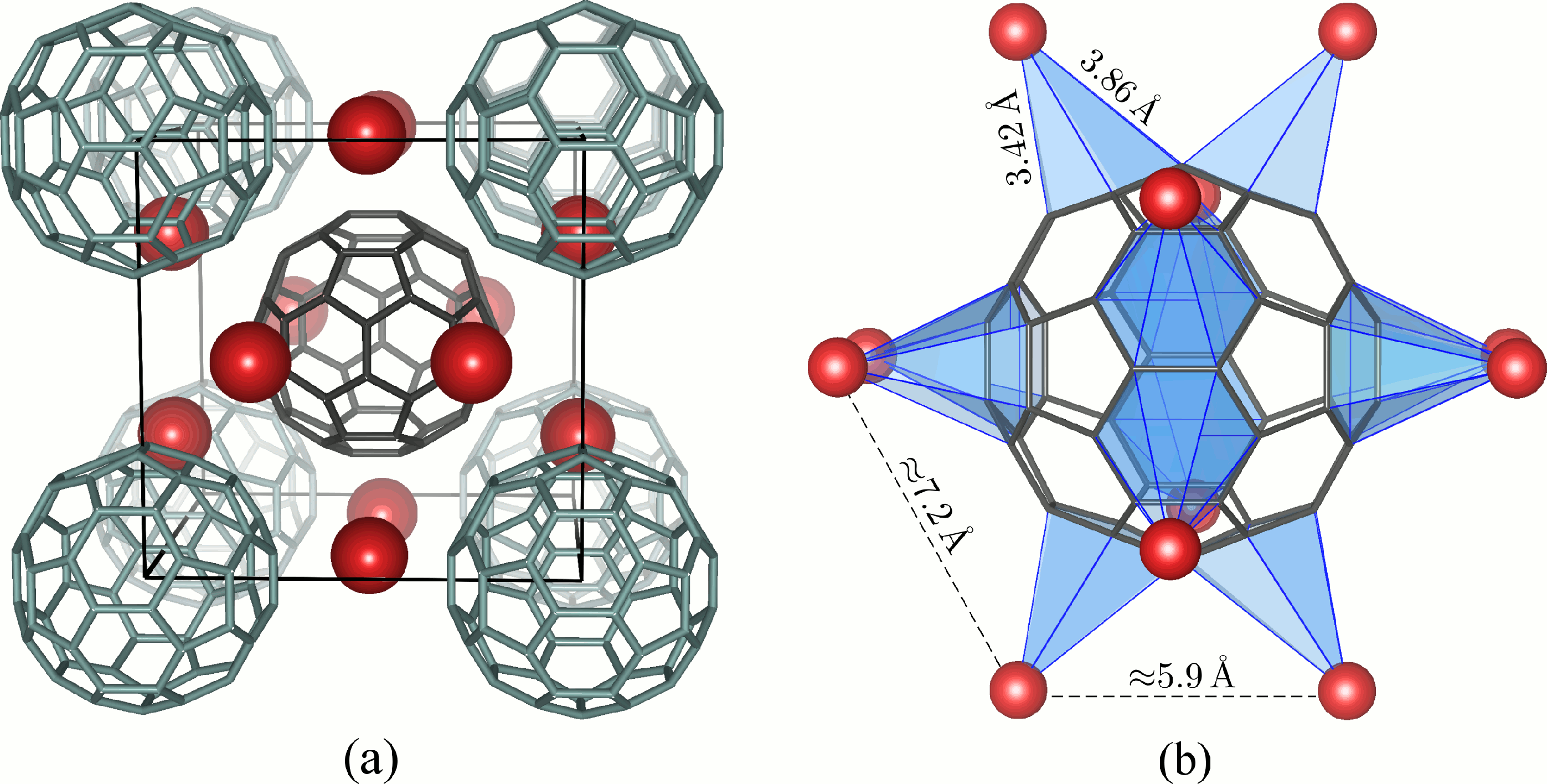
Figure 1: (a) Crystal structure of A15--Cs3C60 highlighting the cubic molecular lattice. (b) Assumed C603− ion geometry with the effective crystal field mimicked by 12 Cs positions.
A15-Cs3C60, which is superconducting under moderate pressure with Tc∼38 K, exhibits an antiferromagnetic Mott state at ambient pressure. The notable features in its low-temperature IR spectrum—mode splittings and emergent peaks—have previously been tentatively attributed to static Jahn-Teller distortions. The lack of corresponding static structural symmetry breaking, along with the rapid disappearance of these IR features upon modest heating, has motivated a fully quantum theoretical framework.
Electronic Structure, Adiabatic States, and Multiplet Inversion
The low-energy sector of C603− in a cubic crystal field consists of three electrons occupying three t1u orbitals, with possible spin and orbital configurations corresponding to high-spin (4A, S=3/2, L=0) and low-spin (2H, S=1/2, L=2; 2T, S=1/2, L=1) multiplets. Static Hund’s rules would assign the quartet 4A as the ground state, with energetic separations ∝JH, but in fullerides the reduced JH (∼50 meV) is comparable to vibrational energies, promoting strong vibronic entanglement and dynamical JT effects.
Static DFT calculations on the adiabatic potential surface identify three minima (α, β, γ). α is undistorted and corresponds to the highest-spin configuration, β shows a tiny D5d distortion and intermediate spin, and γ is heavily JT-distorted (D2h symmetry, S=1/2). The static calculations yield an energy ordering with the distorted low-spin state (γ) lowest, indicating the dominance of electron-phonon entanglement over the static intra-molecular Hund’s exchange.
Infrared Spectroscopy: Adiabatic and Symmetry-Protected Regimes
Computation of the IR spectra for the three adiabatic states reveals the impact of nuclear distortions. In neutral C60, four IR-active T1u modes are observed. For the C603− ion, ionization induces a red shift and amplitude suppression of these modes. In the heavily distorted γ state, additional peaks and mode splittings appear due to symmetry lowering; forbidden modes such as Hu and T2u acquire IR activity.
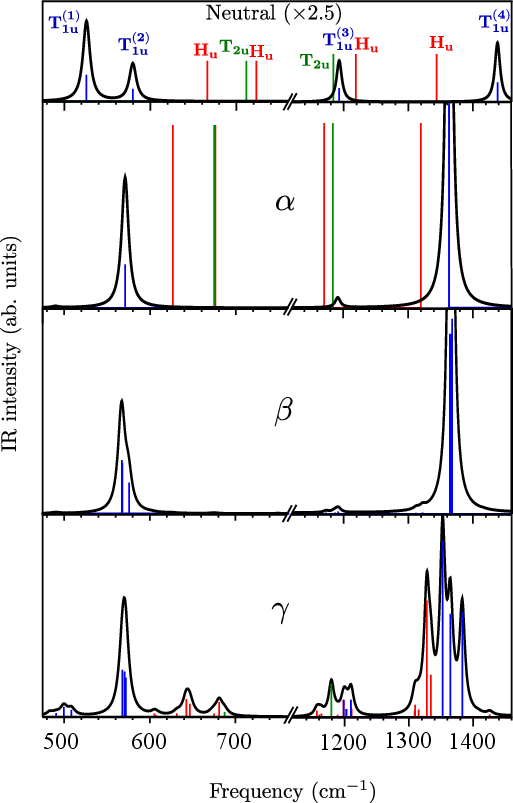
Figure 2: (a)-(d) Calculated IR spectra of neutral C60 versus adiabatic DFT-optimized α, β, and γ states of C603−, illustrating mode splittings and activation of otherwise silent modes under distortion.
To rigorously describe the Mott state, restoration of full spin and spatial symmetry to the quantum state is essential. This is achieved by constructing proper linear combinations of adiabatic states, yielding the physical 2T, 2H, and 4A multiplet states which are symmetry-respecting vibrations coupled to appropriate electronic states. Energies are obtained by inverting the relations between adiabatic and symmetry-projected states, yielding E2T as the ground state, E2H as a low-lying excited doublet (∼15 meV above), and E4A as the highest.
A strong and nontrivial result is that the true symmetry-respecting ground state is 2T (spin-1/2, L=1), with a pure orbital excitation 2H (spin-1/2, L=2) lying only ∼15 meV higher. Notably, this low-energy scale is a direct consequence of the nanoscale site and the weakened Hund’s exchange—a marked reduction from the atomic d-shell analogs, where orbital excitations are typically a factor of 10–100 higher in energy. The calculated moment of the ground state (1.73 μB) is consistent with experiment.
Temperature Dependence of the Infrared Spectrum and Orbital Excitations
The IR spectrum at low temperature is dictated by the 2T ground state, displaying prominent nuclear distortion-induced splittings and new IR-active modes matching experimental data. Upon increasing temperature, thermal population of the tenfold degenerate 2H orbital excited state grows significant, leading to a suppression of these distortion-induced features even as local dynamic Jahn-Teller distortions persist. This effect is not attributable to thermally averaged classical distortions, but is a non-classical consequence of the mixed orbital-nuclear character of the relevant states.
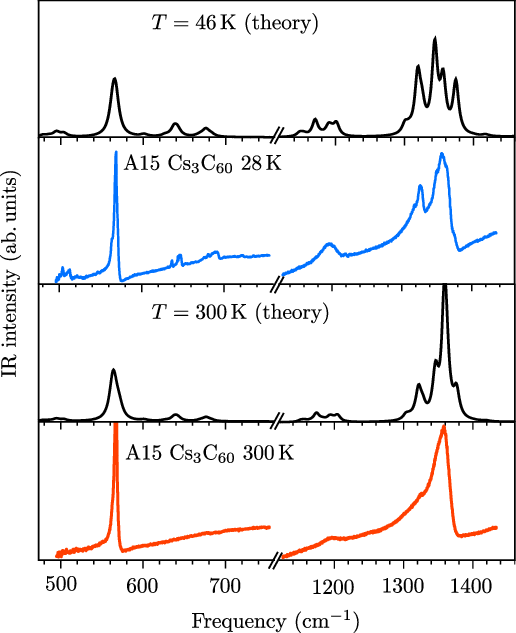
Figure 3: Comparison of calculated temperature-dependent IR spectra with experiment for Mott insulating Cs3C60, highlighting the thermal attenuation of distortion-derived peaks and splittings due to low-lying orbital excitation population.
A central claim of the paper is that the demise of IR splittings and extra peaks with increasing temperature directly evidences the existence of a low-lying orbital excitation. Were it not for this state, the dynamical distortions of the ground state would persist up to much higher temperatures, and the IR spectral features would remain robust. The unique thermal sensitivity of the experimental IR features is thus "smoking gun" evidence for the predicted orbital excitation.
Theoretical and Practical Implications, Outlook
This work establishes the necessity of treating both electronic and nuclear degrees of freedom fully quantum mechanically in molecular MMIs. It reveals that the emergence of orbitally excited multiplets, entangled with vibrational dynamics and lying at anomalously low energies, is intrinsic to nanoscale Mott systems with high symmetry.
On the theoretical front, the results indicate that DMFT-based treatments and model Hamiltonian approaches must incorporate not only static, but also dynamical symmetry and full joint electron-ion quantum states to accurately describe MMIs. The existence and entanglement of low-lying orbital excitations with nuclear motion could influence other spectroscopies beyond IR, such as EPR or Raman, and impact coupled magnetic and orbital ordering phenomena, especially below the N\'eel temperature where Kugel-Khomskii interactions become relevant.
Practically, these signatures provide fingerprints for identifying and differentiating between static and dynamic JT scenarios in other fulleride and molecular Mott systems. The methodology can guide both theoretical predictions and experimental interpretations of the spectroscopic response in correlated molecular materials.
Conclusion
The paper presents a comprehensive microscopically-grounded framework for the spectroscopy of the A15-Cs3C60 molecular Mott insulator (1609.08774). By unambiguously linking IR spectral features and their temperature dependence to nanoscale orbital excitations—entangled with nuclear dynamics and lying at energy scales atypically low compared to atomic Mott insulators—the work provides a rigorous foundation for interpreting correlated physics in MMIs. The implications extend to other spectroscopies and materials, inviting future exploration of dynamic orbital phenomena in correlated molecular solids.