- The paper introduces a novel diagrammatic proof for the Haagerup-Larsen theorem, extending its implications to eigenvector correlation functions.
- It uses planar diagrammatic techniques and cumulant generating functions to map R-diagonal operators within biunitarily invariant ensembles.
- The work simplifies the analysis of random matrix products, demonstrating practical benefits in resolving complex resolvent structures.
Complete Diagrammatics of the Single Ring Theorem
Introduction
The paper "Complete diagrammatics of the single ring theorem" (1704.07719) addresses the complex resolve of biunitarily invariant ensemble expansion, employing diagrammatic techniques to establish functional relations between cumulant generating functions in the limit of large matrices. This work provides significant insights into the interconnection of Hermitian positive definite operators and non-normal R-diagonal operators, offering a novel diagrammatic proof for the Haagerup-Larsen theorem. The paper starts with a historical note on the evolution of random matrix theory, identifying the Ginibre ensemble's role in diversifying matrix model spectra from Hermitian to complex.
Diagrammatic Techniques and R-Diagonal Operators
The authors use planar diagrammatic techniques to map the R-diagonal operators, conceptualized by Nica and Speicher within Voiculescu's free random variables framework, to an analytical domain using cumulant generating functions. The reformulation of Free Probability into combinatorial non-crossing partitions represents a milestone in understanding these operators' structure. The Ginibre ensemble serves as a case for biunitarily invariant matrices, crucial in chaotic quantum systems and telecommunication models due to their isotropic and azimuthally symmetric properties.

Figure 1: Several exemplary planar diagrams which appear in the expansion of the complex resolvent for the potential V(H)=g2H2+g4H4.
Haagerup-Larsen Theorem and Eigenvector Correlations
A pivotal contribution of this study is the diagrammatic derivation of the Haagerup-Larsen theorem, originally obtained through analytic free probability methods. The theorem posits that for biunitarily invariant ensembles, the spectral density of non-normal matrices is constrained to annular forms, or 'rings', illustrating an enhanced symmetry through singular value decomposition. The authors extend this theorem to encompass eigenvector correlation functions, thus addressing an aspect overlooked in previous mathematical proofs.
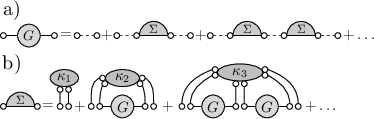
Figure 2: a) Relation between the Green's function and the sum over all 1LI diagrams. b) Self energy represented by the cumulants and the Green's function.
Applications to Random Matrix Products
The methodologies are applied to exemplify simplifications in calculating quaternionic R-transforms and an effective reduction of non-Hermitian diagrammatics to R-diagonal operators. This is illustrated by calculating R-transforms for unitary matrix ensembles and demonstrating the product law for free non-Hermitian Poisson matrices. The developments are grounded in the algebraic structuring of matrices in large N limits, highlighting the clear operational advantages afforded by the quaternionic R-transform in simplifying free non-Hermitian products.

Figure 3: General structure of 1PI diagrams in the resolvent expansion of XX†.
Conclusion
The paper establishes a pivotal framework for advancing the understanding of spectral and eigenvector properties in random matrix theory through explicit diagrammatic models. This work not only reinforces the Haagerup-Larsen theorem's foundational aspects but also extends its applicability to new domains of operator algebra. Such an approach promises further integration within both theoretical and applied settings, with particular relevance in areas requiring robust analysis of non-normal matrices, such as quantum physics and signal processing.