- The paper introduces a unique NMF method using archetypal analysis that relaxes separability constraints to achieve robust and distinctive data decompositions.
- It employs a blend of empirical risk minimization and data-dependent regularization to accurately reconstruct archetypes from noisy mixture data.
- Three descent algorithms, including PALM and stochastic gradient descent, are demonstrated to outperform traditional methods in both convergence and noise robustness.
Non-negative Matrix Factorization via Archetypal Analysis
The paper "Non-negative Matrix Factorization via Archetypal Analysis" explores an efficient approach to matrix factorization that relaxes traditional separability constraints to achieve unique decompositions even with non-separable data. The authors propose a method that blends empirical risk minimization with data-dependent regularization to reconstruct archetypes from mixture data points. This essay explores the methodology, robustness, algorithm design, and empirical evaluation presented in the paper.
Methodology
The central idea of the paper is to express data points as convex combinations of a smaller set of archetypes, which are unique under the conditions proposed by the authors. This is accomplished by minimizing the empirical risk, interpreted as the data point's distance from the convex hull of the archetypes, and the regularization term, interpreted as the archetypes' distance from the convex hull of the data points. Archetypal Analysis works by optimizing a balance between these objectives. By assigning infinite weight to regularization, the archetypal analysis method aligns with that proposed by Cutler and Breiman.
Robustness
The paper introduces a 'uniqueness condition' critical for recovering archetypes accurately from noiseless data and provides robustness guarantees under specific geometric conditions. This forms a significant portion of the theoretical framework. The authors demonstrate that their method is robust against noise, provided certain regularity conditions are met regarding the geometry of the archetypes. Strong numerical results show that the estimated archetypes’ distance from true values grows proportionally to the noise level, controlled via the uniqueness condition.
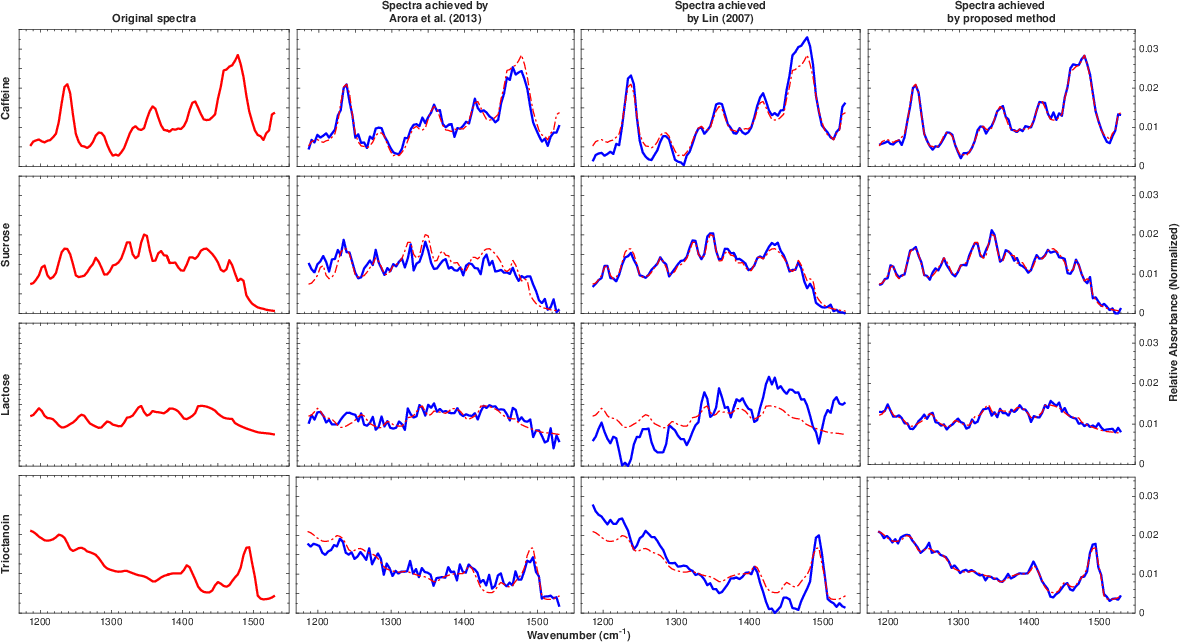
Figure 1: Reconstructing infrared spectra of four molecules, from noisy random convex combinations. Noise level σ=10−3.
Algorithms
The paper proposes a non-convex optimization problem to compute archetypes. Three descent algorithms are introduced, including a proximal alternating linearized minimization (PALM) algorithm that is guaranteed to converge to critical points of the risk function. Another approach described is based on stochastic gradient descent, leveraging efficient subsampling for scalability. At initialization, methods like spectral initialization, relying on singular value decomposition, are discussed for providing good starting points.
Implementation
Empirical results indicate that the proposed method performs well, even with non-separable data and noise. It outperforms existing techniques that assume separability or non-negativity, demonstrating better reconstruction accuracy under varied conditions. The paper details complexities regarding initialization and convergence, with potential avenues for further optimization and scalability.
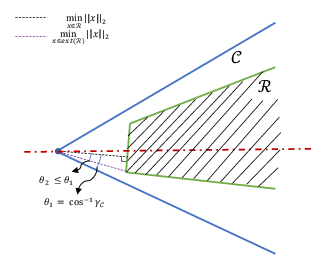
Figure 2: Picture of Lemma \ref{lemma:cone}, illustrating data geometry and algorithm application.
Conclusion
This paper presents a non-negative matrix factorization method via archetypal analysis, which accommodates broader application scenarios by relaxing traditional constraints. The theoretical foundation, complemented by robust algorithms and empirical validation, confirms its utility for diverse applications like chemometrics, image processing, and topic modeling. Future work could explore computational efficiency and parameter estimation to improve real-world model deployment. The method's capacity to handle non-separable data without sacrificing uniqueness or accuracy holds promise for extending matrix factorization applications across multiple domains.