Papers
Topics
Authors
Recent
Search
2000 character limit reached

Detecting Recycled Commodity SoCs: Exploiting Aging-Induced SRAM PUF Unreliability

Published 21 May 2017 in cs.CR | (1705.07375v1)

Abstract: A physical unclonable function (PUF), analogous to a human fingerprint, has gained an enormous amount of attention from both academia and industry. SRAM PUF is among one of the popular silicon PUF constructions that exploits random initial power-up states from SRAM cells to extract hardware intrinsic secrets for identification and key generation applications. The advantage of SRAM PUFs is that they are widely embedded into commodity devices, thus such a PUF is obtained without a custom design and virtually free of implementation costs. A phenomenon known as `aging' alters the consistent reproducibility---reliability---of responses that can be extracted from a readout of a set of SRAM PUF cells. Similar to how a PUF exploits undesirable manufacturing randomness for generating a hardware intrinsic fingerprint, SRAM PUF unreliability induced by aging can be exploited to detect recycled commodity devices requiring no additional cost to the device. In this context, the SRAM PUF itself acts as an aging sensor by exploiting responses sensitive to aging. We use SRAMs available in pervasively deployed commercial off-the-shelf micro-controllers for experimental validations, which complements recent work demonstrated in FPGA platforms, and we present a simplified detection methodology along experimental results. We show that less than 1,000 SRAM responses are adequate to guarantee that both false acceptance rate and false rejection rate are no more than 0.001.
Citations (2)

Summary

  • The paper introduces a novel method using aging-induced SRAM PUF unreliability to detect recycled SoCs with error rates below 0.001.
  • It details an ASR selection phase using temperature variations and statistical evaluation of interA- and intraA-distances.
  • Experimental results on commercial microcontrollers confirm that fewer than 1,000 ASR bits suffice for accurate recycled device detection.

Detecting Recycled Commodity SoCs: Exploiting Aging-Induced SRAM PUF Unreliability

Introduction

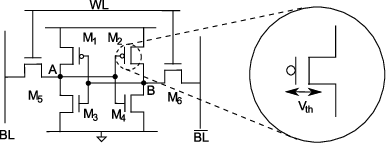
This paper investigates the use of aging-induced unreliability in SRAM-based Physical Unclonable Functions (PUFs) to detect recycled System-on-Chip (SoC) components. SRAM PUFs exploit the variations in initial power-up states of SRAM cells to generate unique identifiers for electronic devices. A key advantage of using SRAM PUFs is their widespread presence in commodity devices, allowing for PUF implementation without additional costs. However, the reliability of these responses degrades over time due to aging effects, which can be exploited to identify recycled devices. Figure 1

Figure 1: SRAM cell diagram illustrating voltage thresholds influencing power-up states.

Methodology

The proposed methodology leverages the aging-induced variability of SRAM PUFs to differentiate between new and recycled SoCs. The paper introduces a novel approach for selecting aging-sensitive response (ASR) bits from SRAM cells. This approach entails the following:

  1. ASR Selection Phase: During this phase, SRAM PUF responses are evaluated under different temperature conditions to identify responses sensitive to aging effects.
  2. Detection Phase: ASRs obtained from the selection phase are used to detect recycled SoCs based on variations in their response reliability.

The efficacy of this approach lies in its ability to utilize inherent properties of widely available SRAMs, thereby achieving cost-free implementation. The detection methodology relies heavily on the statistical evaluation of the interA- and intraA-distances to assess the variability in response patterns pre- and post-aging.

Results and Detection Performance

Experiments conducted on commercial microcontrollers demonstrated that a small subset of SRAM PUF responses is particularly sensitive to aging, making them ideal candidates for detecting recycled components. The detection system was validated with rigorous experimental results, indicating:

  • Sufficient ASRs: Less than 1,000 ASR bits are needed to achieve error rates below 0.001 for both false acceptance and rejection.
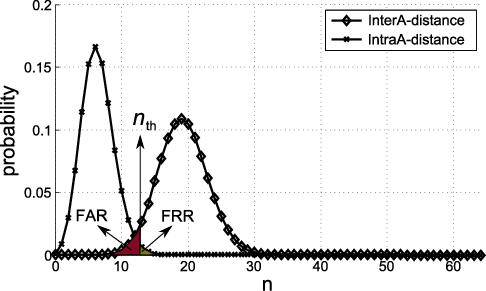
  • Aging Period Sensitivity: Longer in-field aging periods of SoCs improve detection accuracy, allowing for more pronounced differences in PUF response reliability. Figure 2

    Figure 2: Distribution illustration for interA- and intraA-distances for a 64-bit response.

Conclusion

This research presents a simplified, effective methodology for detecting recycled SoCs using aging-sensitive SRAM PUF responses. The approach significantly reduces the number of bits needed to accurately identify recycled components while maintaining high detection accuracy. By exploiting existing microcontroller infrastructures, this methodology offers a cost-effective solution to secure supply chains against counterfeiting and recycling threats, extending the functional utility of SRAM PUFs beyond traditional identification and authentication applications. The discussed framework contributes towards enhancing hardware security by addressing a significant gap in recycled device detection without requiring substantial modifications to existing system designs.

Paper to Video (Beta)

Whiteboard

No one has generated a whiteboard explanation for this paper yet.

Open Problems

We haven't generated a list of open problems mentioned in this paper yet.

Collections

Sign up for free to add this paper to one or more collections.