- The paper presents a comprehensive taxonomy that organizes and evaluates core cloud services such as compute, storage, databases, and networking across leading vendors.
- It systematically categorizes cloud offerings including VM, container, and serverless models, highlighting quantitative differences like AWS’s high-scale VM configurations and Google’s TPU-enabled machine learning.
- The analysis highlights emerging trends towards serverless architectures, integrated AI/IoT solutions, and adaptive cloud deployments, offering actionable insights for vendor selection and future research.
Comparative Analysis of Public Cloud Infrastructure Vendors
Taxonomy of Services and Deployment Models
The paper presents an exhaustive comparative taxonomy of public cloud infrastructure vendors, focusing primarily on Amazon Web Services (AWS), Microsoft Azure, Google Cloud Platform (GCP), and IBM Cloud. It systematically organizes cloud services across critical categories: compute, storage, databases, analytics, data pipelines, machine learning, and networking. Each vendor is analyzed in terms of its offerings in these categories, enabling precise mapping and evaluation of service parity and differentiation.
Cloud deployment models are described according to the prevalent paradigms: Infrastructure-as-a-Service (IaaS), Platform-as-a-Service (PaaS), and Software-as-a-Service (SaaS). The paper identifies the trend towards flexible, scalable, and distributed architectures, and notes the increasing migration from private data centers to fully cloud-native infrastructures. Major vendors provide a broad spectrum of services across these models, exploiting their existing computing and networking assets to enable global coverage and performance.
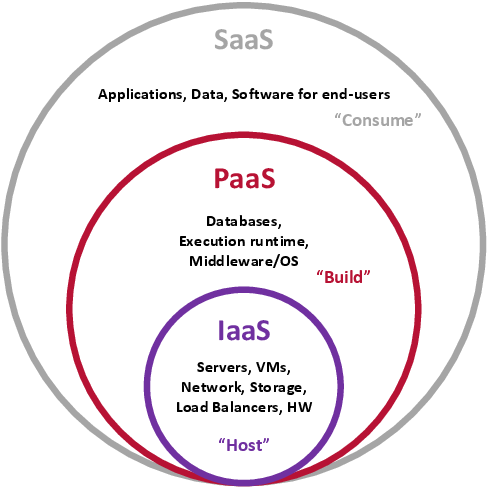
Figure 1: Taxonomy of core cloud computing solutions distributed across IaaS, PaaS, and SaaS frameworks.
Compute Services: VM, Container, and Serverless
The compute service taxonomy underscores progression from VM-centric infrastructures to container-based and serverless paradigms. AWS, Azure, GCP, and IBM provide substantial VM scalability—AWS EC2 supports up to 128 vCPUs and 1952 GB RAM, GCP offers customizable VM configurations, Azure provides large-scale VM deployments, and IBM emphasizes custom VM and bare-metal provisioning.
Transitioning to containers, all vendors deliver robust CaaS offerings with orchestration capabilities (Docker Swarm, Kubernetes, Mesos). Integration depth and feature completeness are noted, with AWS and GCP exhibiting strong cluster management and registry options. Serverless architectures (AWS Lambda, Azure Functions, GCP Cloud Functions, IBM OpenWhisk) are covered in detail, with comparative attention to language support, execution limits, scalability, and operational constraints.
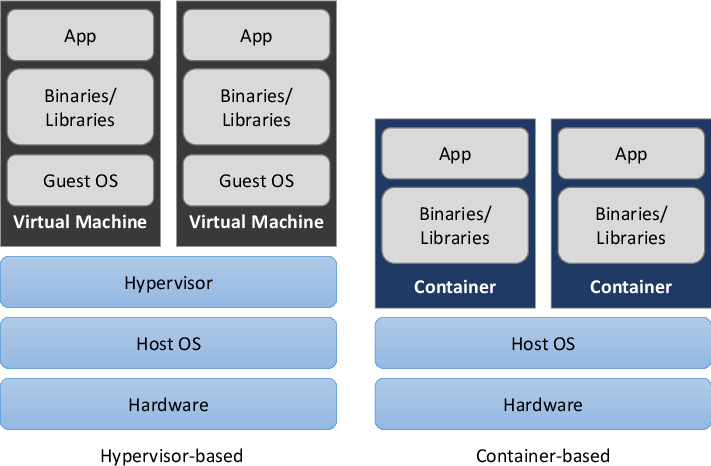
Figure 2: Contrast between hypervisor-based VM virtualization and container-based virtualization approaches, indicating architectural efficiency gains.
Storage Services: Object, Block, and File
The paper systematically compares object, block, and file storage modalities. Object storage (AWS S3, Azure Blob Storage, GCP Cloud Storage, IBM Cloud Object Storage) is analyzed for cost, regional replication, scalability, and durability guarantees. AWS S3's formal specifications usage (TLA+) is noted for reliability engineering.
Block storage assessments focus on volume size, performance metrics (IOPS, throughput), and technology backing (SSD/HDD), with GCP demonstrating superior IOPS for high-end workloads. File storage solutions are mapped against traditional shared fs paradigms (EFS, SMB/NFS), with attention to integration and scale.
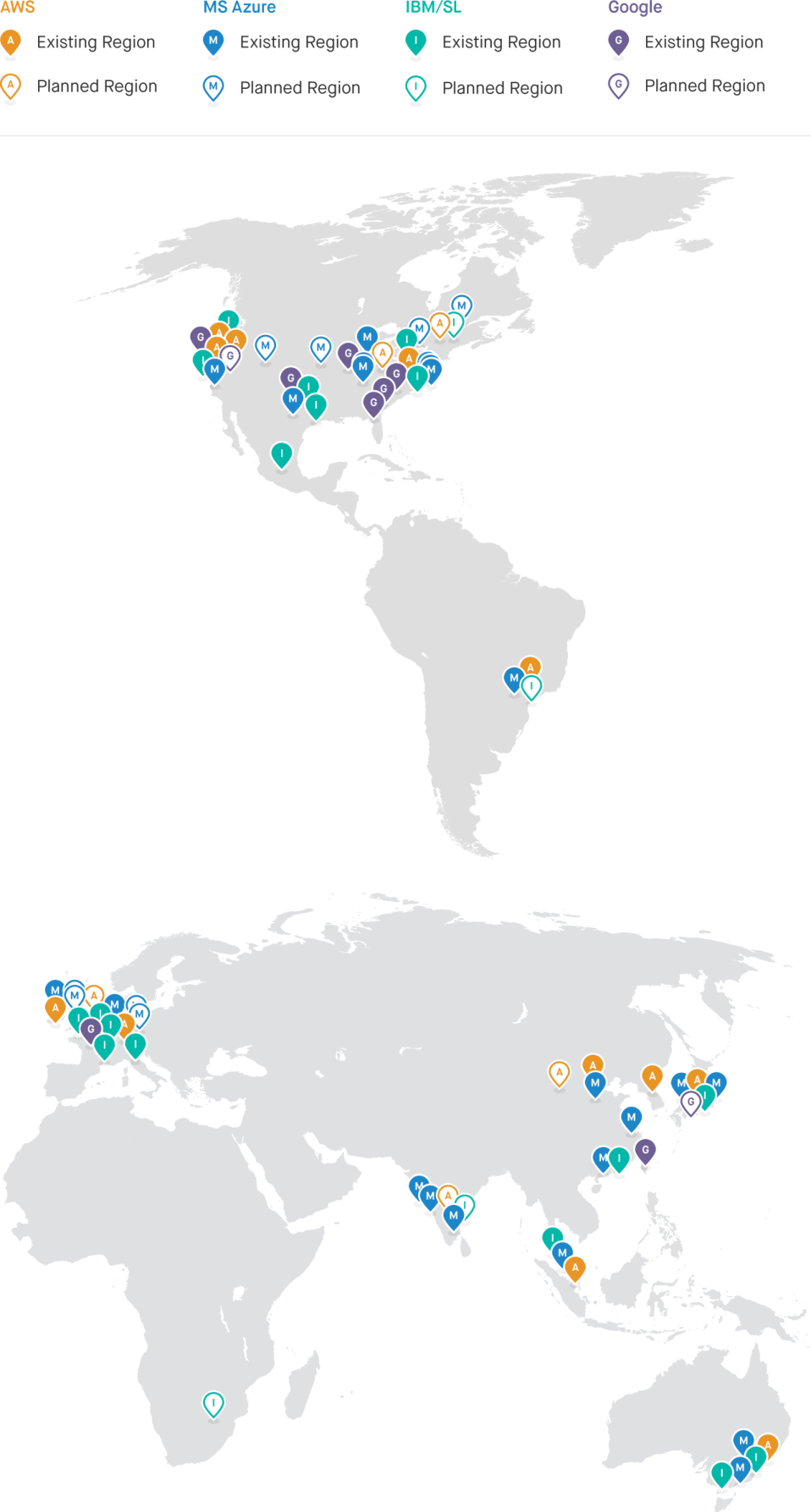
Figure 3: Global distribution of cloud data centers and regions, highlighting the reach and redundancy of each major vendor.
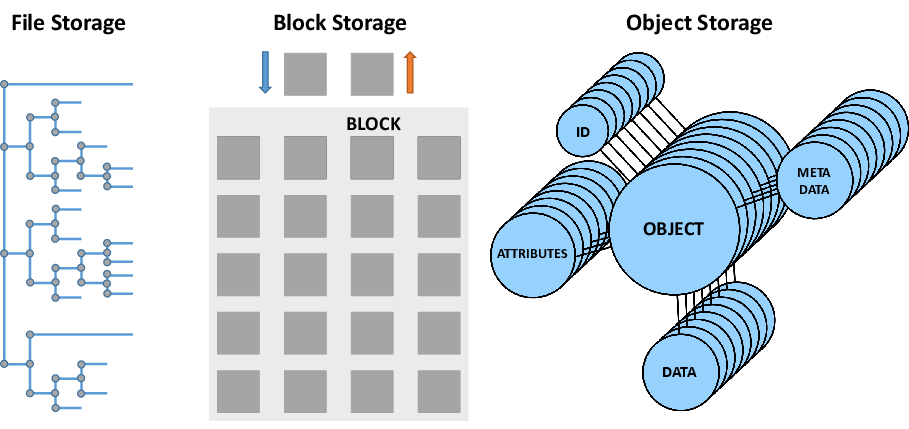
Figure 4: Overview of cloud storage types—object, block, and file storage—in relation to hierarchical data management.
Database and Big Data Services
For database services, both relational (RDBMS) and NoSQL offerings are evaluated. AWS RDS, Azure SQL Database, GCP Cloud SQL/Cloud Spanner, and IBM DashDB are dissected in terms of scalability, replication, and operational automation. NoSQL integration is addressed via AWS DynamoDB, Azure Cosmos DB, GCP Datastore/BigTable, and IBM Cloudant, emphasizing factors like consistency models, API support, and global replication. Cosmos DB's advanced consistency options and formal specification-driven design are highlighted as noteworthy differentiators.
Big data and analytics services incorporate MapReduce-based clusters (EMR, HDInsight, DataProc, BigInsights), data warehousing (Redshift, SQL Data Warehouse, BigQuery, dashDB Analytics), and streaming/data pipeline engines (Kinesis, Stream Analytics, Dataflow, Streaming Analytics). The paper summarizes API flexibility, performance optimization, and vendor-specific enhancements.
The analysis includes cloud-based machine learning and AI platforms: AWS ML, Azure ML, GCP ML Engine, IBM Watson ML. NLP, speech, and vision APIs are compared for functional breadth, language support, and integration with external hardware accelerators (Tensor Processing Units, FPGAs, GPUs). Google's use of TPUs and TensorFlow integration is noted as a significant vendor-specialized capability.
Networking and Content Delivery
Networking services—virtual networking, DNS, private connectivity, CDN, load balancing—are compared with respect to isolation, bandwidth, latency, and security. Each vendor's CDN range, edge locations, streaming protocol support, and content optimization features are discussed. Load balancing is analyzed across both L4 and L7 paradigms, with operational nuances detailed for each vendor.
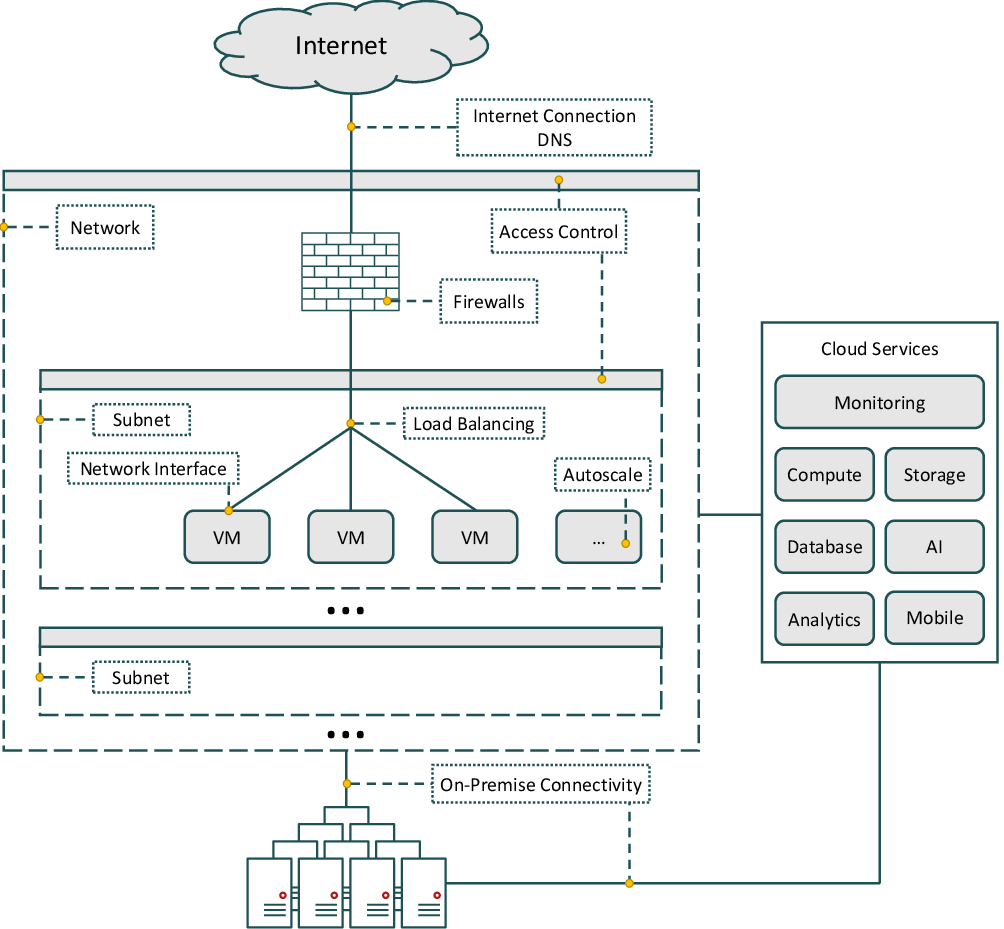
Figure 5: Schematic of a networked cloud application architecture with compute, storage, and network interconnectivity managed by cloud services.
Additional Services and Emerging Vertical Integration
The paper covers additional service offerings including identity management, security, hardware-based trust, directory services, monitoring, logging, application management, mobile development, IoT platforms, and edge computing. IoT services are evaluated for protocol support (MQTT, AMQP, HTTP), security, scalability, integration with analytics/AI, and device management—a critical area given the anticipated explosion of edge-device-generated data.
Research Challenges and Future Directions
Several open research challenges are identified: economic optimization (SLAs, pricing), cross-vendor interoperability, serverless deployment at scale, chaos engineering for resilience, storage and database benchmarking, reliability modeling, and vertical integration (IoT, specialized hardware). The theoretical implication is the evolution of cloud architectures towards hybridized, highly distributed, and AI-optimized environments. Practically, this points to rapid expansion in both the breadth and depth of cloud-native services, increasingly specialized hardware, and adaptive, self-healing infrastructures.
Conclusion
The paper establishes a comprehensive taxonomy of cloud infrastructure services across leading vendors, providing critical comparative analysis that exposes architectural trends, maturity, and vendor-specific innovations. Numerical claims regarding scalability, regional coverage, and performance are leveraged to highlight technical disparities. The implications are significant for enterprises and researchers seeking optimal vendor selection, as well as for the anticipated evolution of AI- and IoT-centric cloud deployments. Continued innovation is expected in cross-platform operability, serverless architectures, hardware integration, and vertical industry solutions, driven by the dynamic requirements of emerging smart environments and massive-scale data processing.