Sex differences in network controllability as a predictor of executive function in youth
Abstract: Executive function emerges late in development and displays different developmental trends in males and females. Sex differences in executive function in youth have been linked to vulnerability to psychopathology as well as to behaviors that impinge on health. Yet, the neurobiological basis of these differences is not well understood. Here we test the hypothesis that sex differences in executive function in youth stem from sex differences in the controllability of structural brain networks as they rewire over development. Combining methods from network neuroscience and network control theory, we characterize the network control properties of structural brain networks estimated from diffusion imaging data acquired in males and females in a sample of 882 youth aged 8-22 years. We summarize the control properties of these networks by estimating average and modal controllability, two statistics that probe the ease with which brain areas can drive the network towards easy- versus difficult-to-reach states. We find that females have higher modal controllability in frontal, parietal, and subcortical regions while males have higher average controllability in frontal and subcortical regions. Furthermore, average controllability values in the medial frontal cortex and subcortex, both higher in males, are negatively related to executive function. Finally, we find that average controllability predicts sex-dependent individual differences in activation during an n-back working memory task. Taken together, our findings support the notion that sex differences in the controllability of structural brain networks can partially explain sex differences in executive function. Controllability of structural brain networks also predicts features of task-relevant activation, suggesting the potential for controllability to represent context-specific constraints on network state more generally.
Paper Prompts
Sign up for free to create and run prompts on this paper using GPT-5.
Top Community Prompts
Explain it Like I'm 14
Overview
This paper explores why boys and girls often develop self-control and thinking skills differently during childhood and the teenage years. These skills—called “executive function”—include working memory, paying attention, stopping yourself from doing something impulsive, and switching tasks smoothly. The researchers ask: could differences in how the brain’s wiring allows certain areas to “control” the whole brain’s activity explain these sex differences?
Key Questions
The study focuses on four simple questions:
- Do boys and girls differ in how easy it is for specific brain areas to steer the brain into different activity patterns (called “network controllability”)?
- Do these controllability differences change with age differently for boys and girls?
- Do controllability differences help explain why girls, on average, show stronger executive function scores in youth?
- Can controllability predict which brain regions “light up” during a working memory challenge (the n-back task), and does that depend on sex?
How They Studied It
Big picture idea
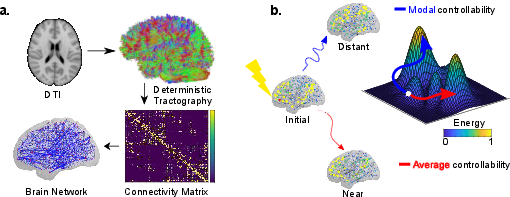
Think of the brain like a huge city with 234 neighborhoods (brain regions) connected by roads (white matter pathways). Some neighborhoods are better at acting like traffic control centers, nudging the whole city’s traffic into a new pattern. The study uses math from control theory to measure how good each region is at:
- Average controllability: steering the brain into many nearby, easier-to-reach activity patterns (like adjusting traffic within familiar routes).
- Modal controllability: steering the brain into harder-to-reach patterns (like quickly rerouting traffic to unusual detours when needed).
Who was studied and what was measured
- Participants: 882 healthy youth ages 8–22 (389 boys, 493 girls).
- Brain wiring (structure): Measured with diffusion MRI, which maps the “roads” between brain regions.
- Brain activity (function): Measured with fMRI during an n-back working memory task (a common test where you must remember items shown a few steps earlier).
- Thinking performance: Measured with computerized tests, focusing on a score for executive function (speed and accuracy in attention, reasoning, and working memory).
How the measurements were used
- The team built each person’s brain “roadmap” and calculated average and modal controllability for each region.
- They compared boys and girls and also looked at how these measures changed from ages 8 to 22.
- They used statistics to control for other factors like age, brain size, handedness, and head motion.
- They tested whether controllability helps explain (mediates) the connection between sex and executive function.
- They checked if controllability predicts how much certain brain areas activate during the n-back task.
- As a “contrast check,” they also examined a different network property called synchronizability (how easily the whole brain falls into a single, locked-together pattern), to make sure their findings weren’t just general network differences.
Main Findings and Why They Matter
1) Sex differences in controllability
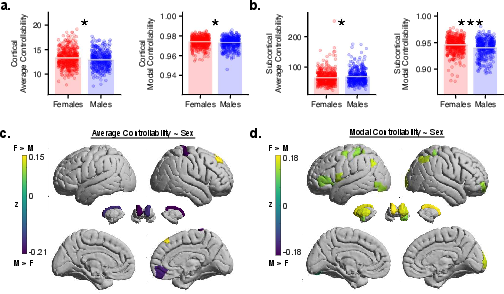
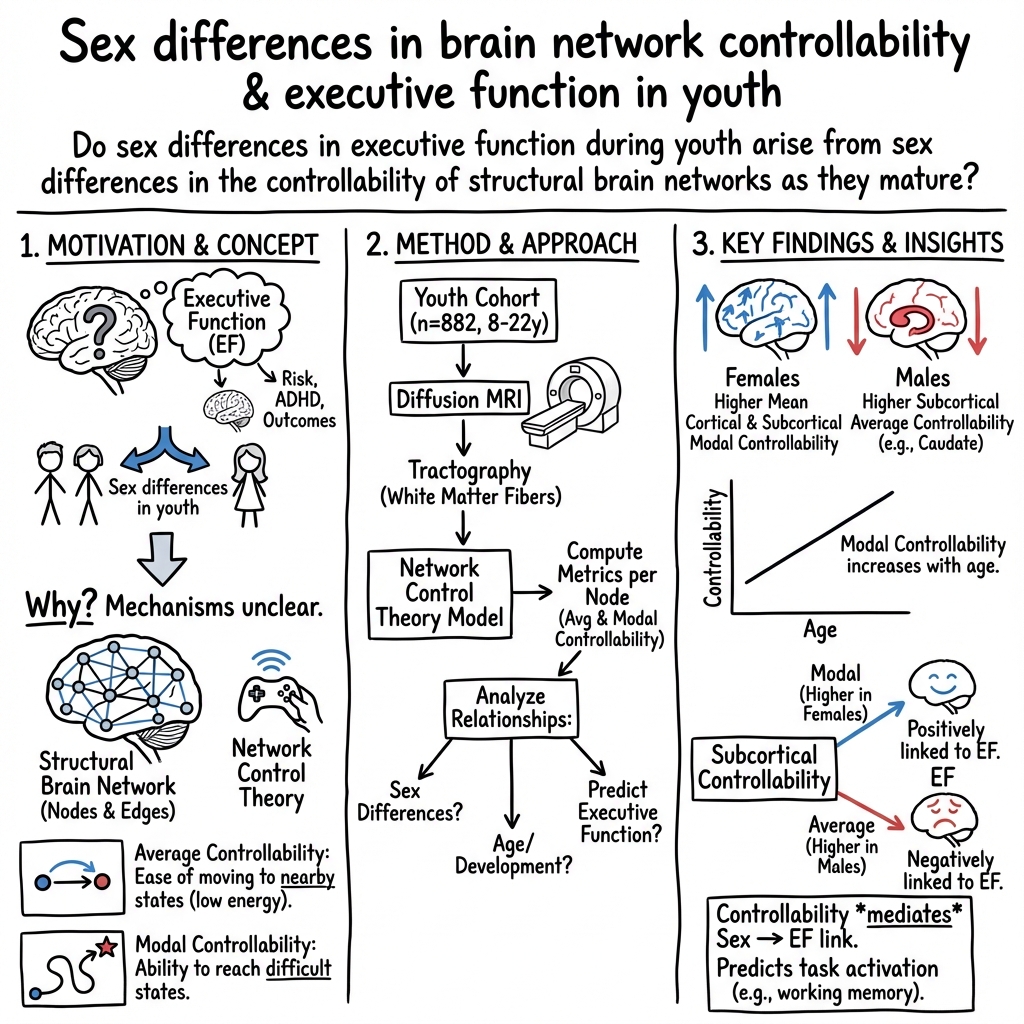
- Girls showed higher modal controllability in frontal, parietal, and subcortical regions. In plain terms: girls’ brains may be better at pushing into harder-to-reach activity states when needed, especially in areas important for thinking and control.
- Boys showed higher average controllability in some frontal and subcortical regions. In plain terms: boys’ brains may more easily shift into many nearby, typical activity states in certain areas.
Why this matters: Executive function often requires flexible shifting into the right brain state at the right time. Having higher modal controllability (more ability to reach difficult states) could support that flexibility.
2) Development with age
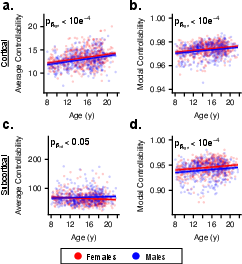
- For both sexes, controllability generally increased with age in the cortex (the outer brain) and, for modal controllability, in the subcortex (deep brain areas). One exception was average controllability in the subcortex, which showed different trends by sex.
- This suggests that as the brain’s wiring matures, its “control centers” get better at guiding the brain into helpful activity patterns, but boys and girls may do so differently in deep brain regions.
3) Controllability and executive function
- In the subcortex, higher average controllability was linked to worse executive function, while higher modal controllability was linked to better executive function.
- In specific regions where boys had higher average controllability (like parts of the medial frontal cortex and the caudate nuclei), that higher average controllability predicted lower executive function.
- Mediation tests showed that average controllability in several regions partly explains the link between sex and executive function. In other words, differences in these “control center” properties help account for why girls scored higher on executive function.
Why this matters: It points to a brain-network mechanism that could underlie sex differences in self-control and thinking skills—especially involving deep brain structures that help regulate motivation and action.
4) Controllability and brain activation during working memory
- Average controllability (not modal) predicted how strongly certain brain areas activated during the n-back task. The pattern was complex, with both positive and negative relationships between controllability in one region and activation in others.
- These relationships showed anatomical similarities in boys and girls, but details differed; there was no strong statistical interaction by sex.
Why this matters: It suggests that the brain’s wiring “control properties” shape real-time brain activity during thinking tasks. That ties the structural network to functional performance.
5) A useful cross-check
- Synchronizability did not differ by sex or explain the main results. This strengthens the idea that the specific controllability measures (average and modal) are key to the observed differences.
Implications and Potential Impact
- Better understanding of why boys and girls differ in executive function: The study shows that differences in how brain networks can be controlled—especially in deep brain regions—help explain behavioral differences seen in youth.
- Health and education: Executive function affects school performance, decision-making, and risk-taking. Insight into the brain’s control “wiring” could guide more personalized strategies to support teenagers, potentially tailored by sex.
- Mental health: Since executive function relates to conditions like ADHD and impulsivity, these findings could help refine early detection or suggest new intervention targets.
- Future research and caution: The study is cross-sectional (a snapshot in time), so it cannot prove cause and effect. Longitudinal and experimental work is needed to test whether changing network controllability changes executive function. Still, controllability looks promising as a biomarker that connects brain structure to thinking and behavior.
In short, the paper suggests that how easily different brain areas can steer the whole brain—toward easy or hard-to-reach activity states—differs between boys and girls, develops through adolescence, and helps explain differences in executive function and brain activation during thinking tasks.
Collections
Sign up for free to add this paper to one or more collections.