A Multi-Agent Neural Network for Dynamic Frequency Reuse in LTE Networks
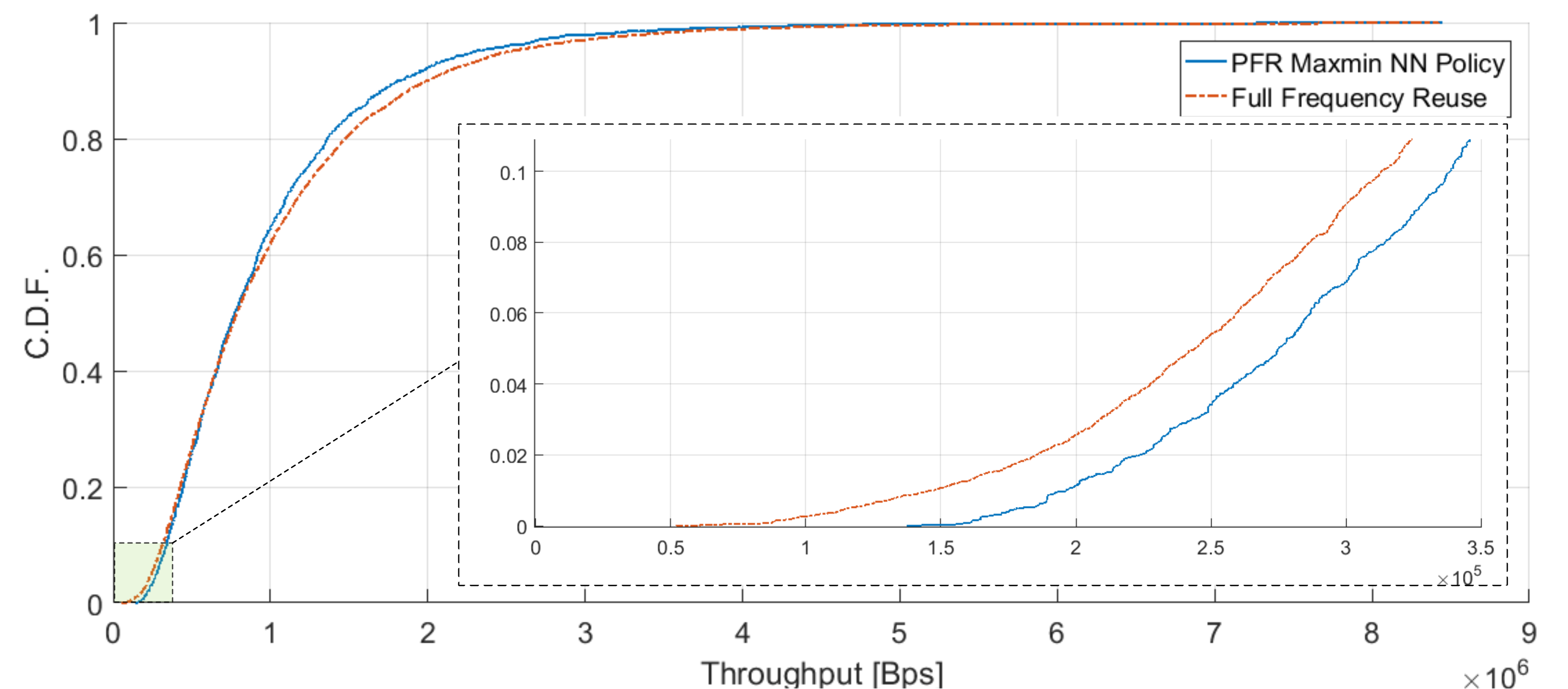
Abstract: Fractional Frequency Reuse techniques can be employed to address interference in mobile networks, improving throughput for edge users. There is a tradeoff between the coverage and overall throughput achievable, as interference avoidance techniques lead to a loss in a cell's overall throughput, with spectrum efficiency decreasing with the fencing off of orthogonal resources. In this paper we propose MANN, a dynamic multiagent frequency reuse scheme, where individual agents in charge of cells control their configurations based on input from neural networks. The agents' decisions are partially influenced by a coordinator agent, which attempts to maximise a global metric of the network (e.g., cell-edge performance). Each agent uses a neural network to estimate the best action (i.e., cell configuration) for its current environment setup, and attempts to maximise in turn a local metric, subject to the constraint imposed by the coordinator agent. Results show that our solution provides improved performance for edge users, increasing the throughput of the bottom 5% of users by 22%, while retaining 95% of a network's overall throughput from the full frequency reuse case. Furthermore, we show how our method improves on static fractional frequency reuse schemes.
Paper Prompts
Sign up for free to create and run prompts on this paper using GPT-5.
Top Community Prompts
Glossary
- Adamax optimizer: A variant of the Adam optimization algorithm that uses the infinity norm for adaptive learning rates. "the gradient-based Adamax optimizer \cite{kingma2014adamax}."
- Binary integer optimization: An optimization problem where decision variables are restricted to binary (0/1) values. "compute the optimal frequency allocations by solving a binary integer optimization"
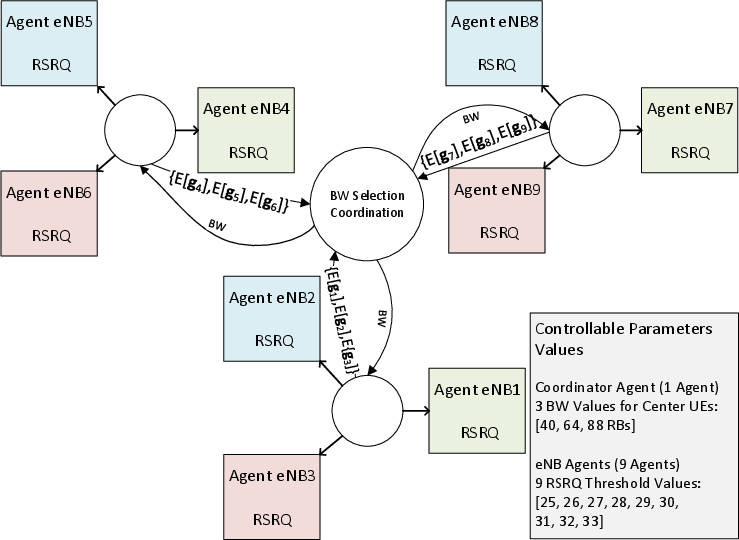
- Coordinator agent: A supervisory agent that aggregates local estimates and enforces a global decision across cell agents. "The coordinator agent aggregates local performance estimates from the underlying cell agents"
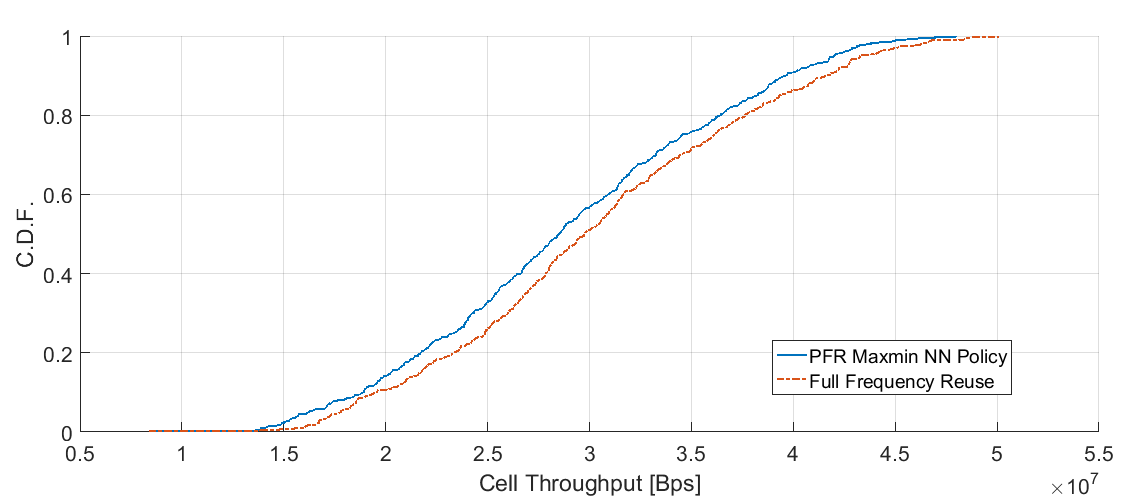
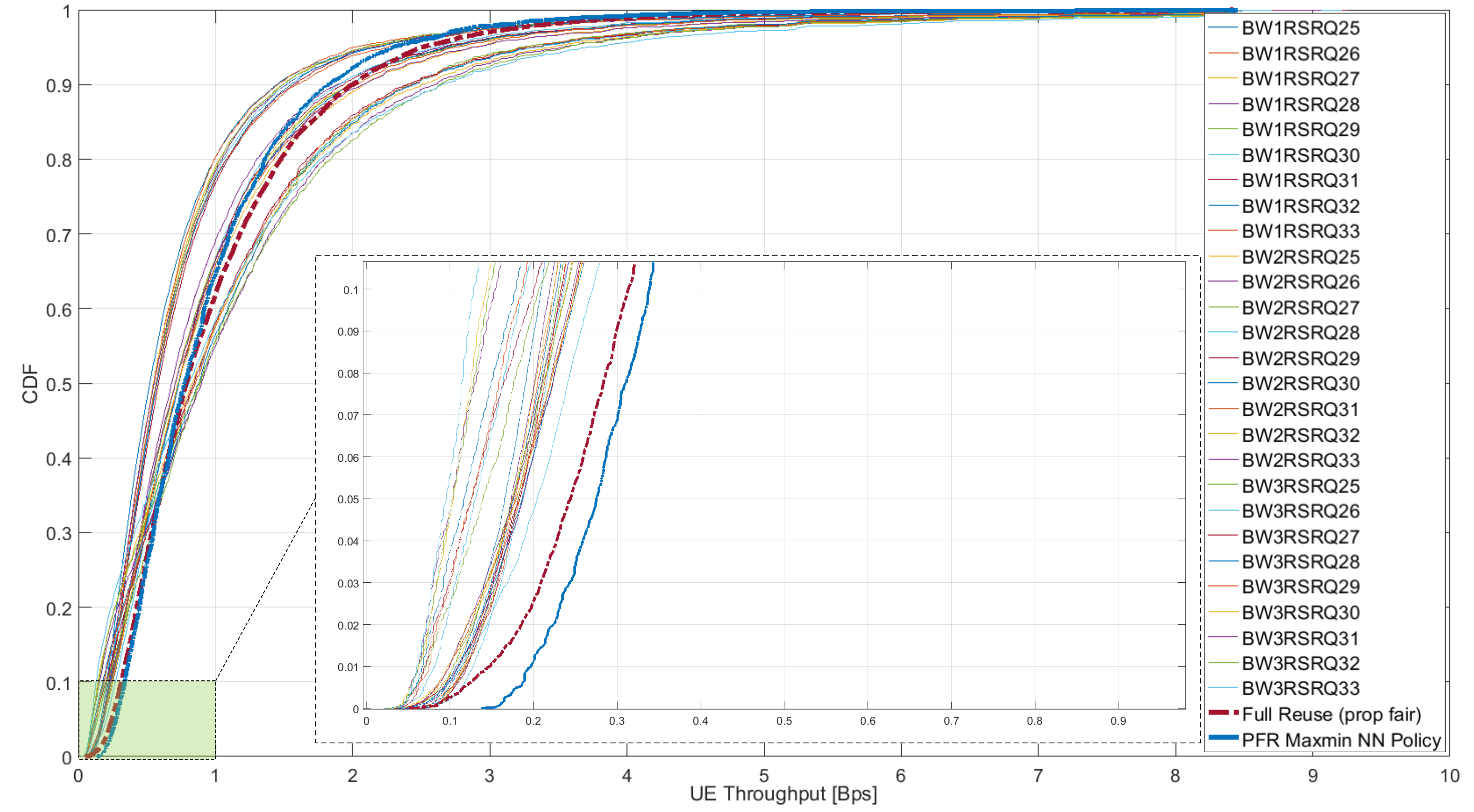
- Cumulative distribution function (CDF): A function giving the probability that a random variable is less than or equal to a given value. "cumulative distribution functions (CDFs)"
- Fractional Frequency Reuse (FFR): A family of schemes that partition spectrum among neighboring cells to reduce inter-cell interference. "Fractional Frequency Reuse (FFR) schemes have been proposed to improve cell-edge performance."
- Full frequency reuse: A reuse scheme where every cell uses the entire available spectrum simultaneously (reuse factor 1). "full frequency reuse is employed with a proportional fair scheduler"
- Hard frequency reuse: A scheme that divides the spectrum into disjoint orthogonal chunks assigned to neighboring cells, eliminating overlap. "the factor for hard frequency reuse, where the spectrum is evenly divided into three orthogonal chunks for three neighbouring cells/sectors"
- Inter-cell coordination: Cooperative mechanisms among cells to manage interference and resource allocation. "With dynamic schemes, inter-cell coordination allows for more efficient utilization of frequency resources between cells"
- Long Term Evolution (LTE): A 4G mobile network standard for high-speed wireless communication. "LTE networks"
- Multi-Agent Neural Network (MANN): The proposed semi-distributed control scheme where cell agents use neural networks and a coordinator resolves bandwidth decisions. "we propose MANN, a dynamic multi-agent frequency reuse scheme"
- NP-complete: A class of decision problems that are both in NP and NP-hard, implying no known polynomial-time solution. "which is an NP-complete problem \cite{karp1972}"
- NP-hard: Problems at least as hard as the hardest problems in NP; no known polynomial-time solution exists. "the problem of optimally allocating resources in order to maximise a metric becomes NP-hard"
- ns-3: A discrete-event network simulator widely used for research and education. "We have evaluated our algorithm using ns-3's LTE simulator"
- Orthogonal frequency-division multiple access (OFDMA): A multi-user version of OFDM enabling concurrent transmissions on orthogonal subcarriers. "In orthogonal frequency-division multiple access (OFDMA) mobile networks"
- Partial frequency reuse (PFR): An FFR variant with a common center band and orthogonal edge bands (full isolation between edges). "One such scheme is partial frequency reuse (PFR), which is also known as fractional frequency reuse with full isolation"
- Poisson Point Process: A stochastic process modeling randomly located points in space. "Thomas cluster process (a special case of Poisson Point Process)"
- Proportional fair scheduler: A scheduling algorithm balancing fairness and throughput by prioritizing users relative to their average rates. "full frequency reuse is employed with a proportional fair scheduler"
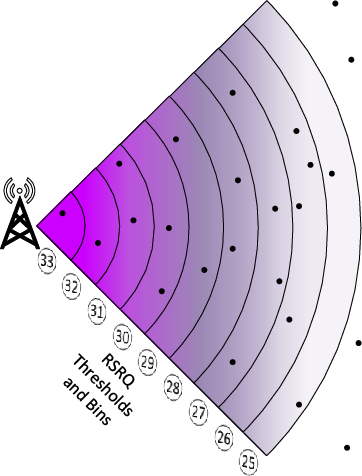
- Reference Signal Received Quality (RSRQ): A radio quality metric combining signal strength and interference across resource blocks. "RSRQ - reference signal received quality"
- Reinforcement learning (RL): A learning paradigm where an agent optimizes behavior via trial-and-error with feedback (rewards). "a centralised solution with a reinforcement learning (RL) based network level controller"
- Resource Block (RB): The smallest unit of frequency-time resources scheduled in LTE downlink. "100 RBs are used for downlink"
- Reuse factor: The number indicating how many cells share the same frequency resources (e.g., 1, 3). "reuse factor of 3"
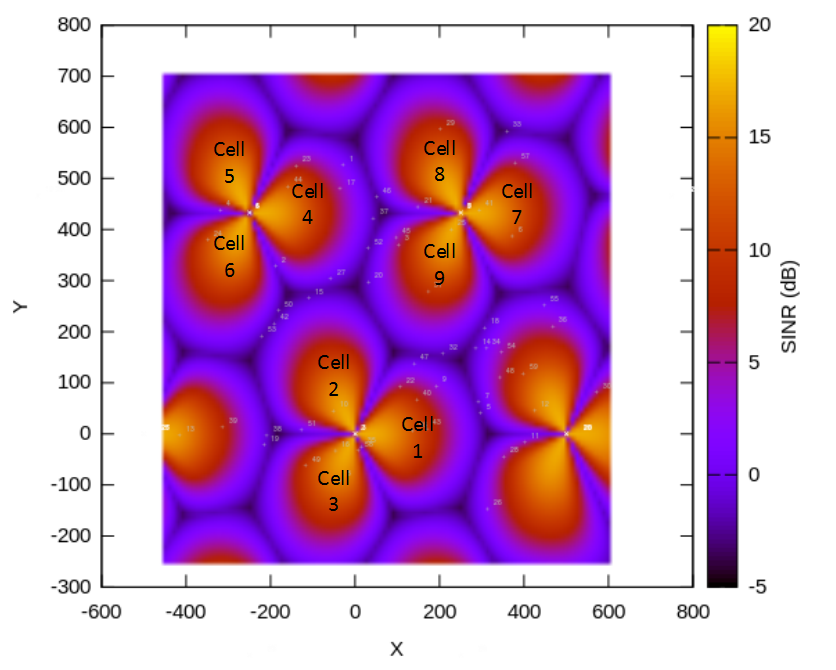
- Signal-to-Interference-plus-Noise Ratio (SINR): A measure of signal quality comparing desired signal power to interference and noise. "e.g., SINR level or RSRQ - reference signal received quality"
- Social welfare (of agents): The aggregate utility or performance across all agents in a system. "such as maximising the social welfare of agents"
- Soft FFR: An FFR approach where all cells use the full spectrum but allocate higher power on certain orthogonal sub-bands for edge users. "In soft FFR, the full spectrum is used by all cells"
- Stochastic geometry: A mathematical framework for analyzing spatial randomness, often used to model wireless networks. "based on stochastic geometry models."
- Strict frequency reuse: Another name for PFR with full isolation, emphasizing non-overlapping edge bands. "or as strict frequency reuse."
- Thomas cluster process: A clustered spatial point process formed by displacing offspring points from parent points with Gaussian scatter. "Thomas cluster process (a special case of Poisson Point Process)"
- UE (User Equipment): The mobile device or terminal in a cellular network. "UE distributions"
- UE geometry: The spatial distribution of UEs relative to cells/sectors affecting pathloss and interference. "features of the UE geometry"
- Wrap-around ring: A simulation technique that replicates cells around a core area to mitigate edge effects. "with 27 used as a wrap-around ring around the inner 9 cells."
Collections
Sign up for free to add this paper to one or more collections.