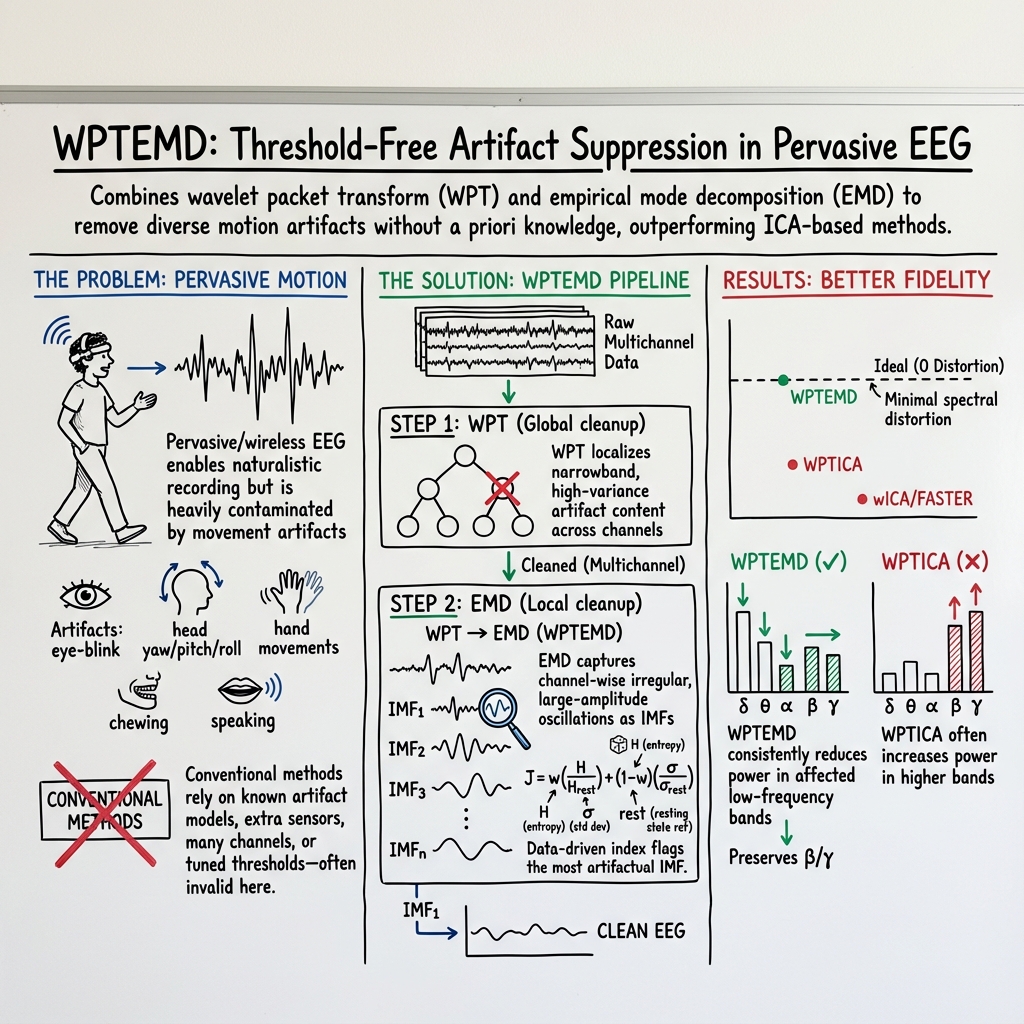
- The paper presents hybrid techniques WPTEMD and WPTICA that effectively remove motion-induced artifacts from pervasive EEG data.
- Using multiscale analysis, it employs Wavelet Packet Transform with either EMD or ICA to isolate and discard artifact components.
- Experimental evaluations show up to 70.4% improvement in artifact suppression metrics and enhanced signal fidelity for real-world applications.
Hybrid Wavelet and EMD/ICA Approach for Artifact Suppression in Pervasive EEG
Introduction and Motivation
Electroencephalography (EEG) signals are crucial for numerous applications, including cognitive function assessment and neuro-disease diagnosis. However, EEG data is often contaminated with artifacts, especially in pervasive and unconstrained environments where motion-induced artifacts are prevalent. Traditional artifact removal algorithms require a priori knowledge about the artifacts, which is impractical in dynamic EEG settings. This paper introduces two novel hybrid techniques designed to tackle this problem: the Wavelet Packet Transform followed by Empirical Mode Decomposition (WPTEMD) and Wavelet Packet Transform followed by Independent Component Analysis (WPTICA). These methods aim to effectively suppress motion-related artifacts in pervasive EEG without relying on predefined artifact characteristics.
Methods and Techniques
The WPT is employed as the initial step in both hybrid techniques to decompose the EEG signals into different frequency components, enabling an effective analysis and identification of corrupted segments. This transform allows for the multiscale analysis of EEG signals, maintaining high frequency resolution and aiding in localizing artifacts.
Empirical Mode Decomposition (EMD) and Independent Component Analysis (ICA)
In the WPTEMD approach, following WPT, the EMD is applied to discard Intrinsic Mode Functions (IMFs) associated with artifacts, characterized by irregular oscillations and high entropy. Conversely, the WPTICA utilizes ICA to identify and remove independent components linked to artifacts. This method capitalizes on the statistical independence properties of EEG signal components.
Experimental Evaluation
The performance of WPTEMD and WPTICA was rigorously evaluated using both semi-simulated and real EEG datasets, gathered through a commercially available 19-channel pervasive EEG system, Enobio. The semi-simulated approach allowed a controlled comparison against benchmark methods like wICA and FASTER, establishing a performance baseline with quantified signal recovery, measured by Root Mean Square Error (RMSE) and Artifact to Signal Ratio (ASR).
Numerical Results
WPTEMD outperformed other examined methods, showing a 49.53% and 70.4% improvement in RMSE and ASR for heavily contaminated channels. In scenarios with real EEG data encompassing eight types of artifacts—ranging from blinking to various head movements—WPTEMD consistently achieved superior artifact suppression without distorting the underlying EEG spectral characteristics. This superior performance was particularly evident in low-density EEG channel setups that posed significant challenges for existing methods.
Discussion
The hybrid nature of WPTEMD and WPTICA allows for flexibility and robustness in artifact suppression, crucial for pervasive EEG applications where movement artifacts are common and unpredictable. The adaptive nature of EMD in WPTEMD, specifically the empirical extraction and suppression of IMFs, demonstrates notable advantages in maintaining EEG signal integrity across varying artifact intensities and types.
Conclusion and Future Work
This study showcases the efficacy of WPTEMD as a robust artifact suppression tool in pervasive EEG scenarios, free from reliance on prior artifact knowledge. Its application improves EEG signal fidelity and utility in dynamic and naturalistic assessment settings. Future work may focus on refining these hybrid strategies further by integrating more sophisticated machine learning-based classification techniques to enhance automatic artifact identification and suppression in ultra-low-density EEG systems.
This work has broad implications for the deployment of portable, real-time EEG monitoring systems in naturalistic environments, enabling more accurate monitoring of cognitive states and potential medical applications outside of traditional lab settings.