- The paper identifies a spinon Fermi surface in 1T-TaS₂ by applying a spin-1/2 XXZ model with four-spin ring exchange interactions.
- It employs large-scale DMRG simulations to analyze spin structure factors, revealing 2k_F peaks and power-law decaying correlations indicative of a gapless quantum spin liquid.
- The findings enhance understanding of frustrated magnetic systems and guide experimental efforts, such as neutron scattering, to verify the predicted spinon dynamics.
Spinon Fermi Surface in 1T-TaS2
Introduction
The study of quantum spin liquids (QSLs) has long intrigued physicists due to their exotic ground state properties, such as the absence of long-range magnetic order even at absolute zero. The material 1T-TaS2 offers a compelling platform to explore such phases, particularly in the context of its transformation to a Mott insulator. This paper presents an investigation of a cluster Mott insulator model on a triangular lattice, emphasizing the realization of a spinon Fermi surface (SFS) in 1T-TaS2.
Model and Methodology
The authors derive a spin-1/2 XXZ model embedded with four-spin ring exchange interactions to capture the low-energy physics of 1T-TaS2. This model reflects the intricacies of spin-orbit coupling (SOC) and the unique lattice arrangement in the material. The work leverages large-scale Density Matrix Renormalization Group (DMRG) simulations to explore the phase diagram of this system.
Phase Diagram and Quantum Spin Liquid Phase
The study unveils a rich phase diagram for the material under consideration. For low values of the ring exchange parameter K/J, the system exhibits a 120∘-antiferromagnetic (AFM) order characteristic of the triangular lattice. At intermediate K/J ratios, a valence bond solid (VBS) phase emerges, eventually transitioning into a spinon Fermi surface quantum spin liquid as K/J increases.
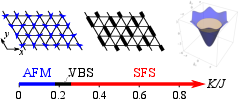
Figure 1: Phase diagram for isotropic case (γ=0), illustrating spinon Fermi surface, AFM, and VBS phases.
In the quantum spin liquid state, there is no observable long-range spin, dimer, or chirality order. The existence of a SFS is confirmed by analyzing the spin structure factor, which reveals 2kF peaks corresponding to the half-filled spinon Fermi surface on the triangular lattice.
Correlation Functions and Spin Susceptibility
The real-space decay of spin-spin and dimer-dimer correlation functions suggests power-law behavior, indicative of a gapless phase. Moreover, these correlations feature modulations that signal the presence of a Fermi surface. The static spin susceptibility, calculated from the linear response to small magnetic fields, further corroborates the gapless spin liquid nature, displaying a finite value consistent with a Fermi surface of spinons.
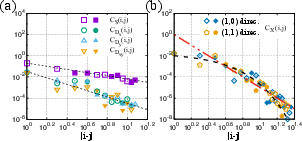
Figure 2: Real space decay of correlation functions showcasing power-law behavior, supporting the gapless nature of the SFS.
Implications and Future Directions
The findings extend our understanding of potential quantum spin liquid candidates like 1T-TaS2, enriching the scope of theoretical models applicable to frustrated magnetic systems. The SFS phase represents a state of matter where spinons govern low-energy excitations, with implications for understanding unconventional superconductivity upon doping.
Moving forward, experimental efforts, such as neutron scattering, could seek the 2kF peaks in the spinon Fermi surface to provide direct verification of the model’s predictions. Additionally, investigating charge transport properties and specific heat could reveal linear dependencies characteristic of spinon Fermi surfaces.
Conclusion
This research delineates a comprehensive theoretical framework for 1T-TaS2 as a candidate for realizing a spinon Fermi surface quantum spin liquid. The exploration of various phases within this model provides insights into the behavior of strongly correlated electrons subjected to geometric frustration and SOC. Such studies bridge the theoretical and experimental realms, offering pathways to discover new states of matter in quantum materials.
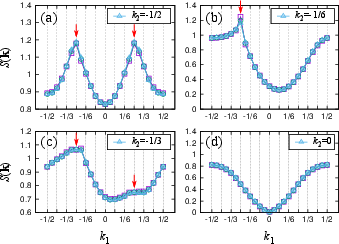
Figure 3: Demonstration of spin structure factor S(k) with 2kF peaks, affirming the SFS phase.