- The paper demonstrates that the closure of the Liouvillian spectral gap marks first-order phase transitions in quantum optical models.
- The methodology integrates numerical simulations of Kerr models to reveal abrupt steady-state changes and bimodal distributions at critical points.
- The research establishes a framework for understanding symmetry-breaking and persistent zero eigenvalue phenomena in second-order dissipative transitions.
Spectral Theory of Liouvillians for Dissipative Phase Transitions
The paper "Spectral theory of Liouvillians for dissipative phase transitions" addresses the dynamics of open quantum systems, specifically focusing on the spectral behavior of Liouvillian superoperators and their role in dissipative phase transitions. This research provides a framework for understanding critical phenomena in non-equilibrium quantum systems, which differ fundamentally from their classical counterparts.
Introduction to Liouvillian Spectral Theory
A state in an open quantum system is represented by a density matrix whose evolution is governed by a Liouvillian superoperator. The paper explores the properties of first-order and second-order dissipative phase transitions, investigating their spectral characteristics within quantum optical models. The study of these transitions is critical, as they often result in non-analytic changes in the system's steady state in the thermodynamic limit, driven by the competition between Hamiltonian and dissipation operators in a non-equilibrium setting.
First-Order Dissipative Phase Transitions
First-order dissipative phase transitions are characterized by an abrupt change in the steady state of the system. Such transitions occur when the Liouvillian's spectral gap closes at the critical point, causing a bimodal steady-state density matrix at this juncture (see Figure 1).
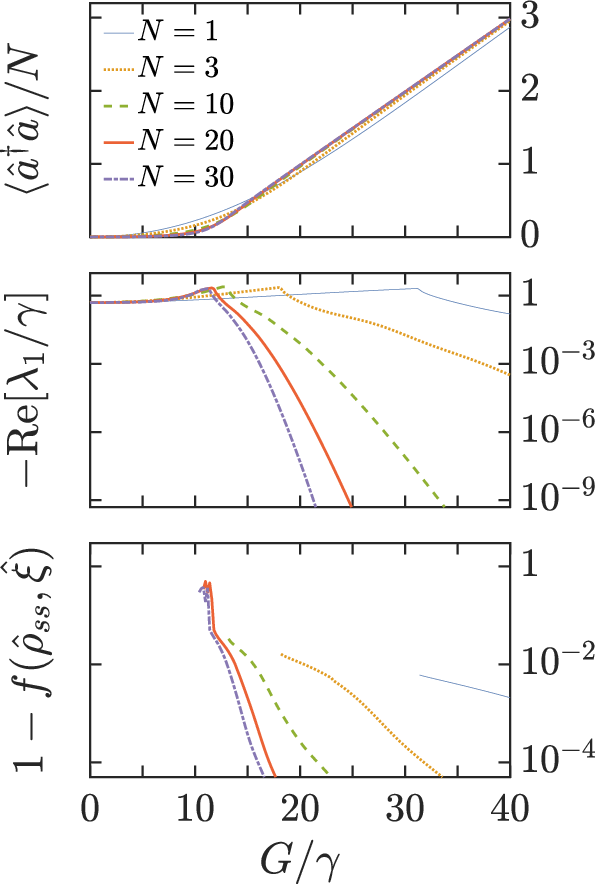
Figure 1: Numerical results for the driven-dissipative Kerr model. Top panel: Rescaled number of photons ⟨a^†a^/N⟩ as a function of the rescaled driving F~/γ for different values of N.
In the context of the Kerr model, the paper highlights how first-order transitions manifest through the closure of the Liouvillian spectral gap (Figure 1), resulting in a change from one stable phase to another. The transition point is associated with a bimodal distribution of the steady-state density matrix, indicating coexisting phases.
Second-Order Dissipative Phase Transitions with Symmetry Breaking
Dissipative phase transitions of the second order are linked to symmetry breaking, where the Liouvillian spectrum develops a zero eigenvalue in a broader parameter range beyond criticality. The study utilizes models such as driven-dissipative two-photon Kerr systems, where symmetry breaking is accompanied by a persistent zero Liouvillian gap in the symmetry-broken phase, as illustrated below (Figure 2).
Figure 2: Numerical results for the driven-dissipative two-photon Kerr model. Top panel: Rescaled number of photons ⟨a^†a^/N⟩ as a function of the rescaled driving G/γ for different values of N.
The critical discovery is the pervasive closure of the Liouvillian gap, resulting from symmetry-breaking phenomena. The steady-state density matrix becomes highly structured, a direct consequence of the interplay between Liouvillian eigenstates in different symmetry sectors.
Implications and Future Directions
This work provides a solid theoretical foundation for analyzing dissipative phase transitions in open quantum systems. Practically, understanding these transitions could facilitate the design of quantum systems with desired critical properties, useful in quantum computing and coherent control applications. The methodologies developed could be extended to explore more complex systems, including lattices of interacting quantum resonators or spins, and their behavior under non-equilibrium conditions.
Conclusion
The exploration of the spectral properties of Liouvillian superoperators and their impact on phase transitions in open quantum systems brings significant insights into non-equilibrium quantum physics. By connecting the closure of Liouvillian gaps with the emergence of critical behavior, this research aids in unraveling the complex nature of quantum phase transitions, offering predictive capabilities and guiding the experimental exploration of quantum critical phenomena.