- The paper demonstrates instanton contributions in the Harper-Hofstadter Hamiltonian using a trans-series expansion derived from path integrals.
- It employs numerical and topological string theory methods to validate non-perturbative energy corrections with precise instanton actions.
- The study links quantum mirror curves with lattice physics, offering actionable insights for further research on nonperturbative phenomena.
Instantons in the Hofstadter Butterfly: Difference Equation, Resurgence, and Quantum Mirror Curves
Introduction
The manuscript "Instantons in the Hofstadter butterfly: difference equation, resurgence and quantum mirror curves" examines the spectral characteristics of the Harper-Hofstadter Hamiltonian under rational magnetic flux conditions. This work elucidates the emergence of instanton effects in the butterfly spectrum, leveraging path integral formulations to explore non-perturbative corrections and the relationship with topological string theory. The findings link the Harper-Hofstadter problem to its spectral characteristic arising in the mirror geometry of toric Calabi-Yau manifolds.
Path Integral Analysis and Spectrum
The study primarily considers the weak magnetic limit of the Harper-Hofstadter model where the magnetic flux ϕ assumes rational multiples of 2π. Instanton corrections emerge as perturbative series augmented by non-perturbative components, captured via path integrals. The authors compute actions for 1-instanton processes and derive expressions for fluctuations using topological string theory techniques.
The Hamiltonian H(x,y), characterized by a cosine potential, receives exponential instanton corrections due to quantum tunneling effects between lattice vacua. The result is a trans-series expansion for the energy spectrum with leading instanton contributions proportional to exp(−A/ϕ), where A is the instanton action.
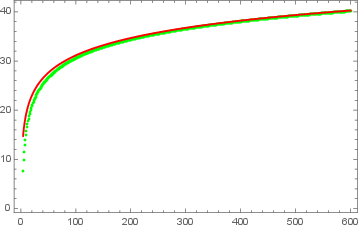
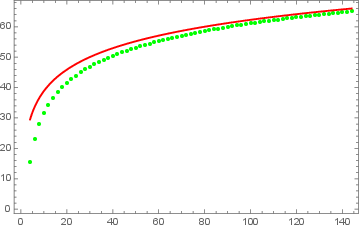
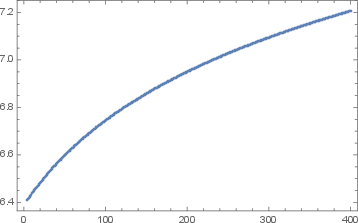
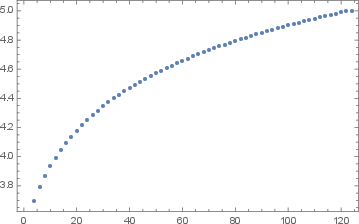
Figure 1: Plots demonstrating numerical results of 2-instanton corrections, verifying the analytical predictions.
Numerical and Topological Validation
A concerted numerical analysis substantiates the theoretical framework, confirming that the band widths align with 1-instanton approximations despite the potential smoothing effects due to flux rationality. Furthermore, numerical fits provide the perturbative and non-perturbative interplay in energy levels, reinforcing the calculated instanton actions.
The intersection between quantum mechanics and topological string theory is explored by evaluating fluctuations using refined topological string free energies. The NS limit opens a portal to understanding the perturbative-non-perturbative interplay inherent in quantum mirror curves.
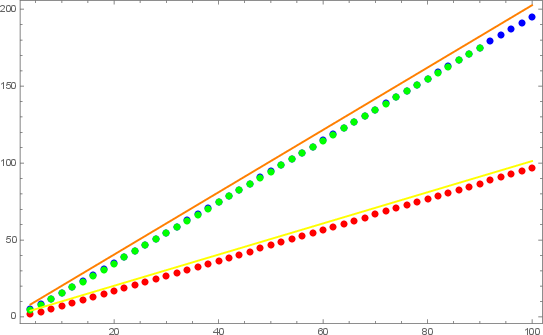
Figure 2: Plot showing digit matches between linear combination results and Fourier transform analyses.
Conceptual Implications and Future Directions
The document highlights foundational ties between the Harper-Hofstadter model and Calabi-Yau manifolds, advancing our comprehension of non-perturbative aspects of quantum mechanics as mirrored in string theory. The integration of resurgence theories proposes new avenues for exploring spectral properties through refined determinants and instanton calculus.
Future investigations may broaden scope into quantum mirror curves emergent in higher-dimensional and anisotropic lattice frameworks, striving to quantify phenomena within a unified topological and quantum mechanical fabric.
Conclusion
The intricate dance of instantons within the Hofstadter butterfly, from differential equations to quantum mirror constructs, exemplifies a rich tapestry connecting lattice physics to topological string frameworks. This research underscores the resurgent beauty of physical theories when viewed through a multidimensional lens, fostering deeper understanding and interdisciplinary advancements.