- The paper introduces a novel hydro-micromechanical model coupling LBM and DEM to capture particle-fluid interactions in saturated granular media.
- It verifies the model through benchmark tests, aligning numerical results with Biot's theory and revealing slow P-wave phenomena.
- The study emphasizes accurate simulation of elastic wave propagation, offering insights for geotechnical and seismic applications.
Introduction
The paper presents a hydro-micromechanical numerical model to simulate elastic wave propagation in saturated granular media, poised at high resonance where microstructure details become significant. By coupling the Lattice Boltzmann Method (LBM) with the Discrete Element Method (DEM), the model meticulously resolves the particle-fluid interactions during wave propagation. Throughout various benchmark tests and simulations across differing configurations, the model's veracity is established, promising insights into granular mechanics and fluid dynamics (1808.08921).
Hydro-micromechanical Model
The model couples LBM and DEM, leveraging the former to capture pore-scale hydrodynamics and the latter to monitor translational and rotational motions of the solid particles. Initiated with discrete Boltzmann equations, the LBM employs a Bhatnagar-Gross-Krook (BGK) operator for fluid flow evolution, where spatial discretization is established via the D3Q19 lattice configuration.
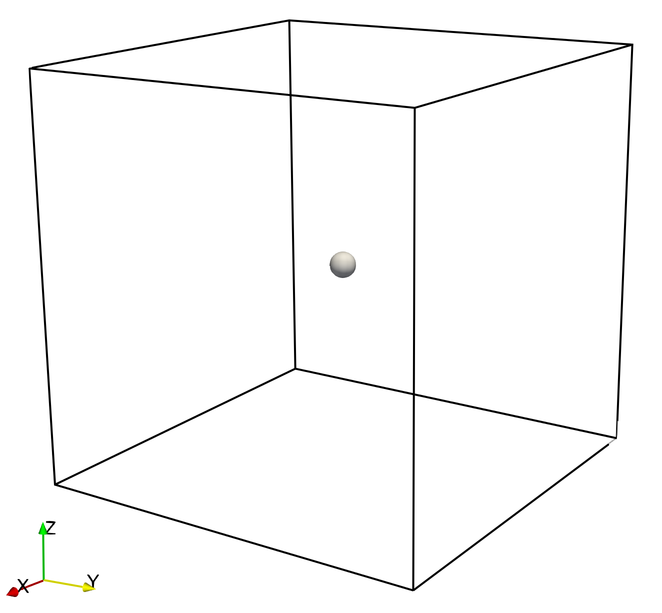
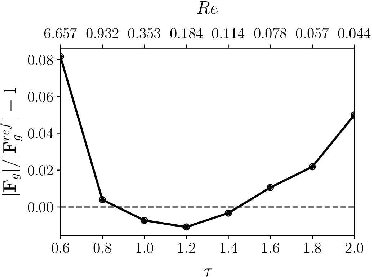
Figure 1: Drag, buoyancy and body forces acting on a settling sphere illustrate hydrodynamic interactions.
The DEM tracks granular interactions through repulsive and viscous spring-dashpot systems, resolving contact forces with Coulomb friction constraints. This ensures a representation of granular micro-mechanics, integrally tied through solid-fluid exchanges using the momentum exchange method.
The model is subjected to several benchmark scenarios, including elastic wave propagation in pure fluid domains, dry granular chains, and saturated granular systems.




Figure 2: First benchmark: elastic wave propagation in a viscous fluid delineates comparison against analytical solutions.
Each setup assesses the model's fidelity by comparing responses to theoretical predictions, and it verifies both fluid-solid coupling and time-domain responses.
Model Application: FCC Packing
The Face-Centered Cubic (FCC) configuration of frictionless spheres serves as the computational model for simulating wave propagation under varying effective confining pressures, employing boundaries set to oscillate pressure in a controlled manner.

Figure 3: A fully saturated regular face-centered-cubic packing of spherical particles instantiates the dense medium for wave traversal.
Comparison with Biot's Theory
Biot's theory predicts wave velocities in saturated porous media, influenced by elastic moduli, medium porosity, and coupling inertia. The numerical results impart a comparative analysis validating Biot's equations, evidencing an agreement albeit with observable numerical errors due to model assumptions and computational constraints.
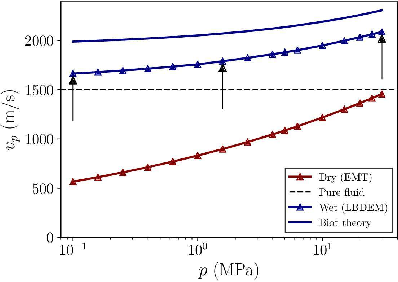
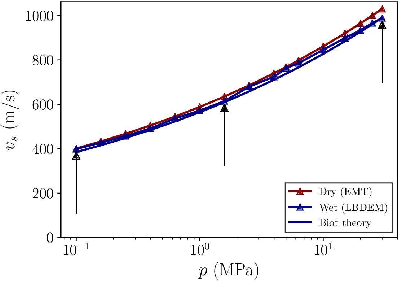
Figure 4: Compressional wave velocity versus pressure details comparison between hydro-micromechanical and analytical solutions.
Slow Wave Phenomena
Highlighted in the results is the presence of a slow P-wave alongside fast compressional and shear waves within the saturated granular matrix, exhibiting attenuation and dispersive characteristics postulated by Biot's framework. The slow waves are notably observed as transient, with high dissipation, recorded near wave sources.
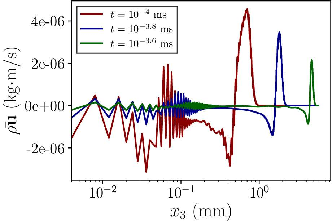
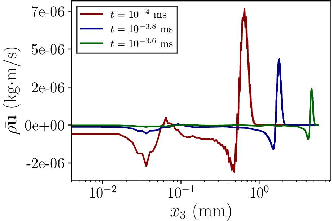
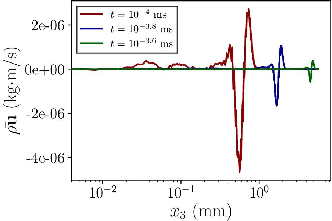
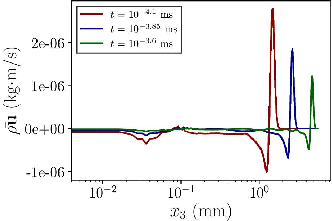
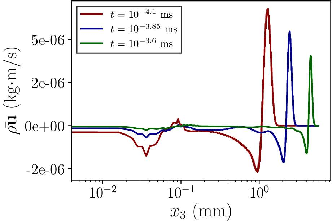
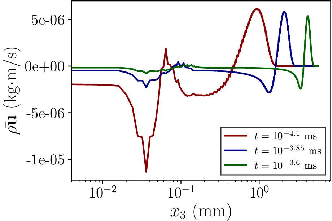
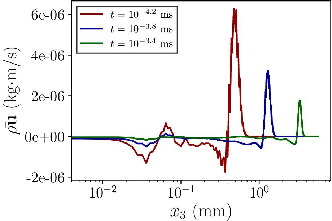
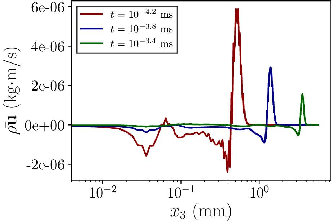
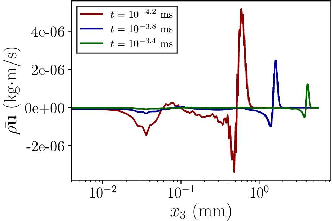
Figure 5: P-waves agitated by the square signal signify attenuation and slow wave recognition.
Conclusion
The model validates theoretical predictions and facilitates exploration into mechanisms unaccounted for by conventional frameworks, making it suitable for diverse applications including geotechnical and seismic analyses. Future advancements involve refining input frequency dynamics, enhancing computational accuracy for viscous interactions, and exploring non-monotonic structures for broad saturation conditions.
The developed hydro-micromechanical model contributes significantly to understanding and simulating wave characteristics in complex saturated granular media, offering comprehensive insights and utility in research and real-world problem solving.