- The paper introduces a MILP model that restores distribution systems by efficiently forming islands with coordinated microgrids and DGs.
- It employs graph theory and McCormick linearization to enforce radiality and manage bilinear relationships for precise optimization.
- Simulations on a modified IEEE 37-bus feeder confirm rapid performance, achieving up to 70% load restoration under severe outages.
Optimal Distribution System Restoration with Microgrids and Distributed Generators
Introduction
The paper presents an innovative approach to Distribution System Restoration (DSR) within single-phase power distribution systems incorporating microgrids and Distributed Generators (DGs). The authors develop a Mixed-Integer Linear Programming (MILP) model that optimally restores the system by forming islands without pre-identifying reference buses, coordinating multiple DGs, and incorporating voltage regulators. This method scales efficiently due to specific optimization strategies and aims to enhance grid reliability and resiliency.
Methodology
The proposed DSR scheme addresses several challenges in power distribution. The model optimizes island formation in a single stage, differing from traditional two-step methods that separately identify reference generators and then create islands. By exploiting graph theory, specifically cycles and paths, the scheme efficiently reconfigures the grid post-fault to maximize load restoration.
Graph-Theoretic Approach
The distribution network is modeled as a graph, G=(N,E), where nodes represent buses and edges represent lines and switches. Radiality, a necessary condition for grid stability, is enforced using indicator vectors for paths and cycles. Constraints on binary edge status variables ensure correct network topology.
Optimization with MILP
One of the key innovations is the use of the McCormick linearization technique, a convex relaxation approach that handles bilinear terms with binary variables effectively. This allows the accurate modeling of interactions between system nodes and DGs.
Coordination of Generators
The coordination of both black-start and non-black-start generators is vital for effective islanded operation. The model ensures that non-black-start DGs are only operational if connected to a powered node. A coordination hierarchy among black-start generators ensures the largest DG operates in PV mode, with others in PQ mode if connected in an island setup.
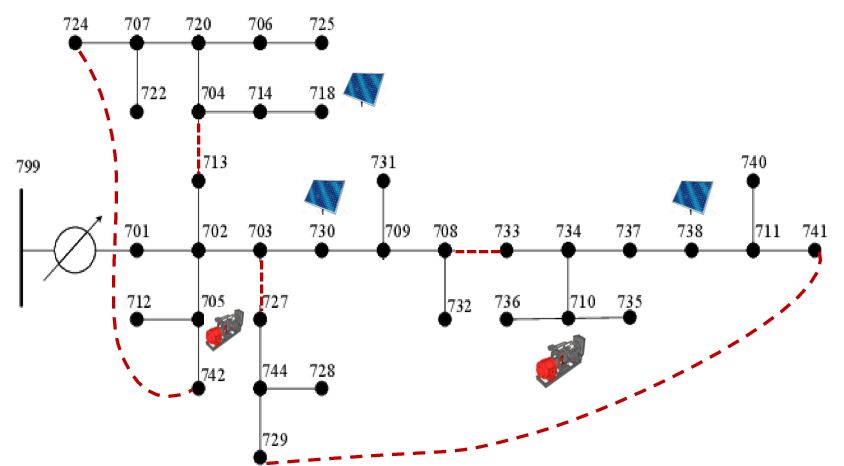
Figure 1: A modified IEEE 37-bus feeder showing existing lines and generators.
Simulation and Results
The methodology was tested using a modified IEEE 37-bus feeder model. Two black-start and three non-black-start DGs were deployed, with scenarios simulated for up to five concurrent line outages. The DSR scheme demonstrated rapid computational performance, solving each scenario in under four seconds on average, a testament to its scalability and efficiency.
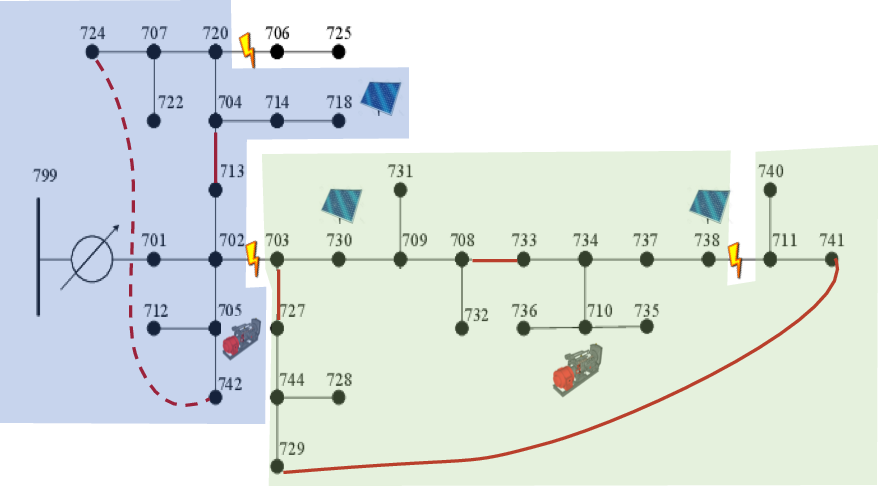
Figure 2: The feeder of Figure 1 restored after a three-line outage.
The simulation results showed that the proposed model could restore up to 70% of load in cases of five simultaneous line outages. The scheme's strength lies in its robust handling of complex DSR problems, showcasing its adept integration of DG coordination and grid reconfiguration.
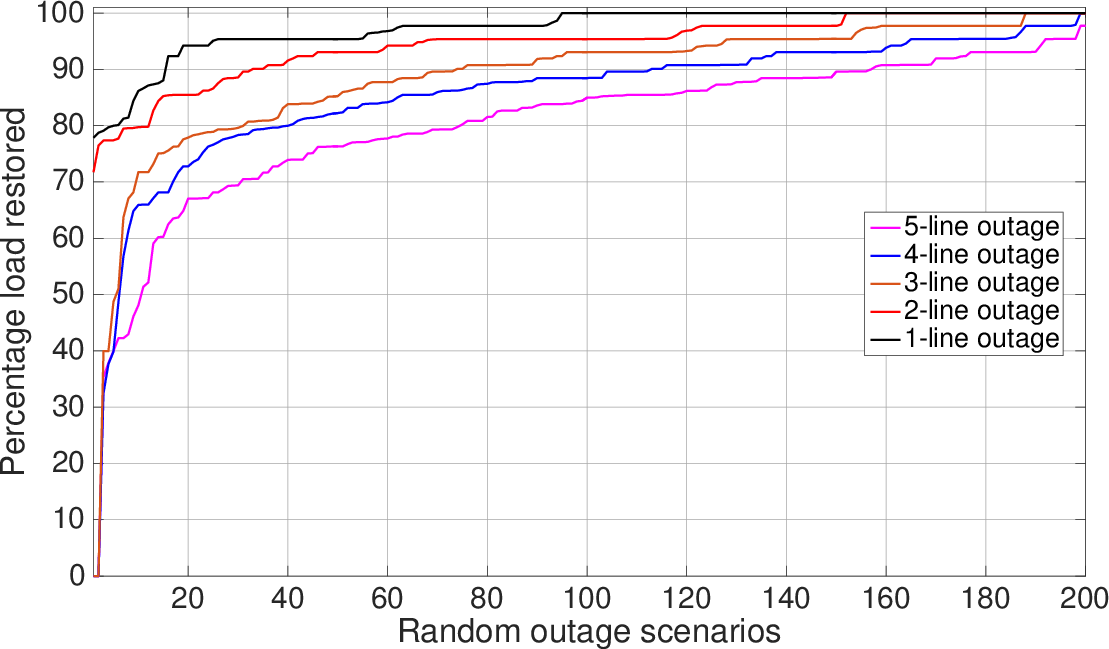
Figure 3: The (ordered) percentage of load restored after 1--5 line outages.
Discussion
The authors highlight a significant improvement in DSR strategies by integrating advanced coordination mechanisms for DGs and leveraging the capabilities of microgrids. The MILP's scalability is attributed to its efficient use of graph-based constraints and linearization techniques, broadening the scope for future applications in power grid management.
Implications and Future Work
The research sets a foundation for advancements in grid resiliency through optimized restoration processes. Potential future developments include multi-step restoration frameworks, integration with three-phase systems, and adaptive strategies for real-time grid threats, such as cyber-attacks and extreme weather events.
Conclusions
The paper demonstrates a sophisticated approach to DSR that optimally maximizes load restoration by forming feasible islands with multiple DGs and integration of voltage regulation. This method holds promise for extending to wider applications in grid management and enhancing the robustness of power distribution systems against disruptions.