- The paper shows that Configurational Entropy increases with operator dimension, identifying conventional hadrons as low-entropy states and exotic ones as high-entropy configurations.
- It employs a soft-wall holographic QCD framework and solves Schrödinger-like equations to derive energy density profiles, establishing a link between radial quantum numbers and CE.
- The findings suggest that the prevalence of simple hadrons in experiments reflects their structural simplicity, while the increased entropy of exotic states may explain their scarcity.
Configurational Entropy as a Diagnostic for Conventional and Exotic Hadrons
Introduction
This paper investigates the utility of Configurational Entropy (CE) as a discriminant between conventional hadrons and exotic multiquark/multigluon states within the soft-wall holographic QCD framework. Specifically, the CE for scalar mesons (JPC=0++) and baryons with JP=21+ is calculated as a function of operator dimension in the boundary theory, reflecting the complexity of the corresponding QCD operators. The analysis establishes a systematic correlation between CE growth and the nontriviality (exoticism) of hadronic configurations, with implications for understanding the compositeness and prevalence of physical hadronic states.
Theoretical Framework
CE, grounded in Shannon entropy, quantifies the spatial complexity of localized energy profiles. For a bounded, square-integrable profile function F(x), its modulus-squared Fourier transform is used to define modal fractions, from which the CE is evaluated as
SCE=−∫f^(k)lnf^(k)dk,
where f^(k) is the normalized modal fraction. Lower CE indicates structural simplicity, while higher CE is associated with more intricate spatial configuration.
To obtain F(x) for hadrons, the study leverages AdS/QCD duality: five-dimensional bulk fields are dual to four-dimensional QCD operators. For the AdS5 soft-wall model, fields are governed by a background metric and a quadratic dilaton. Scalar and spinor bulk actions are constructed, leading to equations of motion whose regular solutions yield the profile F(z). For hadrons, the T00 (energy density) component of the stress tensor derived from these bulk solutions constitutes the profile function for CE computation.
CE Analysis for Scalar Mesons
Scalar mesons are mapped to bulk fields dual to QCD operators of varying dimension Δ. For instance, conventional qˉq mesons correspond to minimal Δ, while tetraquarks, hybrids, and glueballs correspond to higher Δ due to their multiquark/multigluon content. The bulk equations are reduced to Schrödinger-like form, yielding discrete spectra and normalized solutions, from which the energy density is computed.
For a fixed Δ, CE is found to increase with the radial quantum number n, consistent with previous studies on spatial complexity in excited hadronic states.
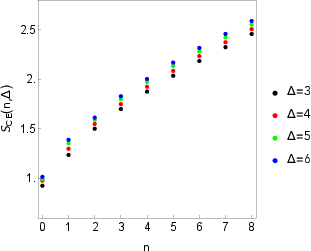
Figure 1: Configurational Entropy of JPC=0++ mesons as a function of radial quantum number n and operator dimension Δ.
When CE is plotted for a series of operator dimensions, a clear monotonic increase is observed: higher-dimensional operators (qˉqˉqq, qˉGq, GG) are systematically associated with higher CE compared to the conventional qˉq case, for the same n.
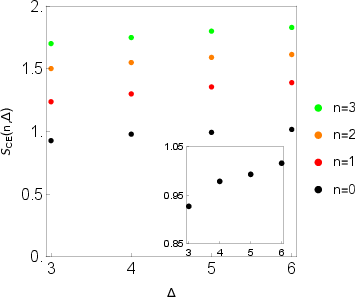
Figure 2: CE for scalar mesons as a function of operator dimension Δ, highlighting the ground state (n=0) region.
CE of JP=21+ Baryons
An analogous procedure is applied to baryons, representing three-quark and pentaquark states via boundary operators of σ=mL=Δ−1/2. The AdS/QCD action for spin-1/2 bulk fermions is solved with a z-dependent mass term, leading to normalizable, discrete spectra for both left- and right-handed fields. The corresponding profile function for CE calculation involves the energy density T00(z) constructed from these solutions.
The CE for baryons exhibits similar qualitative trends: an increase with both the radial quantum number n and, crucially, with operator dimension σ. In particular, CE attains a minimum for three-quark baryons (σ=4), while being systematically higher for pentaquarks (σ=7). This formalizes the intuition that exotic states—those with more constituents—exhibit greater spatial informational complexity.
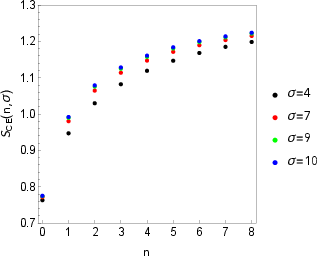
Figure 3: Configurational Entropy of JP=21+ baryons as a function of radial quantum number n and σ.
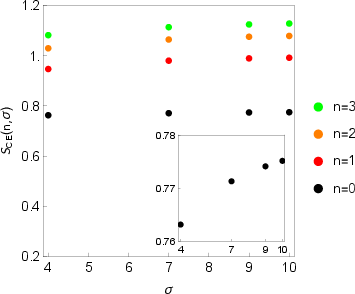
Figure 4: CE for baryons as a function of operator dimension σ, with the n=0 case magnified for clarity.
Numerical Results and Contradictory Implications
A key, assertive finding is that, for both JPC=0++ mesons and JP=21+ baryons, the CE monotonically increases with the number of constituent quark and gluonic degrees of freedom. This increase is nontrivial and robust across both hadronic families. The numerical results imply that conventional hadrons (minimal-constituent configurations) are those with minimum CE under the holographic prescription utilized.
This finding challenges alternative scenarios in which spatial complexity (and hence entropy) might not distinguish between compositeness and 'exotic' character.
Implications, Limitations, and Outlook
The connection drawn between low configurational entropy and conventional hadronic states carries concrete phenomenological implications. If low CE is an indicator of physical (i.e., experimentally prevalent) states, one may interpret the empirical dominance of qˉq mesons and qqq baryons as a reflection of underlying structural simplicity within QCD. Conversely, the scarcity of observable multiquark and hybrid states might stem from their increased spatial informational complexity, as captured by CE.
From a theoretical standpoint, CE offers a quantitative tool for the systematic classification of hadronic states in the AdS/QCD context. Its monotonicity with respect to operator dimension supports the use of CE in model-building, especially for disentangling conventional hadrons from exotic candidates. However, the analysis is confined to the soft-wall holographic model, and omits effects such as anomalous dimensions, mixing, and radiative corrections. The generality of CE as a universal classifier remains to be established in more dynamical settings.
Prospectively, CE-based diagnostics could inform searches for exotic hadrons, guide the development of effective field theories, and be incorporated into computational schemes for QCD spectral analysis. Extensions to finite temperature/density, and to systems including open heavy flavor, are natural directions for future work. The connection between CE and production/detection probabilities of hadrons in experiment is especially intriguing.
Conclusion
The study demonstrates that Configurational Entropy, evaluated in the AdS/QCD soft-wall framework, correlates strongly with operator dimension and identifies conventional hadrons as minimal-entropy configurations. This quantitative distinction between ordinary and exotic hadrons provides a promising tool for state classification in QCD models. The observed regularities motivate further exploration of CE as a theoretical and phenomenological discriminator for exotic hadronic matter.