- The paper demonstrates that spin precession frequencies serve as a diagnostic tool to distinguish Kerr-like black holes from naked singularities in PFDM.
- The methodology integrates Lense-Thirring and geodetic precession analysis to reveal variations in horizon dynamics and observable accretion disk QPO features.
- The study highlights the influence of PFDM parameter α on critical spin thresholds, impacting gravitational wave interpretations and astrophysical observations.
Distinguishing Kerr-like Black Holes from Naked Singularities in Perfect Fluid Dark Matter
The examined paper assesses the theoretical distinction between Kerr-like black holes and naked singularities in the context of perfect fluid dark matter (PFDM). It explores how spin precession frequencies can be employed as a diagnostic tool to differentiate gravitational structures, offering insights applicable to astrophysical observations.
Kerr-like Black Holes and Naked Singularities in PFDM
The study of Kerr-like black holes in PFDM extends conventional understandings by incorporating parameters linked to dark matter effects. A pivotal aspect is the critical spin parameter, ac, which serves to distinguish black holes from naked singularities. For spin values exceeding ac, the solution transitions from a black hole to a naked singularity. Calculations within specified ranges of PFDM parameter α (−2≤α<2/3) reveal crucial details about the relationship between α and the sizes of black hole horizons.
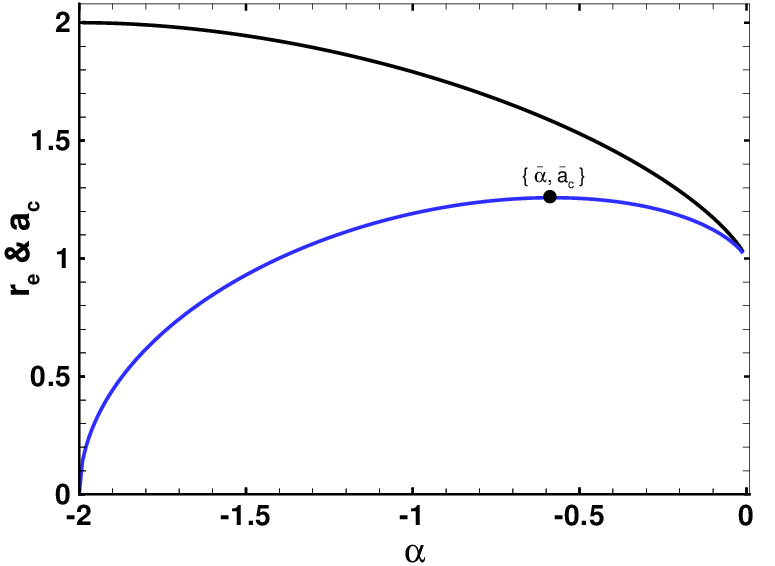
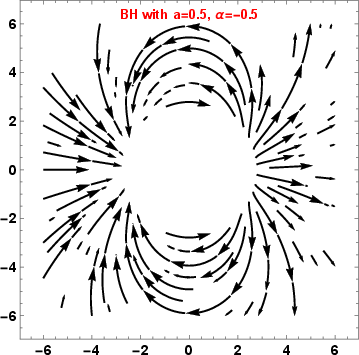
Figure 1: The horizon of the extremal black hole re versus spin parameter ac for negative and positive α illustrates size dynamics with changing α values.
Spin Precession Frequency
The study introduces spin precession frequencies as a method to differentiate the gravitational landscape of PFDM-modified black holes. The detailed examination of Lense-Thirring (LT) precession and geodetic precession frequencies reveals discrepancies in how these frequencies behave around black holes and naked singularities. For stationary observers near the ergospheres of black holes, LT precession increases, diverging at horizon boundaries, contrasting with their finite measurement around naked singularities—except at ring singularities.
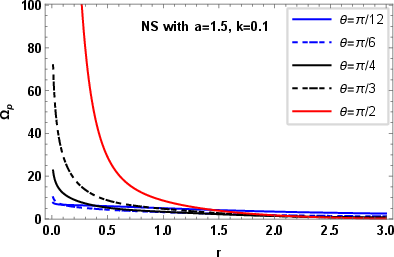
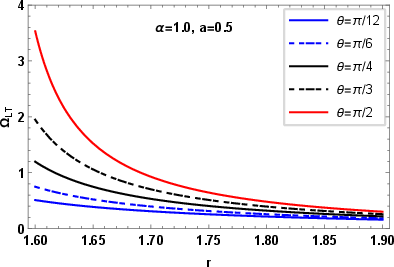
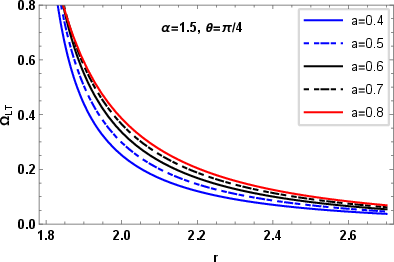
Figure 2: The LT precession frequency ΩLT in terms of M−1 showcases variation dependent on rotation and PFDM parameters.
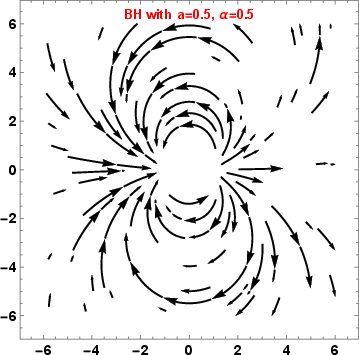
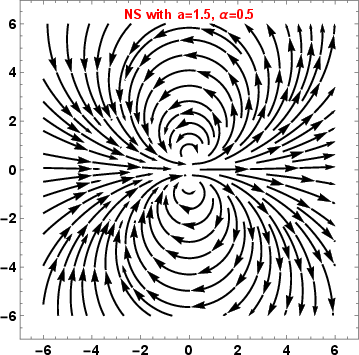
Figure 3: The vector fields of LT precession frequencies for distanced spatial analysis, illustrating observable differences in black holes versus naked singularities.
Observational Implications
Astrophysical observations are enhanced by theoretical insights concerning quasi-periodic oscillations (QPOs) occurring in accretion disks. These model projections align with known features influencing high-frequency and low-frequency QPOs. Through applied relativity principles, distinctive signatures produced by PFDM parameters promise to inform gravitational wave research and possibly equip black hole constraints in observational contexts.
Conclusion
The paper provides a comprehensive framework to differentiate Kerr-like black holes from naked singularities through spin precession frequency analysis. The results, emphasizing dependence on PFDM parameters, extend theoretical astrophysics by offering nuanced methods to explore the influence of dark matter, promoting future developments to test these findings through empirical investigational means, such as gravitational wave detection methodologies and QPO analysis across varied celestial landscapes.