Statistical inference for Bures-Wasserstein barycenters
Published 2 Jan 2019 in math.ST and stat.AP | (1901.00226v2)
Abstract: In this work we introduce the concept of Bures-Wasserstein barycenter $Q_$, that is essentially a Fréchet mean of some distribution $\mathbb{P}$ supported on a subspace of positive semi-definite Hermitian operators $\mathbb{H}{+}(d)$. We allow a barycenter to be restricted to some affine subspace of $\mathbb{H}{+}(d)$ and provide conditions ensuring its existence and uniqueness. We also investigate convergence and concentration properties of an empirical counterpart of $Q_$ in both Frobenius norm and Bures-Wasserstein distance, and explain, how obtained results are connected to optimal transportation theory and can be applied to statistical inference in quantum mechanics.
The paper establishes the existence and uniqueness of Bures-Wasserstein barycenters as a Fréchet mean on positive semi-definite Hermitian operators.
It presents central limit theorems showing that the empirical barycenter converges weakly to a normal distribution with a well-defined covariance operator.
The study bridges quantum mechanics and optimal transport theory to offer actionable insights for aggregating quantum statistical data.
Statistical Inference for Bures-Wasserstein Barycenters
Introduction
The paper "Statistical inference for Bures-Wasserstein barycenters" introduces the concept of Bures-Wasserstein barycenters and investigates their statistical properties within the context of quantum mechanics and optimal transportation theory. The Bures-Wasserstein barycenter, Q∗, acts as a Fréchet mean of a distribution P supported on positive semi-definite Hermitian operators, denoted as H+(d). The authors focus on the existence and uniqueness conditions of barycenters, and establish convergence and concentration properties of their empirical counterparts in Frobenius norm and Bures-Wasserstein distance.
Bures-Wasserstein Distance
The Bures-Wasserstein distance, dBW, is defined for any pair of positive matrices Q,S∈H+(d) as:
dBW2(Q,S)=tr(Q)+tr(S)−2tr((Q1/2SQ1/2)1/2).
This distance originates from quantum mechanics, relating to the fidelity measure between quantum states, and is also significant in optimal transportation theory, acting as a distance for Gaussian measures in the scale-location family [takatsu2011wasserstein].
Figure 1: Visualization of the Bures-Wasserstein distance dBW as applied to quantum states ρ and σ.
Existence and Uniqueness of Buryes-Wasserstein Barycenters
Under certain assumptions, the paper proves the existence and uniqueness of Q∗, described by the fixed-point equation involving the optimal transportation map TQS. The barycenter Q∗ is characterized as the unique solution to:
E(TQ∗S)=I,
where I is the identity operator, ensuring Q∗ is positive-definite. This is analogous to the characterization found in classical Wasserstein barycenters for the scale-location family.
Asymptotic Analysis
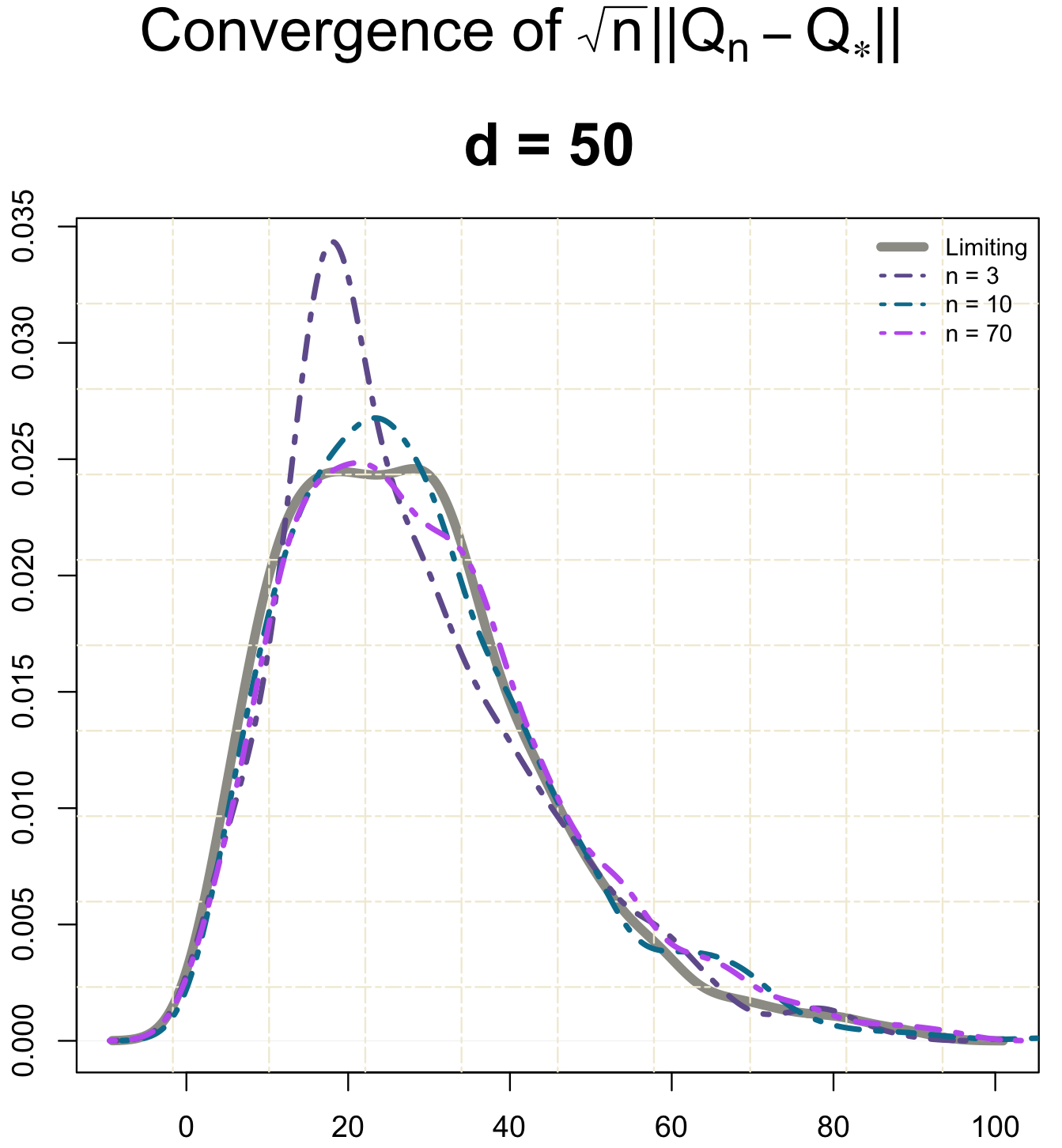
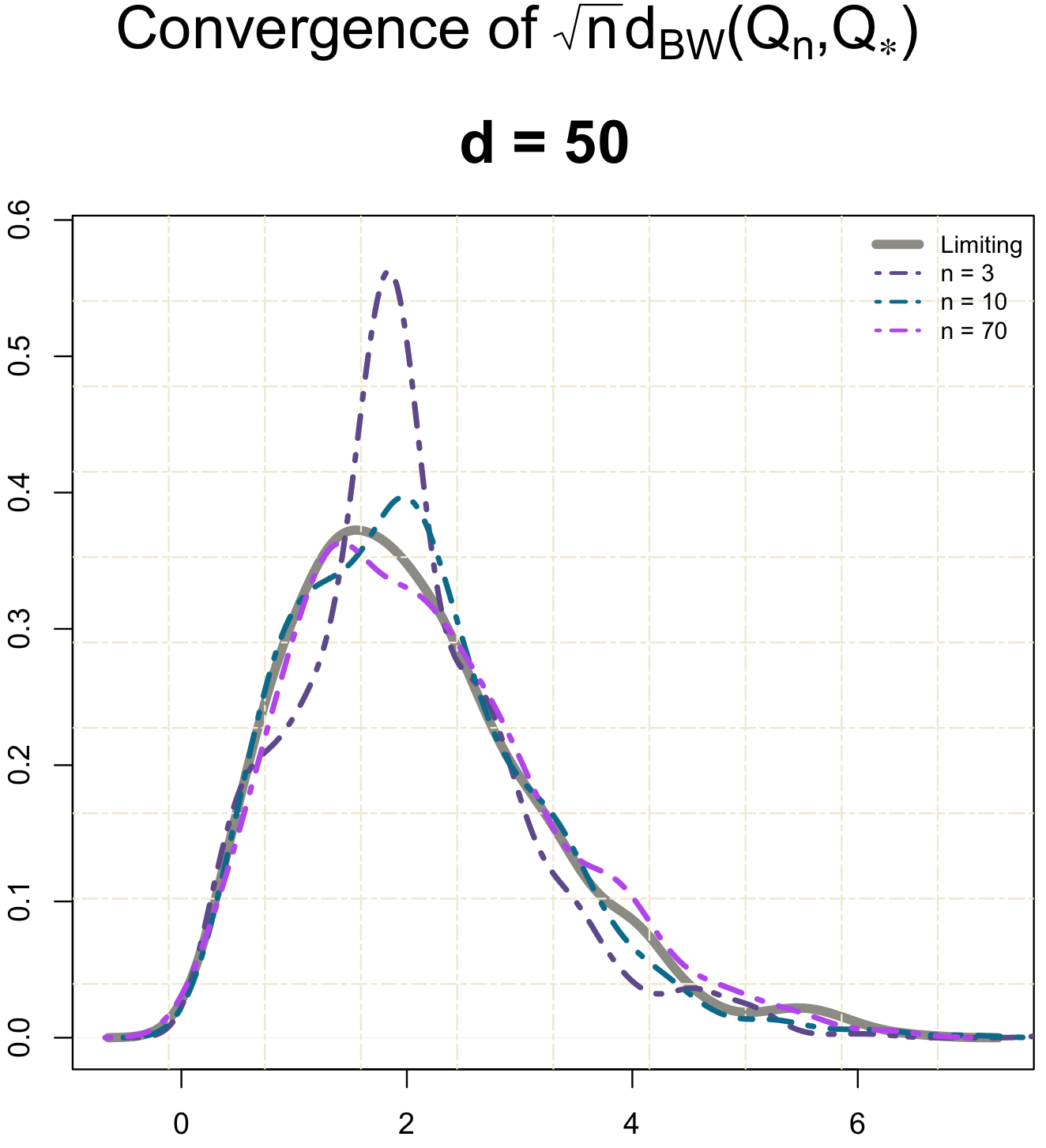
The authors develop central limit theorems detailing the asymptotic behavior of the empirical Fréchet mean Qn and the empirical variance Vn. They establish that the approximation error of Qn converges weakly to a normal distribution:
n(Qn−Q∗)⇀N(0,Υ),
where Υ is the covariance operator. Also, they derive concentration inequalities under sub-Gaussian assumptions for Qn demonstrating the empirical variance's consistency [ahidar2018rate].
Extension to Quantum Mechanics
The paper extends the application of Bures-Wasserstein barycenters to quantum mechanics, particularly in statistical analysis involving quantum density operators. This analytical framework facilitates the identification of mean quantum states reflecting typical observations in experiments, with the barycenter constrained to an affine subspace.
Conclusion
This study enhances the understanding of Bures-Wasserstein barycenters by providing a rigorous statistical inference framework. It bridges quantum mechanics and optimal transport theory, offering substantial theoretical insights and potential applications in aggregating quantum statistical data. Potential future work includes leveraging these findings in practical quantum systems and exploring further statistical properties under relaxed assumptions.