- The paper introduces a skip-connected encoder-decoder with adversarial training to accurately model normal data distributions and detect anomalies.
- It combines adversarial, contextual, and latent losses to enhance image reconstruction fidelity and improve detection performance.
- Experimental results on datasets like CIFAR-10 and X-ray screenings show superior performance, achieving AUC scores up to 0.953 in specific cases.
Skip-GANomaly: Skip Connected and Adversarially Trained Encoder-Decoder Anomaly Detection
Introduction and Background
The research paper "Skip-GANomaly: Skip Connected and Adversarially Trained Encoder-Decoder Anomaly Detection" addresses the intricate challenge of anomaly detection, a significant task within the domains of machine learning and visual scene understanding. Unlike typical supervised methods constrained by the lack of diverse anomalous samples, the study introduces an unsupervised approach leveraging an adversarially trained encoder-decoder neural network with skip connections. This method is crafted to precisely capture the normal data distribution, enabling the detection of deviations indicative of anomalies.
Methodology
The cornerstone of the proposed approach is an encoder-decoder architecture augmented with skip connections to efficiently model both high and low-dimensional feature spaces. The encoder down-samples the input image to a compact latent representation, while the decoder reconstructs the image from this latent space. The model employs an adversarial training scheme where the generator (G) and the discriminator (D) networks engage in a minimax game. The generator aims to reconstruct images as close to the originals as possible, while the discriminator distinguishes between real and generated images (Figure 1).
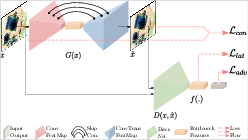
Figure 1: Overview of the proposed adversarial training procedure.
The inclusion of skip connections aids in preserving the spatial and multi-scale information necessary for high-fidelity reconstruction, enhancing the ability to differentiate between normal and anomalous samples. The proposed method uniquely binds adversarial loss with contextual and latent losses to ensure the network learns a robust distribution model.
Experimental Evaluation
The experimental evaluation encompasses standard datasets, including CIFAR-10 and various X-ray screening datasets like UBA and FFOB, demonstrating the model's versatility across different domains. The CIFAR-10 experiments adopt a one-class-vs-rest approach, revealing superior performance over other models such as AnoGAN, EGBAD, and GANomaly, particularly highlighting an AUC of 0.953 for the 'car' anomaly case (Figure 2).
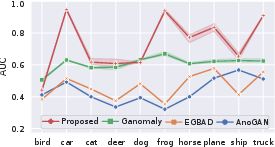
Figure 2: AUC results for CIFAR-10 dataset. Shaded areas in the plot represent variations due to the use of 3 random seeds.
In the challenge of identifying anomalies in X-ray baggage screening datasets, the proposed model outperformed all baseline methods, demonstrating its capability to handle real-world complexity (Figures 5 and 6).
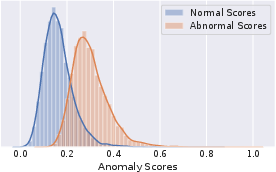
Figure 3: (a) Histogram of the normal and abnormal scores for the test data.
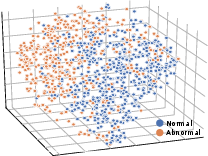
Figure 4: (b) t-SNE plot of 1000 subsampled normal and abnormal features extracted from the last convolutional layer of the discriminator.
The architecture's skip connections and discriminator-based latent feature extraction contribute to numerically superior results, manifesting the model's ability to detect subtle anomalies across diverse test settings.
Discussion and Implications
The deployment of skip connections confers the proposed model with robustness and adeptness in learning both global and local features of the normal class, instrumental in effective anomaly detection. Skip-GANomaly substantially advances the state-of-the-art by exploiting feature extraction from the discriminator, providing a comprehensive scaffold for training unsupervised models in high-stakes applications like security and surveillance.
Conclusion
This study's results highlight the potential of adversarially trained, skip-connected networks for unsupervised anomaly detection tasks, demonstrating significant improvements in detection accuracy. The methodology outlined opens avenues for applying anomaly detection to more intricate datasets and potentially integrating temporal data analysis. Future work should further explore high-resolution imagery and temporal sequences to broaden the effective application of the Skip-GANomaly approach.