- The paper demonstrates GHz-broad quadrature squeezing using CMOS-compatible silicon nitride microring resonators.
- It employs an integrated Sagnac interferometer to generate phase-stable, counter-propagating squeezed states with a measured 0.45 dB squeezing level over a 300 MHz range.
- The study addresses challenges like thermorefractive noise and proposes solutions such as cryogenic operation and improved optical circuit control for scalable quantum applications.
Overview of Nanophotonic Source of Broadband Quadrature Squeezing
The paper investigates the generation of broadband quadrature squeezing using integrated photonic circuits fabricated with CMOS-compatible techniques. Quadrature squeezed states of light are key resources for quantum technologies, enabling applications such as improved precision measurements, enhanced security in quantum key distribution, and advanced quantum computation. The research highlights a method to achieve GHz-broad quadrature squeezing through a silicon nitride (SiN) microring resonator, demonstrating both the potential and challenges of integrating such quantum resources on photonic chips.
Silicon Nitride Microring Resonators
Silicon Nitride was chosen for its favorable optical properties, including low loss propagation and the absence of two-photon absorption up to visible wavelengths. Using a microring resonator structure to enhance self-phase modulation through the Kerr effect, the authors achieved a quadrature squeezing level corrected to be around 1 dB below the Shot Noise Level (SNL). This advance in CMOS-compatible materials opens new possibilities for the integration of continuous variable sources on photonic chips, facilitating the development of scalable quantum technologies.
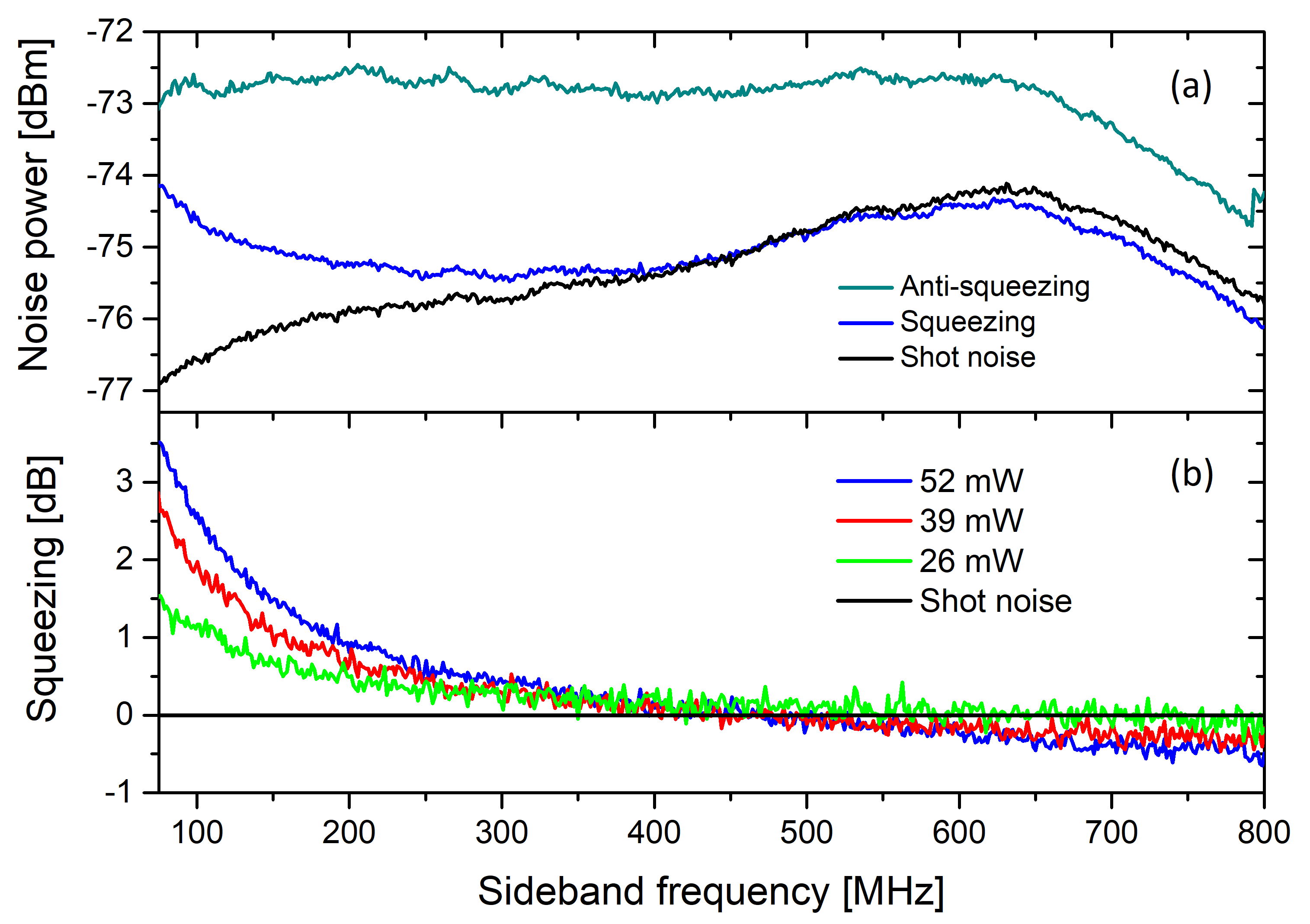
Figure 1: a) Noise spectrum for measured squeezing, anti-squeezing and shot noise for an on-chip pump power of 52 mW, showing the squeezing spectrum and noise corrections.
Experimental Setup and Results
The experimental setup involved an integrated Sagnac interferometer design, which supports phase-stable, counter-propagating squeezed coherent states to create a single quadrature squeezed state through interference. The photonic chip contains multiple microring resonators, optimized to maximize the third-order non-linearity. Transmission measurements demonstrated a loaded Q-factor of 238,000, with the maximum squeezing reaching 0.45 dB observed over a frequency range of 300 MHz.
Challenges and Noise Limitations
A significant challenge identified is the excess noise produced by thermorefractive effects, which causes phase noise due to temperature-induced refractive index fluctuations in the chip. This excess noise diminishes squeezing at low frequencies. Solutions proposed include operating at cryogenic temperatures to suppress thermal noise and improving optical circuit control to enhance the interferometer contrast, potentially reducing classically correlated noise.
Future Prospects and Implications
The authors study possibilities for increasing squeezing levels with improved SiN waveguide properties and higher-Q factor resonators. Predictions suggest achievable squeezing levels up to 13 dB with modest power requirements, paving the way for advanced continuous variable quantum computing that meets the 10 dB threshold for fault-tolerant universal quantum computation. Additionally, integrating such sources could enhance other quantum protocols like quantum teleportation and cryptography.
(Figure 2)
Figure 2: Comparison between measured squeezed spectrum and theoretical prediction without thermorefractive noise showing agreement at high frequencies.
Conclusion
This work demonstrates the integration of quadrature squeezing sources in SiN microring resonators on CMOS-compatible photonic chips, highlighting both the technical progress and challenges faced in achieving high levels of squeezing under practical conditions. Future enhancements in fabrication and design could facilitate a wide array of applications in quantum technologies, emphasizing the importance of scalable, chip-based solutions in the expansion of photonic quantum technologies. The potential to integrate elements like SSPDs and delay lines further strengthens the case for using SiN platforms in realizing complex quantum systems.