- The paper introduces an adjoint sensitivity framework for hybrid systems integrating discrete-continuous dynamics and memory effects.
- The methodology extends forward sensitivity analysis with detailed formulations for jump conditions and transition time sensitivities.
- Numerical examples validate the approach in hybrid ODE problems and computational mechanics models exhibiting hysteretic behavior.
Sensitivity Analysis for Hybrid Systems and Systems with Memory
Introduction
The paper "Sensitivity Analysis for Hybrid Systems and Systems with Memory" (1904.08734) addresses the development of adjoint sensitivity methods tailored for hybrid systems characterized by discrete-continuous dynamics, as well as systems with memory. The authors extend traditional forward sensitivity approaches, providing a detailed formulation that includes ordinary differential equations (ODEs), differential-algebraic equations (DAEs) up to Hessenberg index-two, and specific conditions for initialization and state transfer at mode-switching junctures. The research further introduces mechanisms for addressing hybrid systems with memory, where state dynamics exhibit explicit dependencies on prior mode transition states.
Hybrid systems entail a configuration of continuous evolutionary behavior punctuated by discrete transitions, demanding specialized sensitivity analysis techniques. The paper presents a comprehensive framework, starting with the foundational equation for a parameter-dependent DAE system, which forms the backbone of the hybrid system analysis.
The primary contribution lies in the derivation of continuous 1st order sensitivity analysis equations, notably extending forward sensitivity analysis (FSA) and adjoint sensitivity analysis (ASA) methods. For hybrid discrete-continuous systems, this involves solving a linear time-varying DAE system simultaneously with the original model, specifically addressing sensitivity trajectories across transitions.
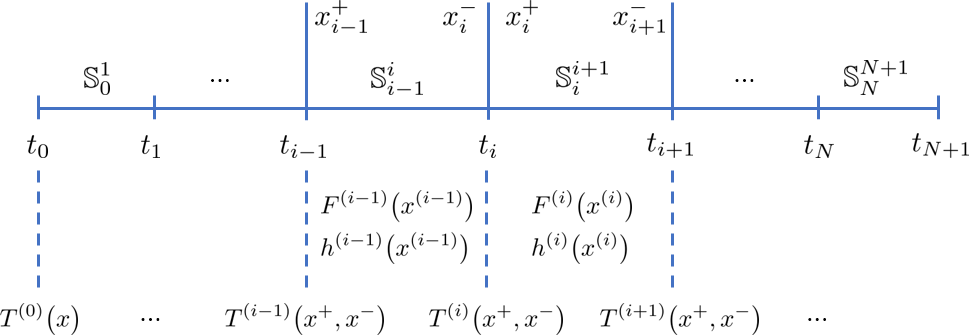
Figure 1: Formulation of hybrid discrete--continuous systems.
The sensitivity equations' solution, particularly at the transition points, necessitates careful attention to potential discontinuities—a challenge mitigated by the derived jump conditions in sensitivity variables. These conditions are complemented by robust assessments of the transition time sensitivity, ensuring continuity in the analysis. The authors employ an adjoint approach to significantly reduce computational overhead, especially when dealing with large-scale systems or when multiple parameters are of interest.
Hybrid Systems With Memory
The study progresses by tackling hybrid systems with memory—a complex class wherein the state dynamics are contingent on the mode's historical states. This treatment is articulated using Hessenberg index-1 DAEs, emphasizing the differentiation of equations to incorporate memory states as time-invariant parameters influencing the system's trajectory.
The hybrid systems with memory necessitate additional steps for sensitivity computations, involving tracking parameter dependencies at transitions and ensuring consistency in both the forward and backward sensitivity propagation.
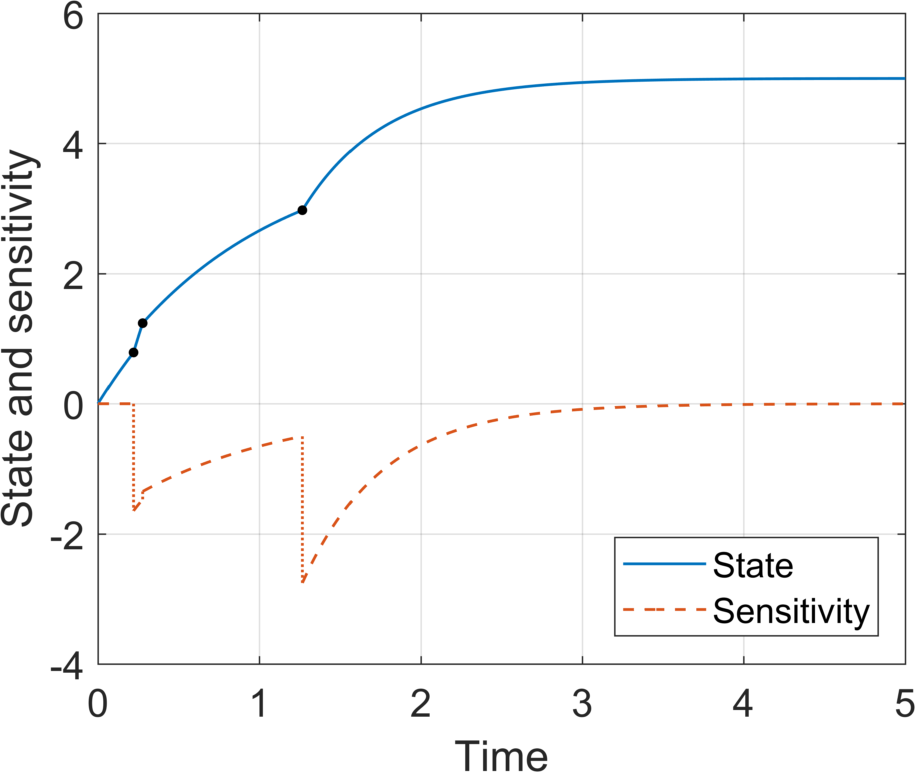
Figure 2: State and sensitivity trajectories for the simple hybrid ODE example.
Numerical Examples and Applications
To validate the proposed methodologies, the authors present two numerical examples:
- A simple hybrid ODE system demonstrating the practical implementation of sensitivity analysis through both forward and adjoint methods, emphasizing the importance of accurately calculating sensitivity jumps and transition time derivatives.

Figure 3: Adjoint variable trajectory for the simple hybrid ODE example.
- A computational mechanics problem featuring a single degree of freedom model based on the exponential model for material behavior under cyclic loading. This example highlights the versatility of the method in capturing complex hysteretic phenomena, corroborating the model's robust handling of memory effects and historical state dependencies.

Figure 4: Forced oscillator using the {em exponential model.
Conclusions
The paper makes significant strides in sensitivity analysis for hybrid systems and systems with memory by providing a structured approach to adjoint sensitivity methods tailored for these complex systems. The extended analysis framework not only offers theoretical value in terms of solvability conditions and initialization strategies but also posits practical implications for computational mechanics and related fields requiring intricate sensitivity studies. Future work could explore deeper into histories manifesting over multiple transition points, thus broadening the applied spectrum of this innovative sensitivity analysis approach.