- The paper introduces XY-mixers in QAOA to preserve constraints and minimize Trotter error using O(κ)-depth circuits.
- It shows that XY-mixers outperform traditional X-mixers by achieving higher approximation ratios in graph coloring experiments.
- The study outlines strategies for implementing XY-mixers on all-to-all and linear architectures using fermionic simulation techniques.
Analytical and Numerical Evaluation of XY-Mixers in QAOA
Introduction to QAOA and XY-Mixers
The Quantum Alternating Operator Ansatz (QAOA) is a powerful quantum algorithm designed for addressing combinatorial optimization problems, particularly on near-term quantum devices. A key challenge in applying QAOA is the implementation of constraints, which this paper addresses using XY-Hamiltonians as mixing operators (mixers). This approach preserves constraint satisfaction while minimizing Trotter error, demonstrated effectively in encoding discrete values into a quantum circuit with depth O(κ), where κ represents the number of discrete values.
Given the practicality of implementing QAOA circuits on hardware with limited connectivity, the authors develop strategies for both all-to-all and linearly connected architectures, leveraging techniques from fermionic simulations. The numerical validation focuses on the graph coloring problem, illustrating that XY-mixers outperform traditional X-mixers and enhance performance when initialized in a generalized W-state.
QAOA Framework
QAOA operates by alternating between applying a problem-specific, phase-separating Hamiltonian, denoted as HPS, and a mixing unitary, typically parameterized by angles optimized within the framework. The algorithm seeks the ground state of HPS in the presence of constraints by enforcing evolution within a feasible subspace of the solution space.
Central to the paper is the exploration of XY-mixers to maintain the computation within the feasible subspace, defined by Hamming-weight constraints. This approach negates the need for penalty terms commonly employed with X-mixers, resulting in more efficient optimization and increased proximity to optimal solutions.
Circuit Realization of XY-Mixers
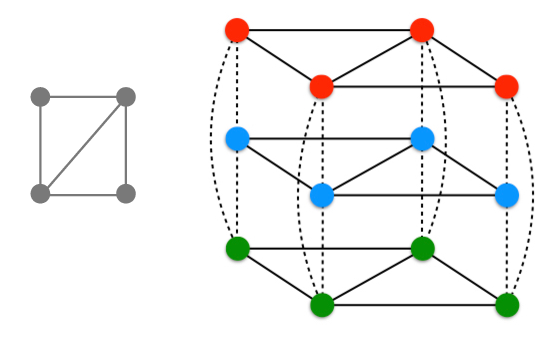
Figure 1: Left: The original graph to-be colored. Right: The qubit-layout encoding the problem. Each vertex v is represented by κ qubits xv,c.
In classical graph coloring translated into quantum circuits, vertices are color-encoded into qubits such that adjacent vertices differ in color. The XY-mixers enable direct manipulation of these encoded states by acting on linear superpositions effectively. Within this framework, simultaneous and partitioned mixers on a complete or ring graph topology are considered.
For a complete-graph mixer, the simulation demonstrates the capability to implement the necessary circuits in O(κ) depth, assuming ideal connectivity. Conversely, the ring mixer capitalizes on the Jordan-Wigner transformation to convert spin interactions into quadratic fermionic couplings, suitable for systems with reduced connectivity to maintain desirable performance characteristics.
Empirical Evaluation
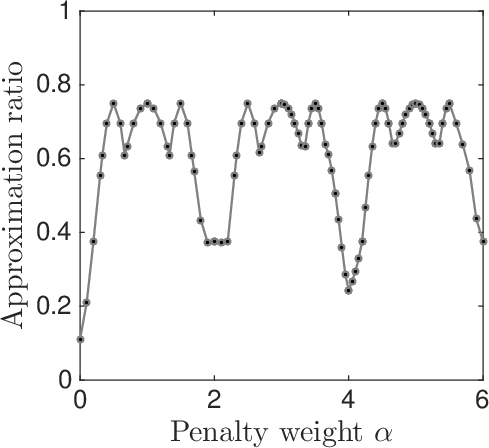
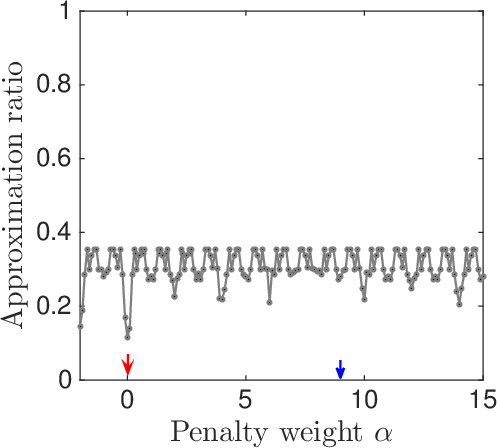
Figure 2: (a) 2-coloring and (b) 3-coloring of a triangle with level 1 QAOA, depicting the approximation ratio versus penalty weight α.
The empirical results profile small hard-to-color graphs, such as the triangle, envelope, and prism graphs. Results indicate a consistent superiority of XY-mixers over X-mixers in scenarios necessitating high approximation ratios at modest depths.
In addition to performance metrics, the choice between simultaneous and partitioned mixers is explored, with the simultaneous mixer exhibiting a notable advantage across tested graph instances at lower QAOA levels.
Conclusion
The investigation into XY-mixers within QAOA indicates their benefit in efficiently enforcing constraints while improving solution quality for complex combinatorial problems. Numerically, they present a compelling case for preference over X-mixers, especially on near-term quantum devices where resources are limited.
These findings support continuing exploration into more varied application domains and contribute foundational insights essential for deploying quantum optimization in practical, real-world scenarios. The challenges remaining chiefly relate to scalability and tackling noisier environments, which will maintain their relevance as the field progresses toward more robust quantum architectures.