- The paper introduces the Pauli Fusion model, a framework that employs ZX calculus for realizing quantum transformations with non-deterministic effects.
- It outlines a polynomial-time algorithm to determine PF-Flows, enabling the deterministic execution of operations via annotated PF-diagrams.
- The study bridges theory and practice, enhancing quantum computation strategies in NISQ devices and optical implementations.
The paper introduces the Pauli Fusion model as an abstract computational framework for quantum computation. The model draws on the ZX calculus, a formal diagrammatic language for quantum computing, to represent quantum protocols. By closely aligning with the ZX calculus, the Pauli Fusion model provides a systematic approach to executing quantum transformations that extend beyond traditional circuit models.
Introduction to the Pauli Fusion Model
The Pauli Fusion model is designed to facilitate the computation of quantum transformations using operations that reflect the generators of the ZX calculus. These operations are simpler abstractions of processes found in quantum technologies such as lattice surgery and optical computing. Unlike traditional quantum computation models based on unitary operations, the Pauli Fusion model incorporates non-deterministic heralded effects similar to measurement-based quantum computation (MBQC). This characteristic allows the model to represent complex quantum procedures with greater ease.
Fundamental Operations
The primary operations in the Pauli Fusion model are defined in terms of completely positive trace-preserving (CPTP) maps. These maps are represented through their Kraus operators and may also be controlled classically. The operations encompass annihilation and preparation maps in various eigenbases, as well as unitary embeddings and non-unitary measurement operations. The capability to handle non-deterministic operations is a key feature of the model, enabling efficient realization of ZX terms beyond the circuit paradigm.
Diagrammatic Representation
A critical component of the Pauli Fusion model is its representation using Pauli Fusion diagrams (PF-diagrams). These diagrams are annotated ZX diagrams that incorporate the non-deterministic effects of operations. The concept of runnability is introduced, describing conditions under which a PF-diagram can be executed as a set of operations corresponding to a Pauli Fusion procedure. This includes ensuring a valid time-ordering based on the dependencies of operations.
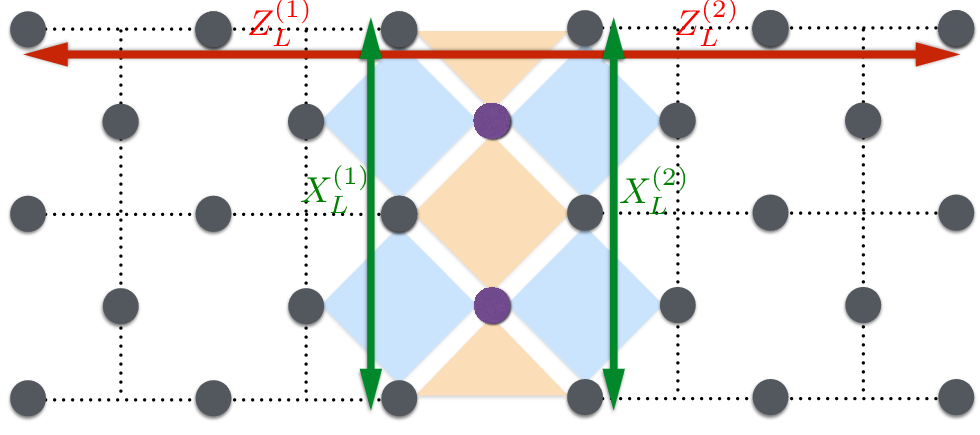
Figure 1: A rough merge. Measuring orange plaquette operators across the join fuses the ZL operators and outputs the result of a $X_L{1$ measurement.
Compilation and Corrector Sets
The paper provides a procedure to transform ZX diagrams into PF-diagrams, allowing deterministic realization of quantum transformations. This involves defining corrector sets within the diagrams that facilitate the correction of phases introduced by different Kraus operators. The existence of a "PF-flow" is essential for the feasibility of deterministic implementation, offering a strategy to navigate the inherent non-determinism of individual PF operations.
Efficient Algorithm for PF-Flows
A notable contribution is the development of an efficient polynomial-time algorithm to determine the existence of PF-Flows in an arbitrary ZX-diagram. When a PF-Flow is present, the algorithm constructs it and provides the necessary structure for realizing the ZX-diagram deterministically. This algorithm significantly enhances the practical applicability of the Pauli Fusion model by automating its integration with existing quantum computational frameworks.
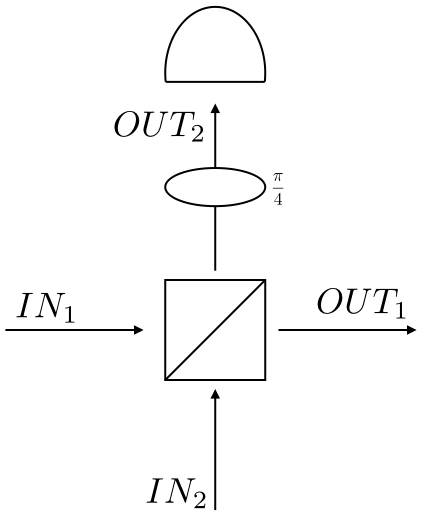
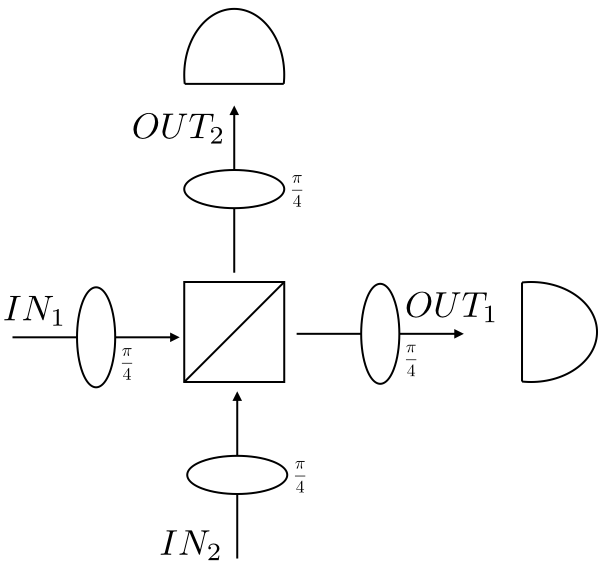
Figure 2: Type I optical fusion gate.
Implications and Future Directions
The introduction of the Pauli Fusion model represents a substantial step towards aligning the design, verification, and operational aspects of quantum computation with a diagrammatic approach. By leveraging the strengths of the ZX calculus, the model offers new pathways for understanding and implementing quantum protocols, particularly in NISQ devices. Future directions include further exploration of the model's applicability to emerging quantum technologies and expanding its integration with optimization and verification tools.
Conclusion
The Pauli Fusion model presents an innovative framework for realizing complex quantum transformations. It bridges the gap between theoretical tools like the ZX calculus and the operational needs of quantum technologies. By enabling a direct representation of ZX diagrams through its operations, the model simplifies the execution of quantum algorithms and opens avenues for enhanced quantum computational strategies.