- The paper demonstrates that AC-based phase retrieval via PROBP-AC revises pulse durations, challenging earlier claims of sub-50 as pulses.
- It reveals that uncompensated attochirp and high-order phase distortions limit the effectiveness of broad spectral bandwidths in shortening SXR pulses.
- The study validates PROBP-AC by yielding revised durations of 62 as, 61 as, and 165 as across three experiments, enhancing measurement accuracy.
Metrology of Time-Domain Soft X-ray Attosecond Pulses: Reevaluation and Phase Retrieval Efficacy
Introduction
Accurate metrology of ultrafast pulses in the soft X-ray (SXR) regime is essential for time-resolved probing of inner-shell electron dynamics—the basis for exploring charge migration and energy flow in atoms, molecules, and materials on attosecond timescales. The extension from extreme ultraviolet (XUV) to SXR attosecond pulses is driven by advances in high-energy, few-cycle, long-wavelength mid-infrared (MIR) lasers that generate high-order harmonics spanning 100 eV to over 1 keV. These broad spectra, in principle, permit pulse durations approaching a few attoseconds. Importantly, rigorous characterization of the temporal and spectral phase is nontrivial due to inherent attochirps introduced during high-harmonic generation, which cannot be compensated across broad bandwidths by available dispersive materials. Therefore, robust phase retrieval and validation techniques are imperative to accurately assess SXR pulse durations attainable in current experiments.
Evaluation of Previous SXR Attosecond Pulse Measurements
Recent experiments have reported isolated attosecond pulses with durations as short as 43–53 as and bandwidths approaching or exceeding 100 eV, positioning these as the shortest SXR pulses claimed in the literature at the time. Typically, retrieved pulse durations are obtained via streaking spectrograms analyzed with iterative phase retrieval algorithms, such as FROG-CRAB, VTGPA, or approximations like PROOF. These methods rest on various levels of simplifications, notably the central momentum approximation (CMA), which breaks down in broad spectral regimes. The reliability of the reconstructed spectral phases—and hence the reported pulse durations—remains an open question for the broadband case.
Visual comparison of simulated and experimental streaking spectrograms is the conventional metric for retrieval accuracy but is shown to be insufficient for ultrabroadband SXR pulses. Simulated case studies demonstrate that spectrograms can be nearly indistinguishable for pulses with durations varying from 20 as to nearly 200 as—especially as bandwidth increases.
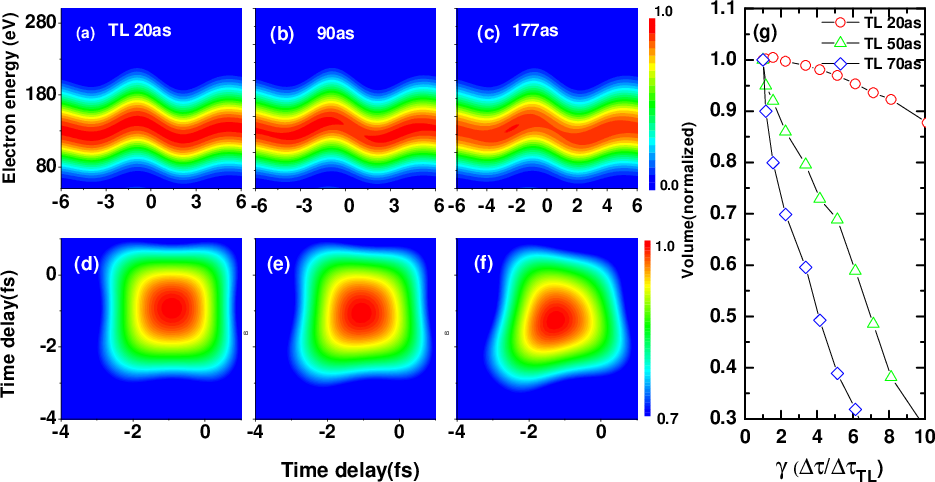
Figure 1: Comparison of theoretically calculated streaking spectrograms and corresponding autocorrelation (AC) patterns for XUV pulses with varying durations and constant spectral bandwidth; the normalized AC volume's insensitivity to increasing pulse duration highlights retrieval difficulties in broadband regimes.
To address these deficiencies, the autocorrelation (AC) of the spectrogram, quantifying correlations between different time delays, is introduced as a robust auxiliary metric. The AC pattern deforms distinctively with increasing pulse chirp and duration, offering sensitivity lacking in direct spectrogram inspection.
The PROBP-AC Retrieval Method and Its Application
The PROBP-AC algorithm circumvented limitations of CMA and error-prone visual matching by leveraging AC patterns directly in the iterative retrieval process. Both amplitude and phase of the SXR and the streaking MIR vector potential are expressed as B-spline expansions, with parameters optimized via a genetic algorithm using AC-based fitness.
The algorithm was applied to three experimental datasets:
- Streaking data from Gaumnitz et al. [Thomas_OE2017, 2017]: The originally reported duration of 43 as was revised to 62 as when reanalyzed with PROBP-AC. The retrieved AC pattern matched the experimental AC far better than previous multi-level VTGPA-based retrievals, indicating the latter's underestimation of both the chirp and duration.
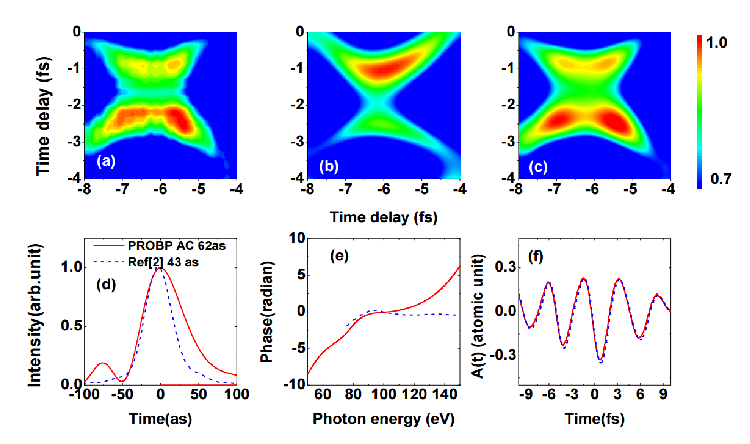
Figure 2: Experimental and retrieved AC patterns and temporal profiles for soft X-ray pulses in \cite{Thomas_OE2017}; the PROBP-AC method achieves superior agreement and a revised longer pulse duration.
- Harmonic pulses from Li et al. [chang_natcom2017, 2017]: The previously reported duration of 53 as (via PROOF) is revised to 61 as. The PROBP-AC method reveals that the generically large phase excursion in PROOF induces an artificial long tail in the temporal profile absent in the new reconstruction.
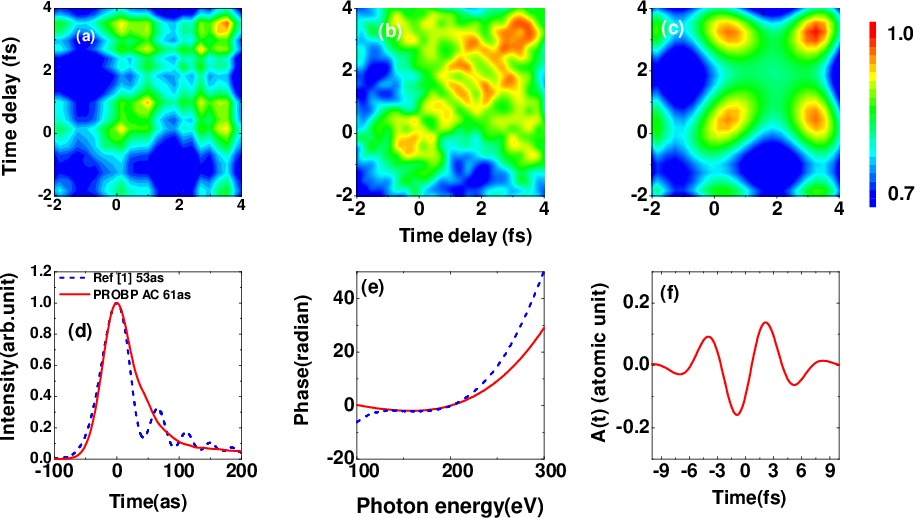
Figure 3: Experimental and methodology-comparative ACs and retrieved pulses for the data of Li et al.; PROBP-AC yields a temporally compact, physically plausible SXR pulse.
- Measurements from Cousin et al. [Bieger_2017PRX, 2017]: For SXR harmonics extending up to 350 eV (TL duration of ≈10 as), the actual retrieved pulse duration is 165 as—much higher than the lower bound set by the bandwidth and nearly half the previously estimated upper limit. The experimental trace's low SNR imposes additional uncertainties, but the result generally illustrates that extremely broadband harmonics do not yield sub-50 as pulses due to uncompensated high-order attochirp.
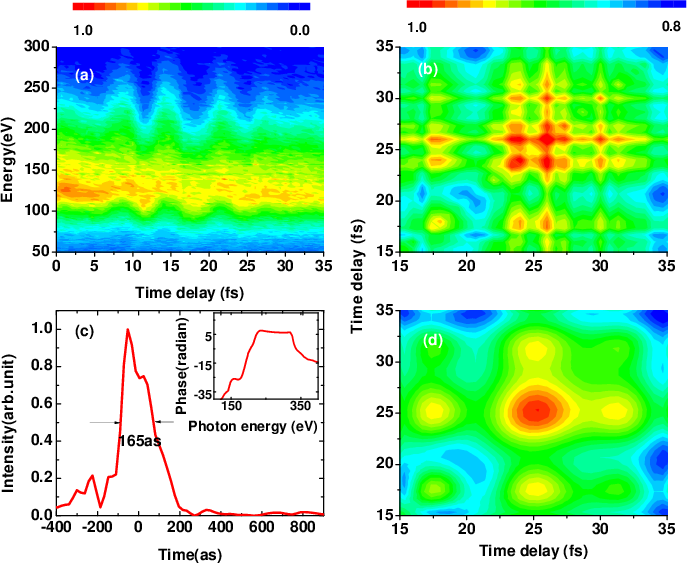
Figure 4: Experimental trace, derived AC, retrieval AC, and the reconstructed SXR intensity envelope for the dataset from \cite{Bieger_2017PRX}; the temporal envelope is significantly broader than the transform-limited expectation.
Implications for Broadband Attosecond Pulse Generation and Metrology
Contrary to previous reports, this analysis establishes that a practical lower bound on SXR pulse duration of ≈60 as currently prevails for all demonstrated sources, regardless of spectral bandwidth. The findings underscore two critical points:
- Bandwidth alone is insufficient: Uncompensated attochirp and high-order phase distortions at spectral wings limit the minimum pulse duration realizable, regardless of the harmonic generator's bandwidth.
- Phase retrieval robustness: AC-based phase retrieval outperforms direct spectrogram fitting in reliability and convergence, particularly as bandwidth and spectral complexity grow.
The study implies that new phase compensation strategies are required for further shortening of SXR pulses, possibly involving adaptive pulse shaping or novel material dispersion engineering. Moreover, further improvements in retrieval algorithms—combining AC analysis with advanced global optimization—are likely necessary for future metrology.
Conclusion
This work demonstrates, with strong experimental corroboration, that the actual durations of state-of-the-art SXR attosecond pulses are consistently underestimated by previous retrieval pipelines. The PROBP-AC algorithm, validated via AC matching, provides a more stringent and physically meaningful measure of pulse chirp and duration. These results prompt a reevaluation of the design principles for attosecond SXR generation and guide the development of next-generation metrology tools targeting accurate, routine characterization of sub-100 as broadband pulses.
Reference: "Metrology of time-domain soft X-ray attosecond pulses and re-evaluation of pulse durations of three recent experiments" (1905.09526).