- The paper develops a bilevel optimization method to reverse-engineer thermal power plant parameters from historical operational data.
- It transforms the complex bilevel problem into a MILP to efficiently estimate efficiencies and cost metrics for CCGT and coal plants.
- Results validate the extracted parameters against industry benchmarks, improving market models and informing policy decisions.
Introduction
The paper presents a methodology for extracting physical and cost parameters of thermal power plants, emphasizing their application within the British electricity market. This is crucial for enhancing fundamental models used in predicting electricity prices and assessing market scenarios. The parameters—such as thermal efficiency, start-up, fixed, and variable operating costs—are not publicly available and thus are typically estimated based on the plant's technology and age. This research addresses the aforementioned limitations by reverse-engineering these parameters using a bilevel optimization approach, leveraging publicly available data to closely match historical production.
Methodology
The paper's method involves a bilevel optimization framework where the Unit Commitment (UC) problem is central to the inner optimization level. Here, given prices for fuel, emissions, and electricity, along with unknown parameters, the UC determines the optimal scheduling of plant operations. The outer level optimizes these plant parameters to closely align estimated production with historical data.
The inner UC problem is defined by maximizing the "clean spark spread," considering startup and fixed costs, subject to constraints including ramping rates and maximum export limits. Simplifications, such as constant efficiency and a single ramping rate, are necessary to mitigate computational complexity. The outer-level optimization uses direct search methods and evolutionary algorithms to efficiently traverse the parameter space and identify optimal parameter settings.
Assumptions and Challenges
Several assumptions underpin the model, including the operational reality that plants run optimally based on the described UC model and engage solely in spot market transactions. While these assumptions facilitate modeling, they do not necessarily reflect nuanced operational behaviors such as maintenance scheduling or participation in reserve services. Additionally, simplifications—like excluding part-load efficiency variations and certain cost dynamics—impose limitations on the model's granularity.
The computational burden of solving a bilevel optimization problem is notable, especially as model complexity increases. By transforming the bilevel problem into a Mixed Integer Linear Program (MILP), many computational challenges are alleviated, allowing the use of sophisticated solvers to obtain solutions efficiently.
Results
The methodology successfully extracts parameters for Combined Cycle Gas Turbine (CCGT) and coal power plants, revealing efficiencies and cost structures that align with industry benchmarks and literature values.
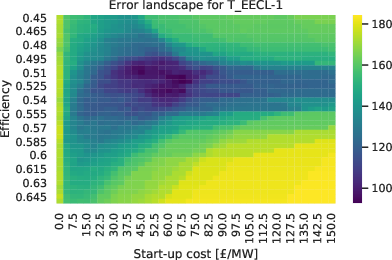
Figure 1: RMS Error [MW] for power plant T_EECL-1 as a function of efficiency and start-up costs, with fixed and variable costs set to ϕ=11\pounds/MW(cap) and ν=0.
Examination of CCGT plants commissioned in the 1990s and 2016 showed extracted efficiencies of approximately 0.53 and 0.58, respectively, with start-up costs reflective of their operational contexts. For coal plants, efficiencies correlated with age and technological upgrades, as evidenced by T_COTPS-2 post-refurbishment results.
Visual representations of the production profiles (Figures 2-6) underscore the efficacy of the method in bridging the gap between theoretical estimates and observed data.
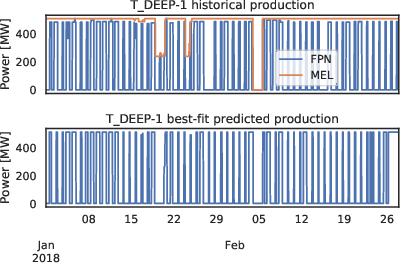
Figure 2: CCGT plant commissioned in 1994 showing efficiency and cost parameter estimates.
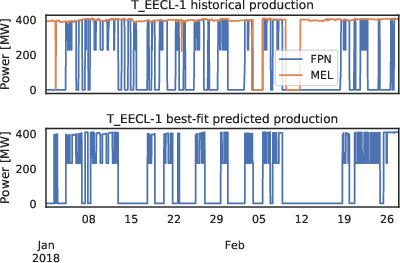
Figure 3: CCGT plant from 1999 demonstrating parameter fitting in line with literature.
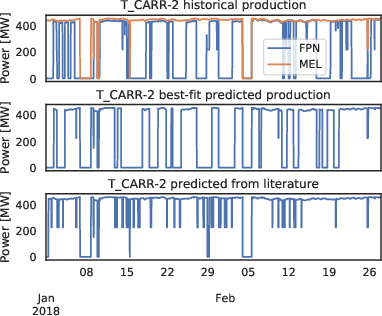
Figure 4: 2016 commissioned CCGT with variances against existing literature parameters.
Practical application extends beyond refining electric market models to potentially influencing policy and operational strategies by offering more precise insights into cost structures and efficiency metrics.
Conclusion
This paper elucidates a novel approach to parameter extraction, leveraging optimization methodologies to overcome data opacity in power market modeling. By translating historical operational data into actionable insights, the research advances the precision and capability of fundamental market models. Future work could explore extending model complexity and overcoming computational hurdles to capture more intricate operational behaviors, further enhancing the model's accuracy and application scope within AI-enhanced market analyses.