- The paper establishes SGWT as an effective feature extractor for enhancing machine learning tasks in neuroimaging, demonstrating improved RMSE and Pearson correlations.
- It employs advanced methodologies with Warped Translate kernels to refine spectral signal representation across synthetic and real fMRI datasets.
- Experimental results indicate consistent performance gains and open avenues for dynamic graph model research in neuroimaging.
Introduction
The paper "Spectral Graph Wavelet Transform as Feature Extractor for Machine Learning in Neuroimaging" (1910.05149) explores the application of Spectral Graph Wavelet Transform (SGWT) as a feature extraction tool for machine learning in the context of neuroimaging. The authors, Yusuf Yigit Pilavci and Nicolas Farrugia, present a detailed methodology to integrate SGWT with neuroimaging data, addressing both theoretical aspects and practical utility. The foundational premise of the research is leveraging Graph Signal Processing (GSP) to address irregular domain problems, significantly enhancing the machine learning performance in brain graph analyses.
Methodology
The central focus of the methodology is the implementation of SGWT for feature extraction. SGWT extends the classical Fourier analogy to graphs, offering a multi-scale representation that is crucial for brain signal analysis. The paper introduces wavelet functions, defined over graphs, which facilitate spectral filtering analogous to Fourier operations. These functions are instrumental in transforming brain signals into a form more amenable to machine learning.
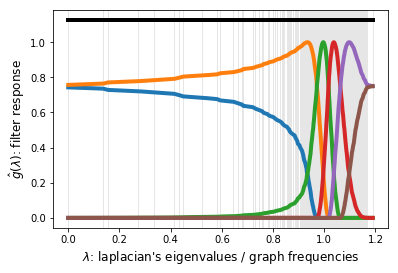
Figure 1: Warped Translate Wavelet Kernels on Spectral Domain, in the case of the KNN-Correlation Brain Graph. Vertical lines depict placement of eigenvalues.
The paper applies SGWT to both synthetic and real fMRI datasets, underscoring its efficacy in feature extraction and signal representation. In generating synthetic graph signals, an Erdos Renyi graph model is employed, optimizing the signal's smoothness across its graph structure. This rigorous construction allows for a comprehensive evaluation of SGWT's feature extraction capability.
In real datasets, the study utilizes an open fMRI dataset, alongside derived functional connectivity graphs. Various graph structures, such as KNN Correlation and Kalofolias Graphs, serve as the baseline for signal transformation, demonstrating the flexibility and adaptability of SGWT across different graph configurations.
Experimental Results
In the experiments, the paper reports significant performance improvements when employing SGWT for machine learning tasks. Notable enhancements are seen in regression problems, with SGWT outperforming baseline methods that rely solely on original or parcellated signals.
The inclusion of Warped Translate kernels notably advances the SGWT's performance, highlighting their role in efficient spectrum coverage and signal interpolation. The results demonstrate a consistent improvement in RMSE and Pearson correlations in the evaluated machine learning tasks, aligning with the expected theoretical benefits of using graph wavelet methods in neuroimaging contexts.
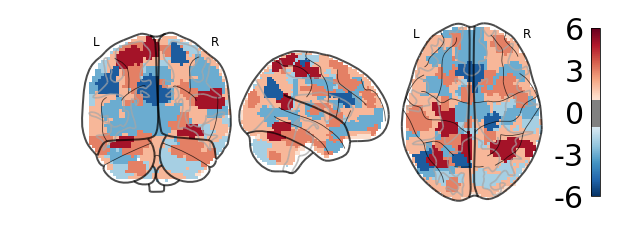
Figure 2: Significant Scale-Localization map on brain. Positive and negative weights are denoted with ± sign.
Discussion
The implications of this research are profound in the field of neuroimaging and beyond. By optimizing the feature extraction process through SGWT, the paper suggests potential advancements in how brain data is processed and interpreted. The effectiveness of SGWT, particularly when utilizing spectral kernels like Warped Translates, underscores a new frontier for feature extraction strategies, offering refined spectral coverage and nuanced signal interpretation abilities.
Moreover, the study opens pathways for further exploration into dynamic graph models, which could capture temporal variations in brain activity more effectively. Such extensions could transform practices in network neuroscience and machine learning applications in neuroimaging, providing deeper insights into brain activity patterns and their correlations with cognitive states.
Conclusion
This paper effectively establishes SGWT as a powerful tool for feature extraction in neuroimaging tasks. By validating its applications through rigorous experiments and theoretical backing, the research sets a precedent for future studies to explore more sophisticated models and kernels within the GSP framework. The approach presents a compelling case for integrating advanced spectral methods into machine learning pipelines, promising significant advancements in both performance and interpretability in neuroimaging analyses.