- The paper demonstrates that LSTMs achieve near-perfect forecasts on synthetic data while ESNs show robust performance on noisy real-world datasets.
- It compares five different ML models using mean squared error to evaluate forecast accuracy over complete degradation cycles.
- The study highlights the potential of RNN-based models for predictive maintenance and emphasizes future work on handling data shifts and uncertainty.
Forecasting Industrial Aging Processes with Machine Learning Methods
This study explores the application of ML models to predict degradation processes in industrial settings, a task traditionally approached with mechanistic models. The paper compares the accuracy and efficiency of different ML methods in forecasting industrial aging processes (IAP), focusing on two primary datasets: a synthetic one and real-world data from a chemical plant.
Problem Context and Formulation
The degradation of industrial equipment, particularly in chemical plants, leads to significant maintenance costs and production losses. Predictive maintenance, achieved through accurate forecasting of degradation key performance indicators (KPIs), can mitigate these issues. Traditional models are limited due to their complexity and lack of adaptability to plant-specific conditions. ML methods, particularly recurrent neural networks (RNNs), offer a potential solution by leveraging historical data to predict KPIs.
The paper tackles the IAP forecasting problem by modeling the KPI evolution as a function of operational conditions over a degradation cycle. This task is evaluated using both synthetic and real-world datasets to assess the performance of various ML models.
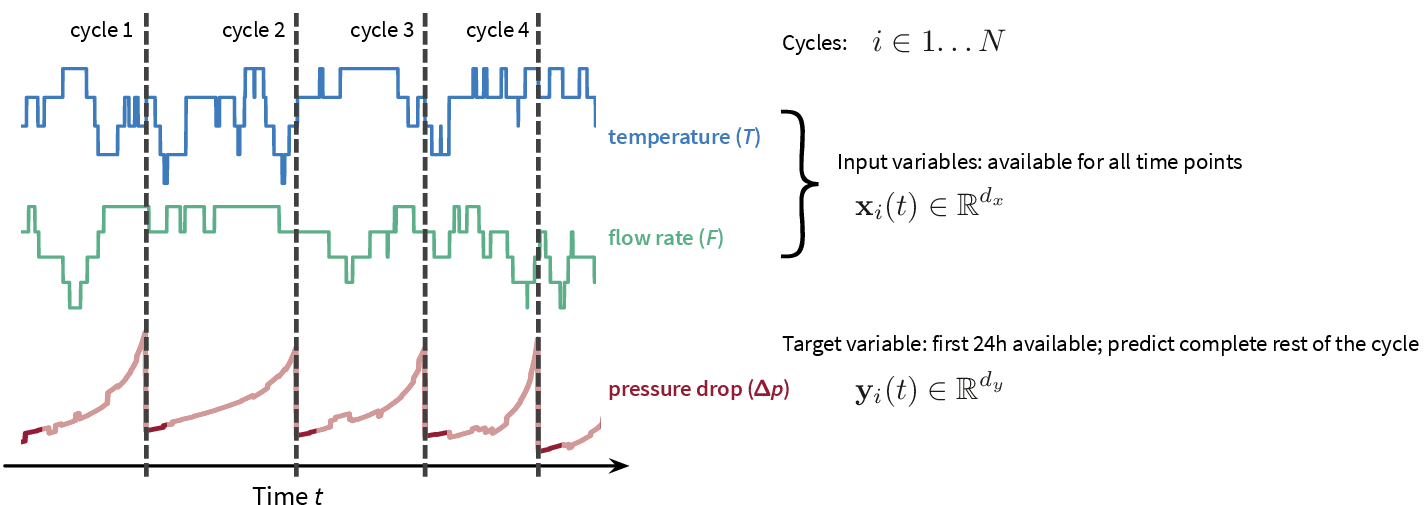
Figure 1: Illustration of the industrial aging process (IAP) forecasting problem.
Machine Learning Models and Methodology
Models Evaluated
- Linear Ridge Regression (LRR): A linear model with L2 regularization to manage overfitting.
- Kernel Ridge Regression (KRR): Extends LRR into a nonlinear model using the kernel trick but is computationally intensive.
- Feed-Forward Neural Networks (FFNN): Non-linear model using hidden layers and backpropagation, effective for capturing complex relationships.
- Echo State Networks (ESN): An RNN variant leveraging a fixed reservoir for reduced training complexity.
- Long Short-Term Memory (LSTM) Networks: A robust RNN architecture managing long-term dependencies through gated cells.
Evaluation Method
Models were evaluated based on their mean squared error (MSE) in predicting the KPIs over entire degradation cycles. Training involved optimizing hyperparameters through cross-validation and assessing performance on held-out test sets to ensure generalization.
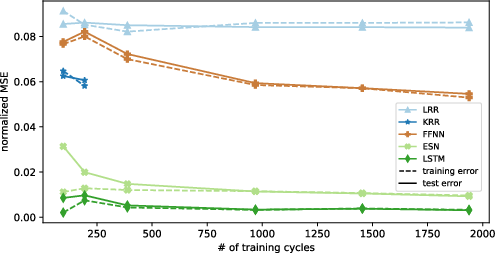
Figure 2: Training and test set MSEs for the five different models on the synthetic dataset.
Results and Discussion
Synthetic Dataset Findings
With abundant, low-noise data from the synthetic dataset, the LSTM model achieved near-perfect predictions, significantly outperforming other models, including ESN. This highlights LSTM's capability to capture complex, non-linear temporal patterns with minimal data requirements.
Real-world Dataset Insights
In contrast, real-world data posed challenges due to noise and dataset shifts. All models showed increased errors. However, ESN and LSTM still surpassed stateless models, suggesting their robustness in handling noisy data and overfitting challenges. ESN slightly outperformed LSTMs, possibly due to its efficient handling of longer sequences in the data.
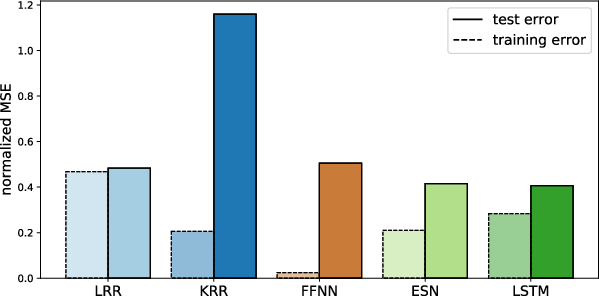
Figure 3: Training and test set MSEs for the five different models evaluated on the real-world dataset.
Implications and Future Work
The experimentation reveals RNNs' potential in effectively forecasting degradation with limited data, emphasizing their use in predictive maintenance strategies. Future work should focus on handling dataset shifts due to operational changes and incorporating uncertainty quantification in predictions, which is crucial for risk management and decision-making in industrial settings. Approaches like transfer learning could leverage broader datasets for better generalization to new conditions.
These insights highlight ML models, particularly sophisticated versions like RNNs, as valuable tools in industrial process optimization. Their integration with current practices could significantly enhance predictive maintenance and efficiency in plant operations.
Conclusion
The application of ML techniques, especially RNN-based models, provides a viable approach to forecasting industrial aging processes. While LSTMs demonstrate superior performance on synthetic data, ESNs offer competitive results and may generalize better across real-world data challenges. Continuous improvement in model handling of data shifts and uncertainties will further cement their role in predictive maintenance.