- The paper demonstrates that dictionary learning combined with total variation methods effectively reduces LIGO's blip noise transients.
- It employs sparse reconstruction using ADMM and optimized dictionary training on 100 blip glitches to enhance signal fidelity.
- The approach notably improved noise mitigation across different frequency ranges, as evidenced by successful application to the GW170817 event.
Application of Dictionary Learning to Denoise LIGO's Blip Noise Transients
Introduction
Data from gravitational-wave (GW) detectors like LIGO are often contaminated by non-astrophysical noise transients known as "glitches." This study investigates the efficacy of dictionary learning techniques in mitigating these glitches, focusing on "blip" glitches, which are prevalent in LIGO data. The researchers apply total variation methods and learned dictionaries to model and subtract the glitch contribution in the GW signal, attempting to enhance the significance of astrophysical triggers.
Variational Methodologies
Total Variation Methods
The paper employs two variational techniques based on the L1 norm: the Rudin-Osher-Fatemi (ROF) method and a Dictionary Learning method. The denoising problem is formulated as a variational problem y=u+n, where u represents the true signal and n the noise. The ROF method uses a total variation-based regularization to remove noise while preserving significant signal gradients:
uλ=uargmin{∫Ω∣∇u∣+2λ∣∣y−u∣∣2}
where λ is a regularization parameter controlling the trade-off between preserving data fidelity and regularization.
Sparse Reconstruction Using Fixed Dictionaries
In dictionary-based denoising, the signal u is assumed to be a sparse combination of dictionary atoms D, optimized via:
αλ=αargmin{∣α∣+2λ∣∣Dα−y∣∣2}
This study leverages the Alternating Direction Method of Multipliers (ADMM) for sparse coding, ensuring convexity through the L1 regularization.
Dictionary Learning
The approach not only uses predefined dictionaries but also learns dictionaries from data. This enhances signal representation quality by adapting to signal characteristics:
αλ,Dλ=α,Dargmin{n1i=1∑m∣∣Dαi−xi∣∣22+λ∣αi∣}
The optimized approach uses stochastic approximations to efficiently update dictionaries during training.
Data Selection and Training
Random samples of 100 blip glitches were selected for training and testing from LIGO's first observing run. Utilizing whitening procedures and a rigorously structured training approach, dictionaries were formulated to optimally represent the blip glitches in real detector noise.
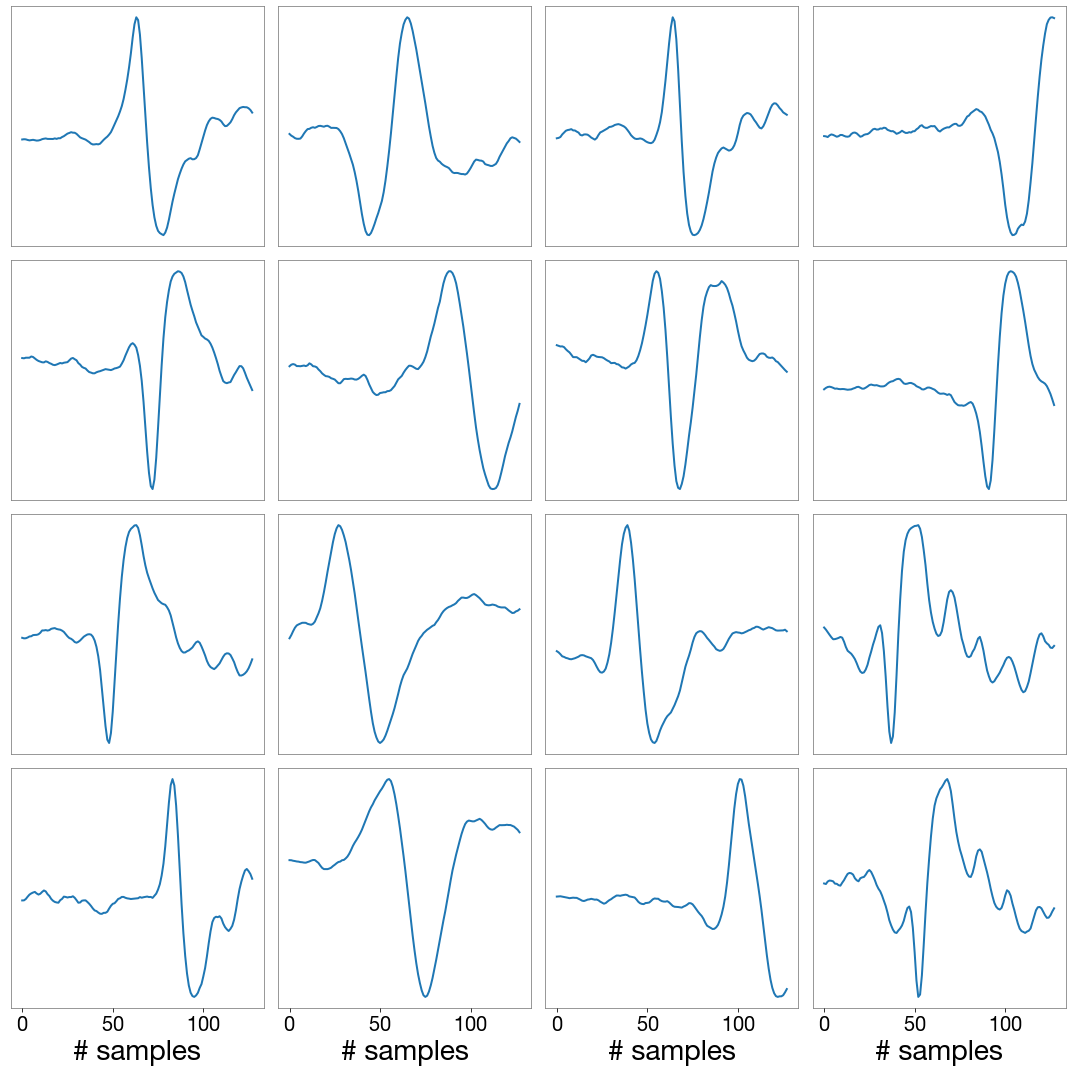
Figure 1: Example of a dictionary composed by a total of 192 atoms with 128 samples each. Only 16 atoms randomly selected are shown.
Results
Blip Glitch Mitigation
The methodologies tested various dictionary lengths (23 to 29 samples per atom) and found that combining dictionaries with different atom lengths optimized high-frequency noise removal.
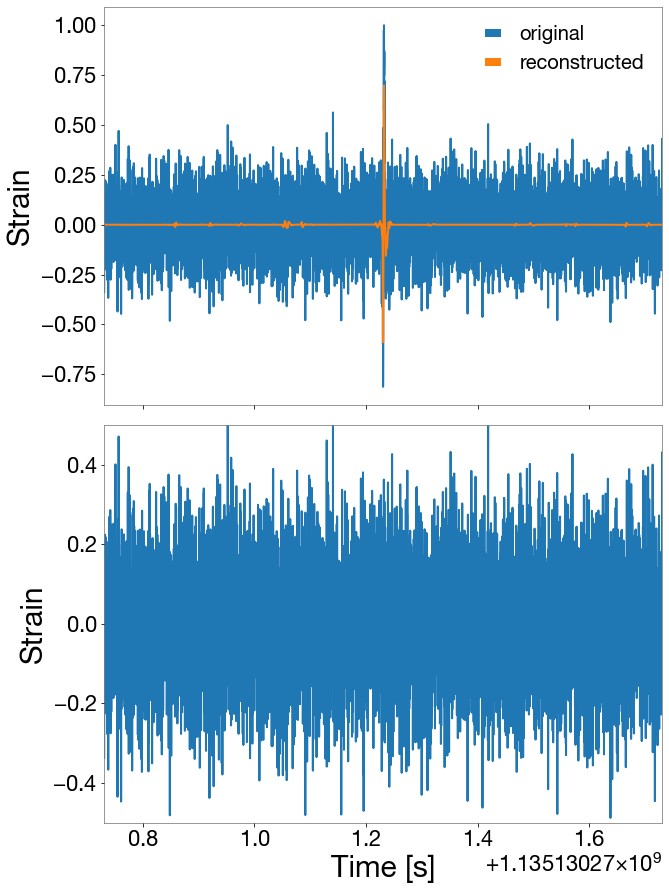
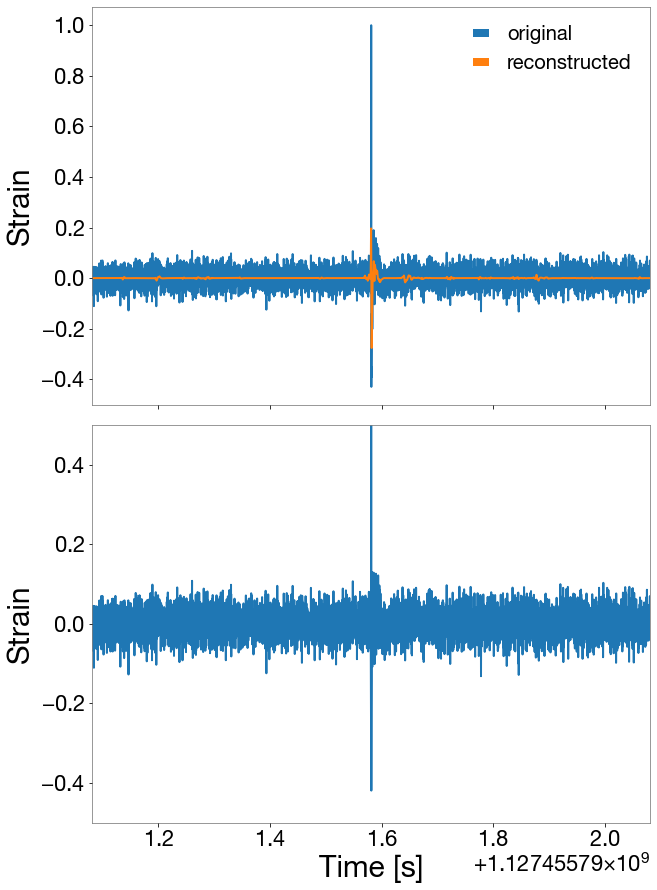
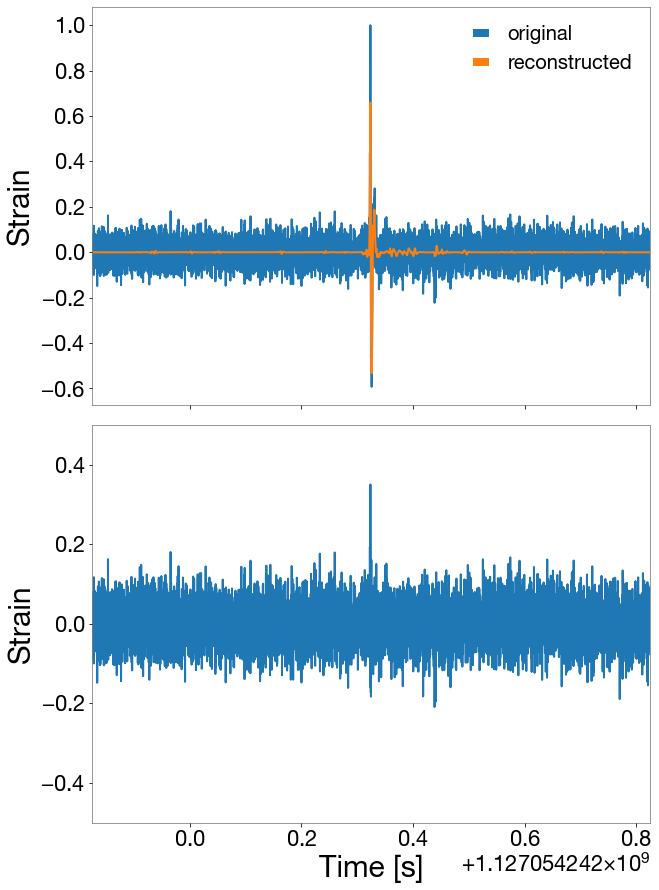
Figure 2: Time-series plots of three illustrative examples of blip glitches, corresponding to numbers 7, 9, and 15 from the test set.
Using a single dictionary effectively mitigated low-frequency glitches, while combining dictionaries improved high-frequency noise subtraction, as highlighted by SNR improvements.
Application to GW170817
Applying the learned dictionary approach to the GW170817 merger event resulted in successful removal of instrumental noise without affecting the GW signal itself. Despite differing glitch characteristics, this demonstrated the approach's robustness.
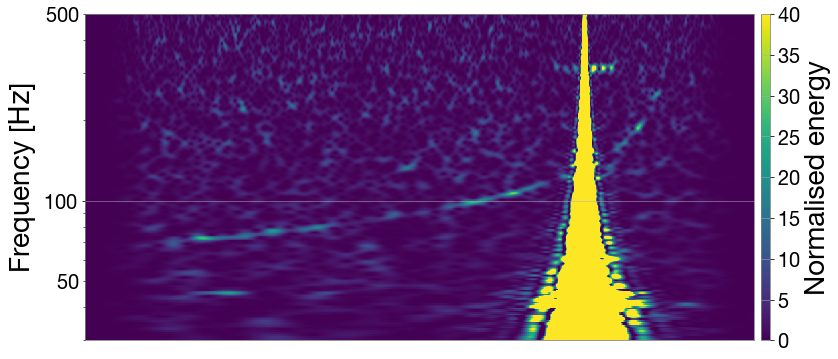
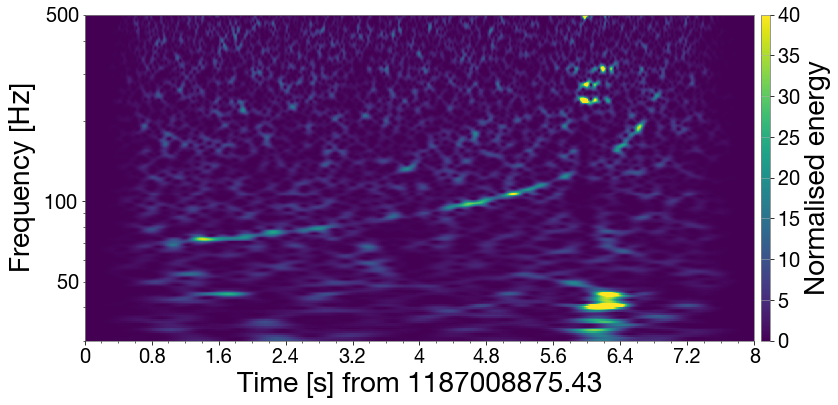
Figure 3: Time-frequency diagram of 8 seconds of data corresponding to the GW170817 signal.
Conclusion
The application of dictionary learning to transient noise reduction showcases potential for improving GW data analysis integrity. The combination of multiple dictionaries proved advantageous, particularly at high frequencies, signifying broad applicability to diverse noise families. Advancements in computational efficiency and dictionary customization might further enhance real-time GW detection capabilities. The research suggests possibilities for dictionary-trained models to aid low-latency pipelines in future GW observatories.