- The paper introduces a framework that clarifies the integration of human and machine intelligence across entire system lifecycles.
- It employs a continuum model—from machine-in-the-loop to human-in-the-loop—to demonstrate varying levels of human-AI coupling.
- The study emphasizes ethical AI design and transparent, human-centric policies, guiding future research and practical implementations.
Conceptualization and Framework of Hybrid Intelligence Systems
The paper "Conceptualization and Framework of Hybrid Intelligence Systems" presents a comprehensive framework for understanding and defining hybrid intelligence systems, where human and artificial intelligence collaborate to solve complex problems.
Definition and Distinction of Hybrid Intelligence Systems
The authors first establish the boundaries and relationships between hybrid intelligence systems and two other key categories: Human Computation and Self-sufficient Artificial Intelligence. Human Computation refers to systems leveraging human cognitive abilities to perform tasks unsolvable by machines, such as utilizing crowd workers for creativity-driven tasks. In contrast, Self-sufficient Artificial Intelligence systems operate independently with no human involvement in their life cycle, representing a theoretical construct as per current technological capabilities.
Hybrid intelligence systems are defined by the integration of both human and machine intelligence across their lifecycle, encompassing a broad range of other intelligent systems including interactive machine learning, where humans iteratively refine algorithms, and AI-infused systems, where AI functionalities are absorbed into end-user applications.
Framework for Hybrid Intelligence Systems
The paper proposes an innovative framework represented as a continuum labeled with "Machine-in-the-loop" and "Human-in-the-loop" systems, delineating the extent and direction of engagement between human and machine intelligence.
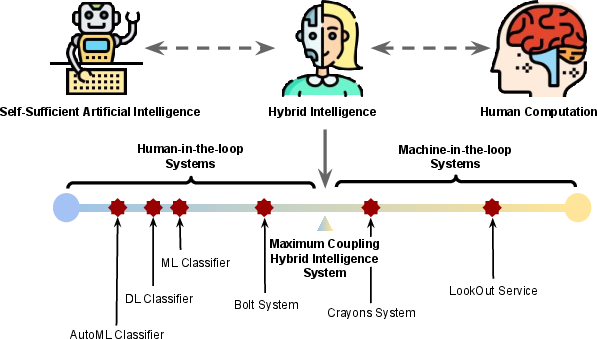
Figure 1: The continuum of hybrid intelligence systems with machine-in-the-loop and human-in-the-loop systems halves. Individual points on the continuum represent distinct hybrid intelligence systems with varying levels of coupling between human and machine intelligence.
In this framework, systems are positioned based on their level of coupling—the integration between human and machine intelligence—and the dominant component in the interaction. The framework helps classify systems like the LookOut Service, a machine-in-the-loop system aiding users with scheduling, and the Crayons System, an interactive machine learning tool with close human-machine collaboration.
Implications and Future Directions
Understanding that hybrid intelligence systems encompass nearly all AI systems with human interaction highlights the necessity of human-centric design in AI development. This recognition has implications for fairness, accountability, and transparency in AI deployments. The provided framework facilitates the systematic study of various hybrid systems, suggesting avenues for advancing research and development.
Future work could focus on refining this framework to identify examples of maximum and minimum coupling levels and investigate distinct properties of systems along the continuum. The framework's application in real-world governance and policy-making could guide the ethical deployment of AI systems.
Conclusion
This paper provides a pivotal definition and conceptual framework for hybrid intelligence systems that incorporates a broad spectrum of intelligent systems involving human and machine collaboration. These efforts not only bring clarity to the hybrid intelligence landscape but also emphasize the essential role of human factors in the life cycle of AI systems, promoting the development of comprehensive, human-aware AI solutions. The evolving understanding through this framework sets the stage for more targeted and ethical AI advancements.