- The paper introduces a method that automates gamification personalization through conditional decision trees and a recommender system.
- It uses survey data on user preferences and contextual factors such as geographic location and learning activity types to inform its models.
- The hybrid system effectively adapts gamification designs in real-time for enhanced engagement in educational technologies.
Automating Gamification Personalization: To the User and Beyond
Introduction
The paper "Automating Gamification Personalization: To the User and Beyond" addresses the topic of personalized gamification, focusing on tailoring gamification designs by exploring user and contextual characteristics. The paper tackles the challenge of enhancing the effectiveness of educational technologies by personalizing game elements to fit individual users and specific contexts. This is achieved through an implementation that automates the personalization process using conditional decision trees (CDTs) and a recommender system (RS).
Methodology and Approach
To address the problem of ineffective one-size-fits-all gamification approaches, the paper proposes a methodology that involves two main steps. Firstly, an exploratory survey was conducted to gather data on user preferences related to game elements across different learning activity types (LATs). The survey explored how various factors such as demographics, game-related characteristics, geographic location, and the LAT influence users' game element preferences.
In the second step, CDTs were employed to model these preferences, enabling an understanding of which features are most relevant for tailoring gamification designs. The CDTs offer intuitive and visual rules that capture user preferences and inform the creation of the RS. This RS makes use of inputs like user profile characteristics and contextual information (LAT and geographic location) to suggest suitable game element configurations.
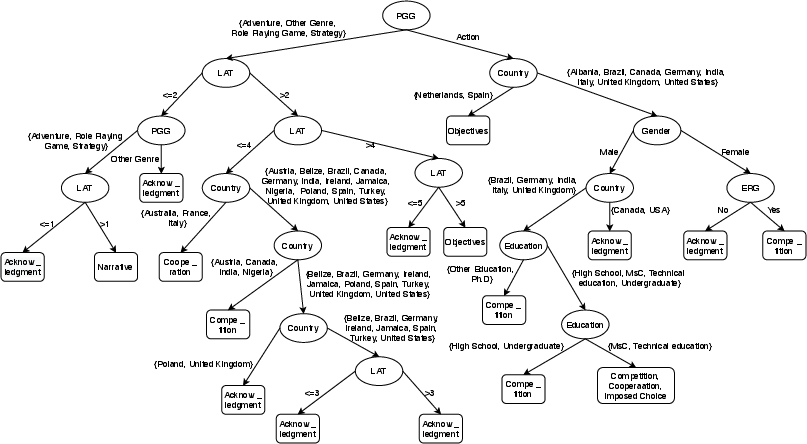
Figure 1: Conditional decision tree for participants most preferred game element. Codes refer to preferred game genre (PGG), learning activity type (LAT), and experience researching gamification (ERG).
Results and Implementation
The empirical evidence obtained from the study indicates that LATs, geographic location, and user attributes significantly influence game element preferences. The CDTs and resulting RS developed as part of this research offer personalized gamification recommendations by considering these multiple aspects simultaneously. For instance, a notable insight is that preferred game genres, geographic location, and LATs were major factors in determining users' selected game elements.
The RS, implemented based on the findings of the CDTs, acts as a plug-in for external systems to automate gamification personalization. It outputs the ratings for game elements ranked by user preferences for different contexts, thereby supporting real-time, adaptive gamification design. The RS is characterized as a hybrid system since it combines content-based and context-aware recommendation approaches.
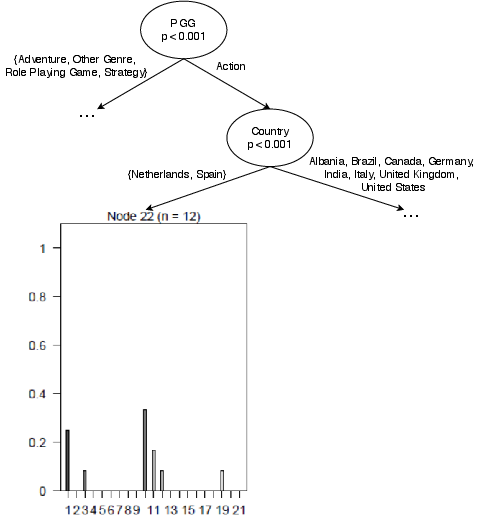
Figure 2: Partial visualization of a CDT generated from our data (CDT1), illustrating how its leaf nodes demonstrate the distribution from participants' selections.
Discussion and Implications
The implications of the research are profound, as it bridges several gaps in gamification by considering a broader range of personalization factors and their interactions. It emphasizes the importance of accounting for task-specific and location-specific characteristics alongside user profiles. The study highlights that demographic conditions and game-related traits are critical moderators of user preferences and need to be weighted appropriately.
Moving forward, researchers and developers can utilize the findings to understand better how personalizing gamification designs can enhance user engagement and motivation in educational systems. The RS provided can be integrated into educational technologies to facilitate automatic adaptation of gamification strategies based on the identified preferences.
Conclusion
The study advances the field of gamification by providing an effective method for automating gamification personalization, using a combination of empirical survey data and decision tree analysis. The approach enables the development of bespoke gamification strategies that cater to specific user and contextual needs, ultimately contributing to more engaging and motivating learning experiences. Future work should focus on experimenting with the RS in real-world educational settings to validate its effectiveness in improving educational outcomes.