A Quantum Interpretation of Bunched Logic for Quantum Separation Logic
Abstract: We propose a model of the substructural logic of Bunched Implications (BI) that is suitable for reasoning about quantum states. In our model, the separating conjunction of BI describes separable quantum states. We develop a program logic where pre- and post-conditions are BI formulas describing quantum states -- the program logic can be seen as a counterpart of separation logic for imperative quantum programs. We exercise the logic for proving the security of quantum one-time pad and secret sharing, and we show how the program logic can be used to discover a flaw in Google Cirq's tutorial on the Variational Quantum Algorithm (VQA).
Paper Prompts
Sign up for free to create and run prompts on this paper using GPT-5.
Top Community Prompts
Explain it Like I'm 14
What is this paper about?
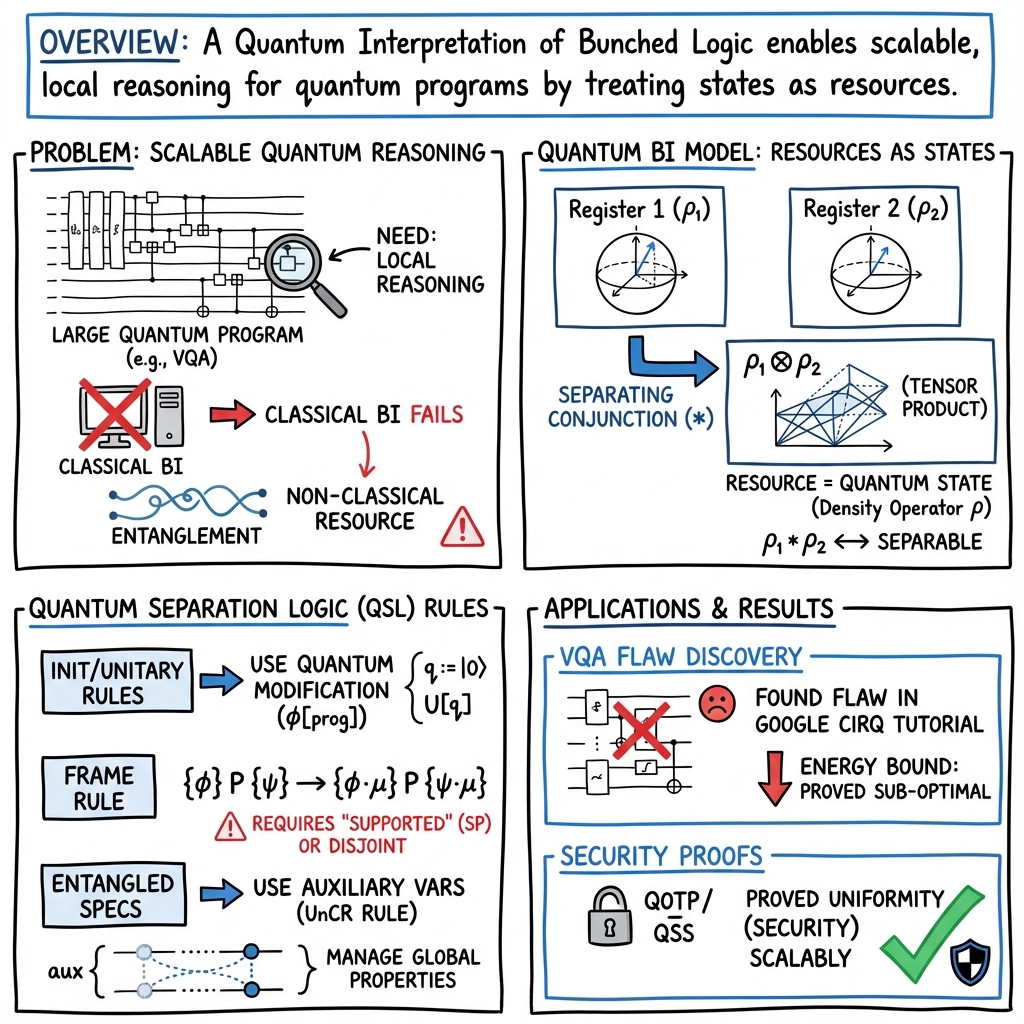
This paper builds a new, simple way to reason about quantum programs. It adapts a logic from computer science called “Bunched Implications” (BI) to the quantum world, and turns it into a “Quantum Separation Logic” (QSL). The big idea is to make it easy to check parts of a big quantum program separately, then combine the results—especially useful for large circuits like those used in Variational Quantum Algorithms (VQAs) and quantum security protocols.
Think of a quantum program like a huge Lego model. QSL helps you check small Lego sections one by one, then snap your checks together to understand the whole model—even when some Lego pieces are stuck together in special ways (entanglement).
What questions did the authors try to answer?
- How can we adapt separation logic (a tool for “local reasoning” in classical programs) to quantum programs, where qubits can be entangled?
- Can we make a logic where “separating” really means the quantum state is separable (not entangled)?
- Can we create practical proof rules to reason about quantum operations (like applying a gate, initializing a qubit, measuring, and looping)?
- Can we handle both independent (separable) and entangled conditions when proving a program is correct?
- Will this help verify real examples, like VQAs or quantum security protocols such as the quantum one-time pad?
How did they approach the problem?
Key ideas in everyday language
- Resources as pieces: In BI logic, “resources” are like pieces you can combine. Here, each quantum state over a set of qubits is a “piece.” Combining two pieces is allowed only if they use different qubits, and the combination is just the tensor product (their ordinary quantum “put-together”).
- Separate vs. entangled: The special connective “separating conjunction” (written as a star, like A ∗ B) means “these two properties hold on two separate, independent parts.” In quantum terms, that means the whole state is separable—not entangled—across those parts.
The logic they built (QSL)
The authors:
- Built a quantum model of BI where the “separating conjunction” matches “separable quantum states.”
- Chose useful basic building blocks (called atomic propositions) to express facts about qubits, such as:
- “These qubits are present” (so the formula only talks about certain registers).
- “The state lies in a certain subspace” (like a projection/predicate).
- “These qubits are completely mixed” (uniform—important in security proofs).
They then used these to write preconditions and postconditions about quantum programs.
Important rules and techniques
- Local reasoning via the frame rule: If your program only changes some qubits, the logic lets you “frame out” everything else—it stays the same. In quantum, this is tricky because of entanglement, so the authors carefully define when this is sound. They even generalize the rule using a notion like “supported assertions” that works especially well for uniformity claims (like “completely mixed”).
- Modification (quantum-friendly “substitution”): In classical logic, assignment x := e uses “substitution” (replace x by e in your conditions). Quantum has no cloning and uses different operations: initialization (set qubit to |0⟩) and unitary gates (apply U). The authors design a “modification” operation that updates formulas to reflect these quantum steps. It’s like a careful, quantum-safe substitution.
- Handling measurements and loops: Measurements split the program into different paths with probabilities, then recombine them. The logic includes rules that are safe under mixtures (weighted combinations), so the proofs still go through.
- Reasoning about entanglement (UnCR rule): Local reasoning works great when there’s no entanglement in your conditions. But many interesting properties are entangled. To handle this, the authors introduce a rule (called UnCR) that uses auxiliary (helper) variables. You can “virtually” create and manage entanglement in your reasoning (mathematically, not physically), and still prove the main program is correct.
What did they find, and why is it important?
- A sound quantum separation logic (QSL): They provide a full set of proof rules to reason about quantum programs using BI-style assertions, including initialization, unitary updates, measurements, and loops. The logic is backed by careful mathematics (like purification arguments from quantum information theory).
- A practical frame rule for quantum: They recover a frame rule that lets you reason locally even with quantum states. They also extend it in a way that’s especially helpful for proving “uniformity” (like showing an eavesdropper sees a completely mixed state).
- A way to reason with entangled conditions: The UnCR rule lets you prove properties that involve entangled predicates, which is crucial for real-world quantum algorithms and proofs.
- Real applications:
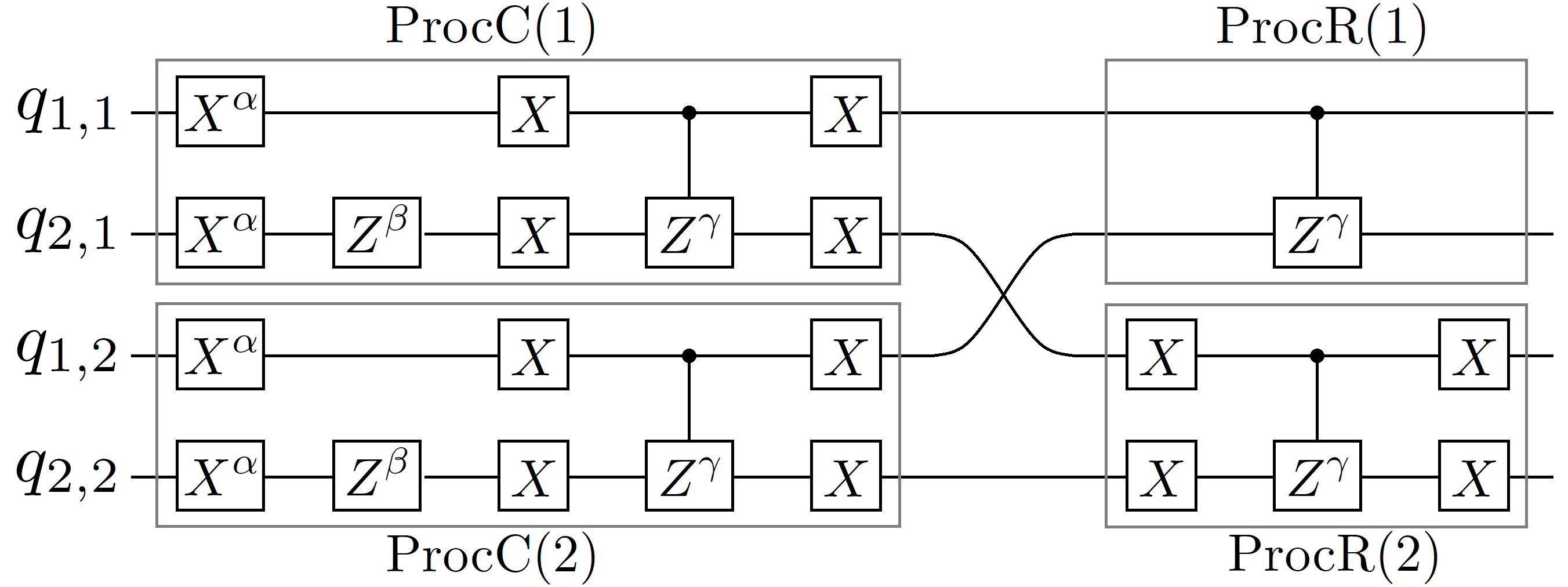
- Variational Quantum Algorithms (VQAs): They show how to verify VQAs by reasoning about subcircuits and then combining the results. Using QSL, they discovered a flaw in Google Cirq’s VQA tutorial—showing the logic can catch subtle mistakes.
- Quantum security protocols: They verify the security of the quantum one-time pad and quantum secret sharing. Their method scales: adding more qubits doesn’t make the proof explode in complexity, which is a big practical win.
Why this matters: Quantum programs can be huge, and their states grow exponentially with the number of qubits. QSL lets you check small parts and then stitch the proofs together, making verification doable where traditional techniques bog down.
What is the potential impact?
- More reliable quantum software: As quantum programs grow (e.g., in quantum machine learning and VQAs), having a logic that supports local reasoning means developers can verify correctness more easily.
- Stronger, scalable security proofs: Protocols like the quantum one-time pad are fundamental. This logic provides clearer, more scalable proofs of their security.
- Better tools and education: The approach could guide future verification tools that integrate with quantum programming frameworks (like Cirq). It also helps teach what “local reasoning” looks like in the quantum world.
- Foundation for future research: The paper bridges classical separation logic and quantum computation, opening the door to more advanced logics and automated checkers that can handle entanglement and large-scale circuits.
In short, the paper gives researchers and developers a practical, mathematically solid way to reason about big, complex quantum programs—piece by piece—without losing sight of the quantum effects that make them powerful.
Collections
Sign up for free to add this paper to one or more collections.