- The paper demonstrates that slow-fast systems on the two-torus robustly generate torus knot limit cycles for any coprime pair (k,l).
- It employs the slow divergence integral and hyperbolicity conditions to rigorously establish the attracting and repelling nature of exactly 2m limit cycles for small ε > 0.
- The analysis bridges knot theory with global dynamical systems, offering insights into nontrivial oscillatory behavior and avenues for extending to non-hyperbolic contacts.
Slow-Fast Dynamics and Torus Knot Cyclicity on the Two-Torus
Introduction
The study "Slow-Fast Torus Knots" (2103.05989) systematically analyzes the existence and structure of limit cycles of knotted topology in C∞-smooth slow-fast systems defined on the two-torus T2. The work synthesizes geometric singular perturbation theory, the slow divergence integral, and extensions of planar dynamical systems theory to elucidate the global organization of periodic orbits with nontrivial topology (torus knots) in the singular perturbation context. Unlike previous studies predominantly focusing on "unknotted" cycles (integer rotation number and trivial knot topology), this paper demonstrates how slow-fast systems can robustly exhibit multiple attracting and repelling (k,l)-torus knots for arbitrary relatively prime pairs (k,l) and multiplicity $2m$.
Main Results: Realization of Knotted Limit Cycles
A central result proves that for any m∈N and any coprime integers k,l, there exists a slow-fast system Yϵ on T2 exhibiting $2m$ slow-fast limit cycles of knot type (k,l) for all sufficiently small ϵ>0. Explicitly, for each small parameter ϵ, there coexist exactly m attracting and m repelling hyperbolic limit cycles, each tracing a nontrivial (k,l)-torus knot (i.e., making k and l windings around the meridional and longitudinal directions of T2 respectively).
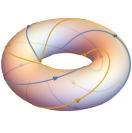
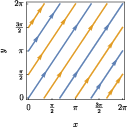
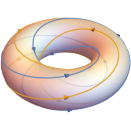
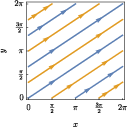
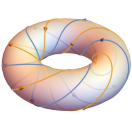
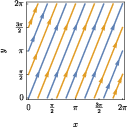
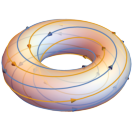
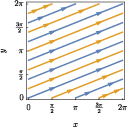
Figure 2: Representative (k,l)-knots arising as critical manifolds for Yϵ (e.g., trefoil and Solomon's seal knots), which, after perturbation for small ϵ, generate corresponding limit cycles.
The method is robust, relying only on normal hyperbolicity and the sign of the slow divergence integral, independent of the explicit geometry of the knot.
Geometric Singular Perturbation Analysis
The existence and uniqueness of knotted limit cycles is established via a covering of the critical manifold by flow box neighborhoods, construction of associated Poincaré sections, and application of a fixed point argument for segments. The leading order contraction/expansion of the Poincaré map is controlled by the slow divergence integral evaluated along the critical manifold:
I±i=∫C±idivX0,ρds
where C±i are the individual components of the critical manifold corresponding to attracting (−) and repelling (+) regions. Negativity (resp. positivity) of I±i ensures local contraction (resp. expansion), rendering the resulting limit cycles hyperbolically attracting (resp. repelling).
The structure of the critical manifold is constructed to wrap k and l times along the generating cycles of the torus, leading to classical torus knots and links as limit sets for ϵ→0. Topological properties of torus knots, including ambient isotopy and link type, are utilized to classify the resulting dynamics.
Topological Classification and Dynamical Consequences
The construction demonstrates that only knots of equivalent type (up to ambient isotopy) can appear as distinct (yet topologically similar) limit cycles in the same dynamical system. However, even pairs of knots that are homeomorphic as embedded curves can yield dynamically nonequivalent slow-fast systems depending on their distribution between attracting and repelling portions.
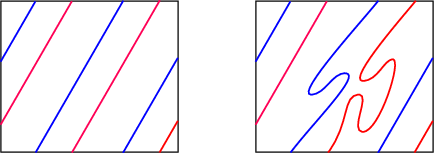
Figure 4: Pairs of equivalent knots (homeomorphic and isotopic), but leading to nonequivalent slow-fast dynamics depending on their assignment to attracting/repelling manifolds.
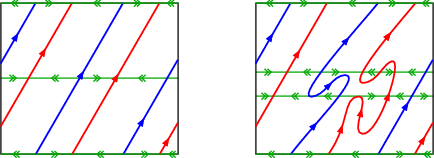
Figure 1: Critical manifolds with homeomorphically equivalent knot topology but dynamically distinct slow-fast behaviors.
For each initial condition outside the tubular neighborhoods of these periodic orbits, the flow is attracted to one of the attracting limit cycles in forward time and repelled by one of the repelling cycles in backward time, leading to a global phase portrait stratified by the knot type.
The framework is extended (with conjectural statements) to the setting where the critical manifolds lose normal hyperbolicity at finitely many isolated regular nilpotent contact points. Such points correspond to local degeneracy in the fast-subsystem linearization, but under regularity and genericity assumptions, persistence of limit cycles can still be deduced. Notably, passage through regular contact (including nilpotent singularity of finite order, e.g., y=x2n+1) remains locally contractive.
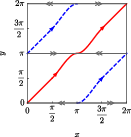
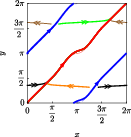
Figure 3: A $2$-link critical manifold consisting of two (1,1)-knots with an odd regular contact point, facilitating persistent hyperbolic limit cycles for small ϵ.
Furthermore, singular slow-fast cycles traversing knot segments perturbed by both slow and fast dynamics (with, for instance, jumps) are shown to give rise to relaxation oscillations, preserving knot topology.
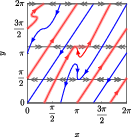
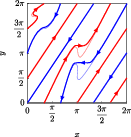
Figure 5: $2$-link critical manifold with two trefoil knots; singular slow-fast cycles perturb to attracting/repelling limit cycles corresponding to relaxation oscillations.
Role of Global Manifold Topology
The work leverages a generalization of the Poincaré-Bendixson theorem for flows on closed orientable manifolds due to Schwartz, ensuring that any nontrivial ω-limit set in the absence of equilibria must be periodic. This precludes the emergence of more complicated minimal sets or chaotic invariant sets, yielding a complete classification of possible recurrent dynamics in this setting.
Exotic Behaviors and Canard Phenomena
The authors identify scenarios not covered by their main arguments, including configurations where candidate cycles are created by connections between distinct components of the critical manifold (via fast dynamics), or where canard points (non-regular nilpotent contacts) intervene.
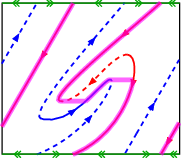
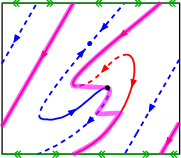
Figure 9: Singular closed candidate orbits (magenta) not covered by the main conjecture, illustrating scenarios where inter-component jumps or canard cycles modify the limit cycle bifurcation structure.
Canard-induced cycles and multi-knot interactions present further complexities beyond the scope of the present analysis, suggesting fertile ground for future work in global slow-fast knot bifurcation theory.
Knot Theoretic Context
A rigorous classification of torus knots on T2 is provided: any knot winds k times meridionally and l times longitudinally, with coprimality ensuring minimal nontrivial knotting. Only two distinct classes (by homeomorphism) exist, respectively corresponding to trivial and nontrivial windings.
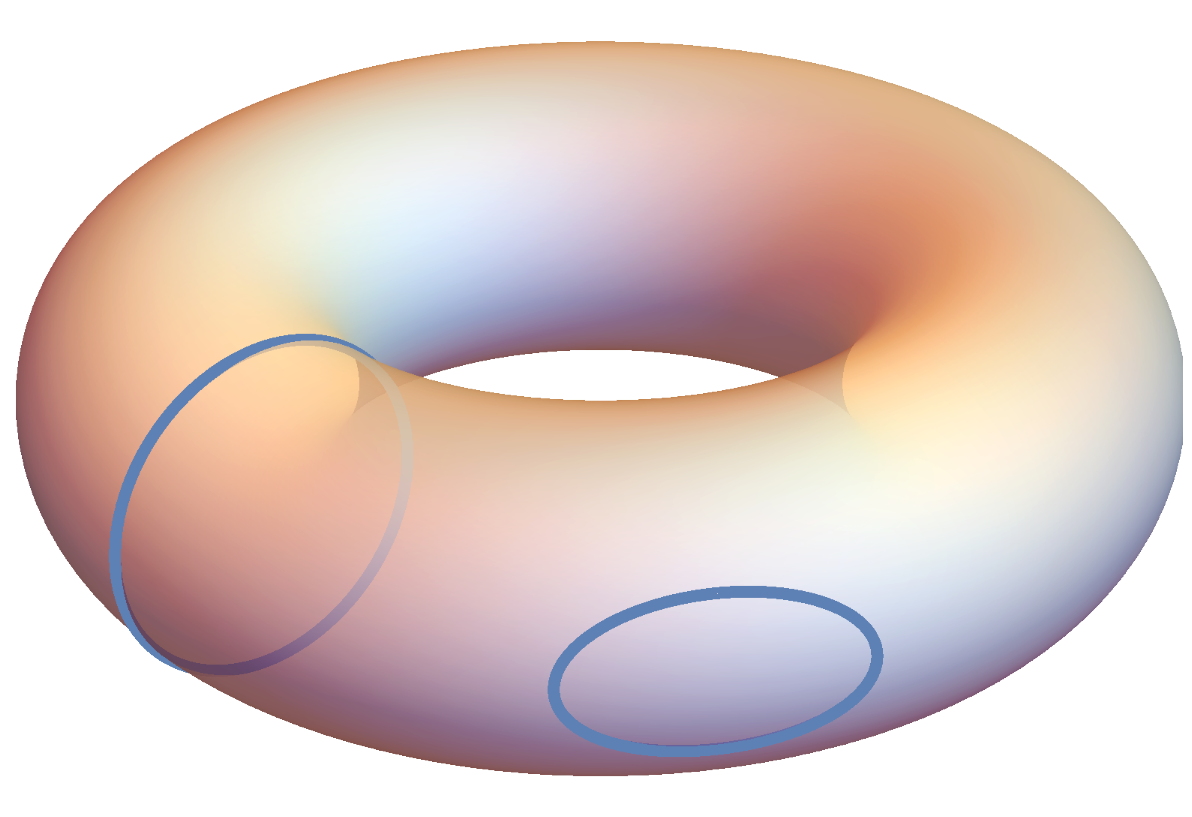
Figure 11: Prototypical representatives of the two classes of torus knots up to homeomorphism on the $2$-torus.
Conclusion
This study rigorously constructs and analyzes slow-fast systems on the two-torus exhibiting an arbitrary number of (k,l)-torus knot limit cycles, explicitly controlling their stability and multiplicity through geometric singular perturbation arguments and the slow divergence integral. The results highlight a profound connection between topological knot invariants and global dynamics of singularly perturbed ODEs on compact surfaces. Extension to systems with non-hyperbolic contacts and further classification of canard-induced phenomena is identified as an important theoretical direction.
The interplay between the topology of invariant sets (knot/link type), global phase space structure, and singular perturbation theory is expected to have broad implications, both for mathematical advances in dynamical systems and in applications where slow-fast mechanisms and topological features coexist (e.g., chemical oscillations, neuroscience, and beyond).