- The paper shows that Rankin-Cohen brackets of eigenforms generally do not yield new eigenforms except under rigid dimension constraints.
- It employs dimension-theoretic and Galois analysis methods to assess when differential operators preserve Hecke eigensystems.
- The findings support Maeda’s conjecture by indicating that any non-forced eigenform occurrence would contradict the irreducibility of Hecke polynomials.
Introduction
This paper establishes a precise connection between Rankin-Cohen brackets, eigenforms, and Maeda’s conjecture, focusing on modular forms of level 1. It extends prior investigations into the structural properties of products and algebraic combinations of eigenforms, here via the Rankin-Cohen bracket—a bilinear differential operator acting on pairs of modular forms. By leveraging dimension-theoretic analysis and Galois properties, the work demonstrates under what conditions the Rankin-Cohen bracket of an eigenform and an arbitrary modular form can itself be an eigenform. Crucially, it is shown that this phenomenon is extremely rare, essentially forced only by ambient dimension constraints, and any deviation would have deep arithmetical consequences—namely, the reducibility of Hecke polynomials, which Maeda’s conjecture precludes.
Background and Mathematical Framework
Let Mk and Sk denote the spaces of modular forms and cusp forms of weight k, respectively, for SL2(Z). The Rankin-Cohen bracket of order n for modular forms f and g is given by
[f,g]n=r+s=n∑(−1)r(sn+wt(f)−1)(rn+wt(g)−1)f(r)(z)g(s)(z),
where f(a)(z) stands for the normalized a-th derivative. This construction lifts pairs of forms (f,g) in (Mk1,Mk2) to Mk1+k2+2n, with cuspidality inherited whenever one input is cuspidal or n>0.
Historical context is set by previous classification results for products of eigenforms (Duke, Ghate, Emmons-Lanphier, et al.). The present work transfers this analysis to the (inhomogeneous, differential) Rankin-Cohen setting, seeking to discern when eigenforms arise as such brackets.
Main Theorems and Structural Results
Three complementary theorems address the various possibilities for the inputs (f,g)—whether they are cuspidal or noncuspidal. The critical parameter is the relative dimensions of the spaces involved: Sk1+k2+2n versus Sk2 or Mk2, as appropriate. The canonical noncuspidal eigenforms considered are Eisenstein series Ek. The theorems systematically describe all scenarios for which [f,g]n may be an eigenform.
- Cuspidal g, noncuspidal eigenform f: The bracket [f,g]n can be an eigenform only in those cases where the dimension of the target space does not exceed that of the input; otherwise, the existence of an eigenform implies Hecke polynomial reducibility.
- Noncuspidal g, noncuspidal f (Eisenstein): Depending on whether the target space's dimension is greater than, equal to, or less than the domain, one can determine whether the operator can possibly produce eigenforms or if reducibility of Hecke polynomials would be forced in contradiction to Maeda’s conjecture.
- Cuspidal f: The existence of eigenforms in the bracket image is conditioned on dimension inequalities and, in critical cases, on operator injectivity. Only very infrequently, when dimension alignments (of an explicitly enumerated list) occur, does the bracket admit eigenforms—again, only by force.
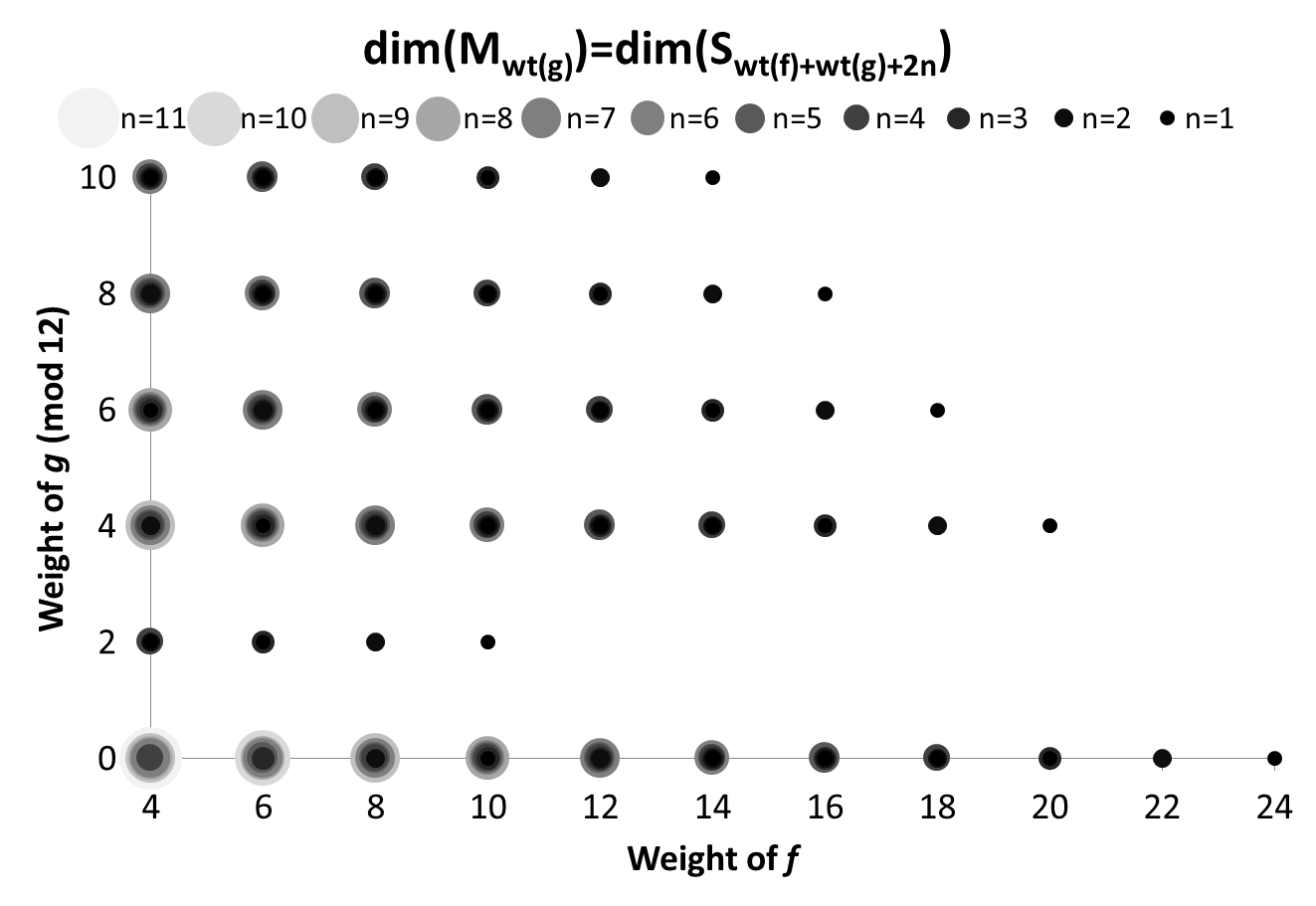
Figure 1: The 149 critical parameter combinations (indexed mod 12) where dim(Swt(f)+wt(g)+2n)=dim(Mwt(g)), representing possible forced eigenform brackets.
These results rest on the algebraic facts that rational Galois subspaces containing eigenforms force Hecke polynomial reducibility, per Lemma 2.3 in [Beyerl2014], and that the Rankin-Cohen bracket operator is rational and equivariant with respect to Galois action on Fourier coefficients.
Numerical Classification and Visualization
A salient contribution is the explicit charting of the parameter space in which the bracket can yield eigenforms. There are exactly 149 parameter triples (wt(f),wt(g),n) (modulo 12) for which the target and domain dimensions coincide, as visualized in Figure 1. This highlights the arithmetical rigidity of the bracket operator—outside these isolated cases, the construction simply cannot yield eigenforms unless major structure-theoretic tenets (notably Maeda's conjecture) fail.
Implications for Maeda’s Conjecture
Maeda’s conjecture posits the absolute irreducibility of all Hecke polynomials for Sk with trivial level. The theorems here demonstrate that, outside forced dimension coincidences, the existence of additional eigenforms given by Rankin-Cohen brackets would violate this irreducibility. Conversely, the observed lack of such bracket-generated eigenforms for vast ranges of parameters provides further indirect evidence for Maeda’s conjecture. Specifically, for all weights up to 12000, only dimension-forced cases yield eigenforms via Rankin-Cohen brackets, as corroborated by computational studies in [Ghitza2012] and [Wiese2013].
Theoretical and Practical Outlook
From a theoretical perspective, the stringent limitations on eigenform generation via Rankin-Cohen brackets reinforce the understanding that higher derivation algebra structures on modular forms have very restricted compatibility with Hecke eigensystems. There are implications for the study of algebraic and Galois properties of modular form spaces and for the possible structure of Hecke algebras.
Practically, the results imply that attempts to generate new eigenforms via differential operations (e.g., in explicit arithmetic or computational applications) are almost always futile except in the rare, dimension-forced cases enumerated. This underpins the computational difficulty in discovering "new" eigenforms by analytic synthesis.
Conclusion
The classification of eigenforms arising from Rankin-Cohen brackets solidifies the understanding that such events are arithmetically and algebraically exceptional, occurring only under rigid dimension constraints. The absence of bracket-induced eigenforms provides compelling, independent evidence in favor of Maeda’s conjecture on the structure of Hecke algebras. These results constrain possible future directions in the algebraic theory of modular forms and emphasize the interplay between algebraic, analytic, and combinatorial aspects of modular form operators.